
The 10,000-hour idea is attractive because it turns a messy question into a clean number. How long does mastery take? Ten thousand hours. How do you know if you are on track? Count the hours. How do you explain the gap between players? The better ones have simply logged more time.
It is a powerful story. It is also a misleading one for musicians.
The problem is not that practice time does not matter. It clearly does. The problem is that the famous number flattens too many things into one bucket. It treats all hours as if they are equivalent, all musical goals as if they mature on the same clock, and all players as if they improve linearly just by accumulating enough repetitions. That is not how music learning works in real rooms with real instruments and real bodies.
If you are a musician, the more useful question is not “when will I hit 10,000?” It is “what exactly is inside the next 100 hours?” That question is smaller, less romantic, and much more predictive.
Where the idea came from, and what got lost when it became a slogan
The famous number traces back to K. Anders Ericsson and colleagues' work on expert performance, later popularized far beyond the original study. In the music context, the headline people remembered was simple: stronger violin students had accumulated more practice. The nuance they tended to lose was more important. Ericsson's framework was never really about raw mileage. It was about deliberate practice: highly structured work aimed at improving specific aspects of performance, with concentration, feedback, problem-solving, and repeated adjustment.
Ericsson summarized that clearly in his 2008 overview of deliberate practice: expert development depends on training focused on improving particular tasks, with immediate feedback, problem-solving, evaluation, and repeated performance to refine behavior. That is already far away from the pop-culture version of “just keep going until you hit the magic number.”
The replication debate matters here too. In 2019, Brooke Macnamara and Megha Maitra revisited the original 1993 violin study. Their conclusion was not that practice is irrelevant. It was that they did not replicate the core finding that accumulated deliberate-practice estimates corresponded cleanly to each skill level. The effect was still substantial, but much smaller than the original paper implied. That is exactly the kind of detail the slogan erases.
| The popular version | What the research actually supports |
|---|---|
| 10,000 hours is a universal threshold | There is no universal musical cutoff that guarantees mastery |
| Any practice hour counts the same | Task-specific, feedback-rich practice matters more than undifferentiated time |
| Once you log enough time, excellence follows | Practice explains a meaningful but incomplete share of performance differences |
| More time is always the main answer | Often the bigger issue is task choice, self-regulation, and diagnosis |
That does not make the original research useless. It makes the simplified slogan less trustworthy. The honest reading is harder and better: practice matters enormously, but the relationship between practice and musical achievement is more conditional than the myth suggests.
Hours matter in music. They just do not explain everything by themselves.
The strongest evidence does not support either extreme. It does not support “hours are everything,” and it does not support “hours barely matter.” It supports something more demanding.
2014 broad meta-analysis
Macnamara and colleagues found deliberate practice explained 21% of the variance in music performance across studies. Important, but far from total.
2014 music-specific meta-analysis
Platz, Kopiez, Lehmann, and Wolf found a corrected correlation of r = 0.61 between task-relevant practice and objectively measured musical achievement.
Williamon and Valentine
In their piano study, quantity of practice was not significantly related to performance quality. The content and timing of practice mattered more.
Self-regulation research
Musicians often underuse planning, reflection, and feedback, which means many logged hours are not as deliberate as they look from the outside.
These findings fit together better than they seem to at first glance. The broad meta-analysis warns against magical thinking. The music-specific meta-analysis shows that relevant practice is still a major force. Williamon and Valentine remind us that within music, the kind of practice can matter more than the size of the time block. Put together, that gives musicians a much more useful view: time matters most when it is attached to the right task, the right level of challenge, and a real feedback loop.
Photo: Florian G via Pexels
What deliberate practice actually means for musicians
For musicians, deliberate practice is not a more intense mood. It is a more constrained kind of work. It usually means choosing a narrow problem, giving it full attention, getting feedback quickly, and changing the next attempt based on what that feedback showed.
That feedback can come from a teacher, a recording, a metronome, a tuner, a drone, a score comparison, a practice log, or a well-designed task that exposes whether the target improved. But the central point is the same: an hour becomes deliberate only when it contains a mechanism that can falsify your own impression.
This is where a lot of musicians quietly leak time. They count work that feels serious, but they do not build in enough falsification. They run the piece. They repeat the passage. They stay busy. But they do not isolate the exact bottleneck, test a variable, or check whether the last attempt produced a measurable change. Those hours feel committed and still do not become especially intelligent.
A 2020 Frontiers study on conservatory musicians' self-regulation makes this point indirectly. The students moved through recognizable phases of preparation, but specific self-regulatory skills were underused. Many spent long periods on technical and musical work while giving comparatively less time to challenge conditions, planning, and feedback before performance. That is a very practical reminder that even highly committed musicians do not automatically turn hours into well-regulated learning.
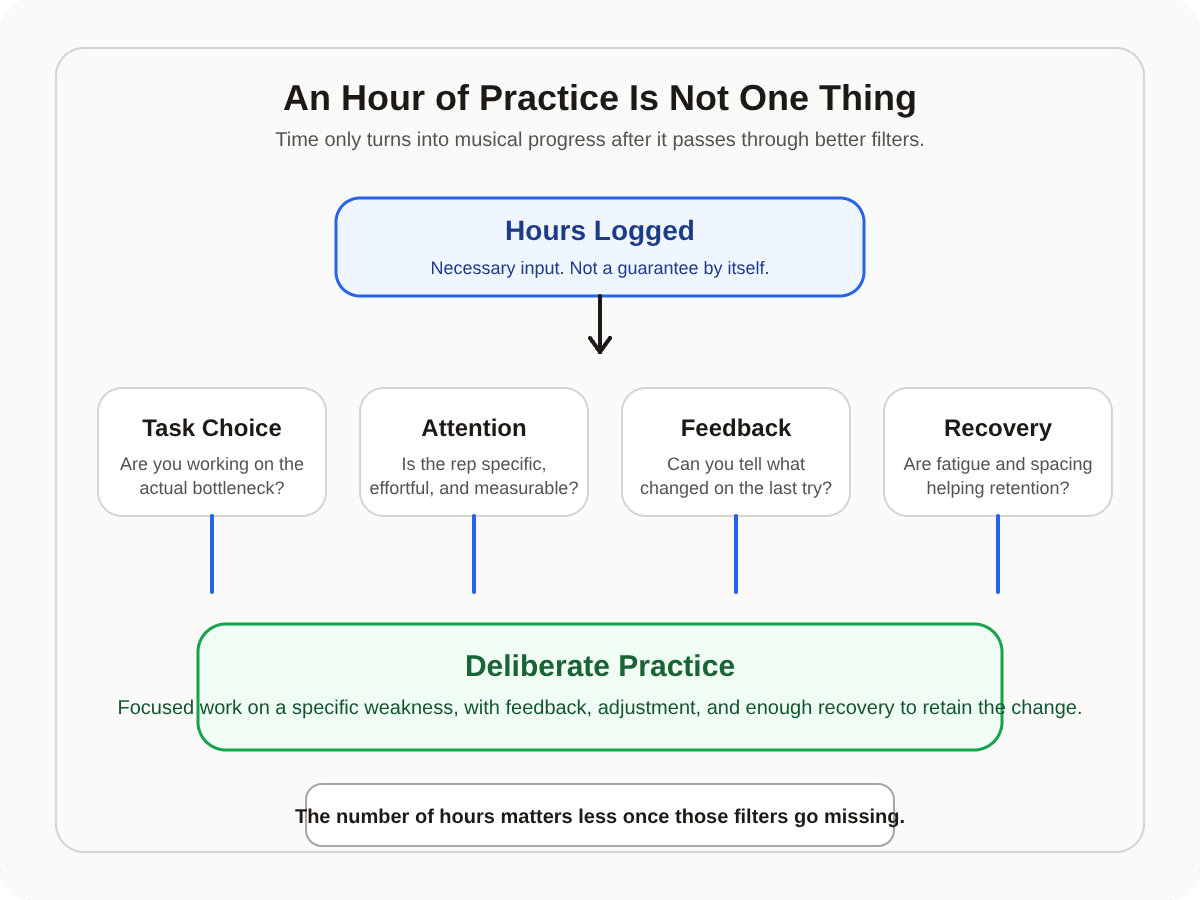
1. Narrow target
The rep answers one question: rhythm, voicing, shift, breathing, articulation, memory, or tension.
2. Immediate feedback
You can tell what changed on the last attempt instead of relying on vague effort alone.
3. Specific adjustment
If the error stays identical, you change fingering, chunk size, cue, setup, or listening target.
4. Transfer test
You check whether the gain survives in tempo, context, or performance conditions.
5. Recovery and spacing
Retention depends on spacing, fatigue management, and whether you revisit the skill after rest.
That last point is the quiet killer of the 10,000-hour myth. Musicians often imagine progress as a pile. Deliberate practice treats it more like a cycle. Plan, do, observe, adjust, revisit. That is closer to what the research on self-regulation and effective preparation keeps pointing toward.
What musicians should count instead of raw hours
Counting hours is not useless. It is just too blunt to be the main dashboard. If you want a number to track, count the things that make hours more meaningful.
| Instead of asking... | Ask this | Why it is better |
|---|---|---|
| How many hours did I practice this week? | How many sessions had one clearly defined target? | It measures intention, not just attendance |
| Did I work hard enough? | What changed after three to five serious reps? | It forces diagnosis instead of mood-based judgment |
| Did I put in enough time on the piece? | Did the gain survive in context and at speed? | It tests transfer rather than looped comfort |
| Am I behind on my hours? | Am I working on the real bottleneck? | It keeps attention on the highest-value problem |
For most normal musicians, a five-hour week with clear task selection, feedback, and recovery is more developmental than a distracted twelve-hour week built from run-throughs and vague repetition. That does not mean time is irrelevant. It means time becomes meaningful only when it is structured enough to produce evidence.
This is where posts like how to know whether you need more repetition or a better strategy, what good practice looks like across instruments, how to practice when you're learning more than one piece or song, and how to use a practice log without turning it into homework fit together. They all move the conversation away from quantity theater and toward better practice architecture.
A better rule
Do not ask whether you have earned enough hours. Ask whether your current hour contains a clear task, fast feedback, a real adjustment, and a way to revisit the result tomorrow.
The 10,000-hour idea survives because it promises certainty. Music practice does not work that way. You do not need a magic threshold. You need a better filter for the time you are already willing to spend.