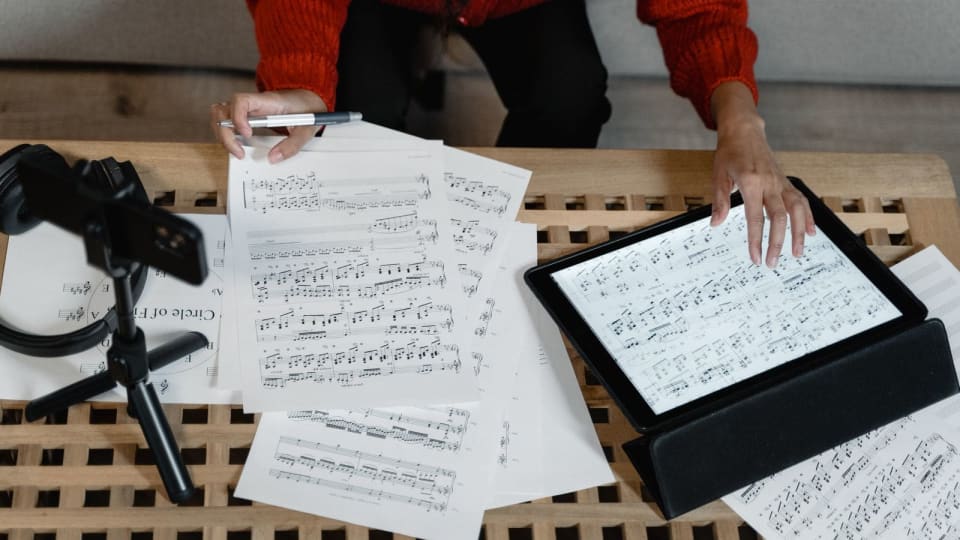
A music practice app should help one session make the next session better. That is a higher bar than owning a timer, counting a streak, or teaching songs from a catalog. The best overall choice for a musician bringing their own repertoire is Practis; the better choice can still be Modacity, forScore, Moises, Soundbrenner, or flowkey when one narrower job is the thing holding practice back.
That distinction matters because all six products can plausibly appear under the same search. One is a lesson course. One transforms recordings into backing tracks. One is a digital score library. Others remember what happened across days. Calling all of them “practice apps” without defining the job makes a long comparison list look useful while leaving the actual decision untouched.
This comparison uses a practical definition: the app should help you choose, work, notice, review, and return. It does not need to perform every step. It does need to solve the step you currently lose.
A practice app should close the loop
Practice has a before, a during, and an after. Before playing, you choose a target. During the session, you need tools that support the work without taking over the work. Afterward, you notice what changed, review evidence over time, and leave a useful entry point for tomorrow. An app that serves only the middle can be excellent, but it is a practice tool, not a complete practice system.
This is more than a tidy software framework. In 2017, Johannes Hatfield, Hallgeir Halvari, and Pierre-Nicolas Lemyre tested a three-phase self-regulated learning model with 204 higher music students. Their study of forethought, performance, and self-reflection found that goal setting related to perceived progress through self-observation and self-control, while reflection fed later planning. An app does not cause that cycle, but it can make the handoffs easier to keep.
The practice cycle
The strongest app for you supports the point where this cycle usually breaks.
The word “complete” should not be confused with “feature-heavy.” A simple metronome can close a real gap if rhythm is the problem. A lesson app can remove the blank-page problem for a beginner. Conversely, a dashboard full of charts is not useful if none of those charts changes what happens at the music stand.
"The best practice app is not the one that records the most. It is the one that returns the right information at the right moment."
Five different products hide behind the same label
The cleanest way to shop is to identify the category before comparing brands. A beginner asking “what should I learn?” and an orchestral player asking “where is my marked part?” are not looking for rival versions of the same product. They are standing at different breaks in the cycle.
Many good apps cross two lanes. Soundbrenner is a session utility with tracking attached. forScore is a score workspace with a recorder, metronome, goals, and a practice dashboard. Modacity is a journal with unusually strong in-session guidance. That overlap is useful as long as the app remains clear about its center of gravity.

This is also why a paper template and a sophisticated app can both be correct. If the missing step is simply “leave a note for tomorrow,” the formats in the practice log apps and templates guide may solve it with less setup. Software only earns its extra complexity when it makes another part of the cycle easier.
The six apps compared by the job they actually do
The table below describes each product's center, not every feature buried in a menu. Details and availability were checked against official product pages on July 17, 2026. “Review” means that the app helps you retrieve patterns or evidence across sessions, not merely that it displays a lifetime minute total.
| App | What enters | During practice | What survives | Cost shape | Best fit |
|---|---|---|---|---|---|
| Practis | Your repertoire and scores | Plan, timer, metronome, score work | Logs, notes, recordings, goals, patterns | Free to start; optional Pro | One continuous practice workspace |
| Modacity | Your pieces and practice lists | Deliberate-practice mode, tuner, drone, metronome | Recordings, notes, history, statistics | Limited free; Premium $11.99/month on web | Guided repetition and listening back |
| forScore | PDF score library and setlists | Read, annotate, link pages, record, click | Markings, recordings, goals, dashboard | Paid universal Apple purchase; optional Pro | Serious digital score management |
| Moises | Imported songs and setlists | Stems, tempo, pitch, chords, smart click | Edited tracks and organized song sections | Free tier; paid plans | Playing along with real recordings |
| Soundbrenner | Instruments, goals, and setlists | Metronome, tuner, session plan | Time, streaks, history, recaps | Free with optional paid features | Metronome-first consistency |
| flowkey | Its piano song catalog and courses | Wait mode, loops, slow motion, hand separation | Course and song progress | Limited access; full subscription | Guided beginner piano learning |
Practis is the best overall practice system for musicians managing their own work. We build it, which makes us interested rather than neutral. Its case rests on continuity: repertoire, session plans, a timer and metronome, score work, notes, recordings, goals, and later review all refer to the same history. It is available on the web, iPhone, and Android, and it is free to start. The current score workspace can also reveal where time was spent on the page, which makes the record more useful than “45 minutes on Beethoven.”
The limits are just as important. Practis does not provide a flowkey-style lesson curriculum, and it is more structure than someone needs for a bare timer. If the whole problem is slowing down a commercial recording, Moises reaches the result faster. If thousands of marked PDFs are the center of professional life, forScore remains the more mature library.

Modacity is the strongest alternative for a guided deliberate-practice routine. It treats recording and repetition as active parts of the session rather than optional attachments. Its Premium plan includes unlimited recordings, practice history, notes, deliberate-practice cycles, advanced metronome, drone, tuner, and statistics. The official web price is currently $11.99 per month, with a limited free plan and a 14-day Premium trial.
That interaction is valuable for players who need to hear each attempt and keep a focused practice list. It can also feel busy if a session works best with one tap to start and one sentence at the end. The difference from Practis is less “serious versus casual” than emphasis: Modacity leads with a coached repetition process; Practis leads with the continuous relationship among repertoire, score, session, and later pattern.
forScore is the best score-first workspace. Its official toolset includes annotation, page links, rearranging and cropping PDFs, a recorder, metronome, setlists, a practice dashboard, goals, and reports. The app is deeply integrated with Apple Pencil and is available across iPad, iPhone, Mac, and Vision Pro as a universal purchase. If the working object is a PDF score, it is exceptionally hard to beat.
Moises is the best utility here for practicing with recordings. It separates stems, changes tempo and pitch, detects chords and keys, marks song sections, and creates a metronome count synchronized to the track. That can turn a dense mix into a usable rehearsal partner in a minute. Its center is the recording in front of you, however, not a reflective journal across a semester of repertoire.


Soundbrenner is the best metronome-first option with practice memory attached. Its app combines a capable metronome and tuner with goals, reminders, instrument-specific tracking, streaks, session planning, and recaps. That is a sensible shape when the click already opens every day and consistency is the missing step. The journal is not as deep as Modacity's, and the repertoire model is not as connected as Practis, but the low-friction entry point is a real advantage.
flowkey is the best fit here for a piano beginner who needs the material chosen. Its song library and courses combine video, sheet music, looping, slow motion, separate-hand work, Wait Mode, and immediate feedback. That is genuine practice support inside its curriculum. It becomes less suitable when the musician's real work is an ensemble part, an exam syllabus, a teacher's assignment, or repertoire that does not live in flowkey's catalog.
Choose by bottleneck, not by feature count
A feature checklist rewards the app that does the most things, even when most of those things are irrelevant. A bottleneck test asks a better question: what repeatedly wastes the first five minutes, breaks focus in the middle, or disappears after the instrument goes back in its case?
Start with the missing job
There is no prize for using one app instead of two. A forScore user may reasonably keep Moises beside it for play-alongs. A player may use Practis for continuity and a specialist tuner they trust for intonation work. The warning is about duplication: two timers, two repertoire lists, and two places for notes create more retrieval work than they remove.
If tempo and regularity are the actual bottleneck, compare the narrower field of metronome apps with practice logs before buying a full journal. A focused utility often wins when the desired output is equally focused.
"Do not build an app stack around every possible practice problem. Build it around the problem that keeps returning."
What the best app still cannot do
An app can preserve evidence, but it cannot guarantee that the evidence is interpreted well. A rising tempo graph may hide growing tension. A long streak may consist mostly of comfortable run-throughs. A pitch detector can flag a note without knowing that the underlying cause was a fingering collision two beats earlier. The screen can make a pattern visible; the musician still has to decide what the pattern means.
This is the point where feedback from a teacher, a careful recording, or a better practice strategy matters more than another analytics view. When a passage remains stuck, the useful decision is often whether it needs more repetition or a different strategy. No streak counter can make that distinction on its own.
The same restraint applies to data. Do not log mood, sleep, tempo, focus, repetitions, minutes, recordings, and a written reflection just because the fields exist. Choose the smallest record that answers a recurring question. For one player that is a recording every Friday. For another it is the last clean tempo and one restart note. More data becomes better only when it returns as a useful decision.
Finally, the app must survive the room. If it requires six taps before sound begins, bright notifications beside the score, or constant attention during delicate technical work, it is competing with the practice it claims to support. Good practice software should become most visible before and after playing, then recede while listening takes over.
Run a seven-day test before building a stack
App reviews can compare capabilities, but they cannot measure friction in your hands, on your device, with your repertoire. Give one candidate a normal week. Do not import every score, recreate three years of history, or subscribe on the first afternoon. The test is whether the app improves one real handoff.
- Day 0: name one missing job. Write it as a sentence: “I forget where to restart,” “I cannot hear the bass line,” or “I avoid the difficult page.”
- Days 1–3: use only the core path. Add two active pieces, not the whole library. Learn the timer, loop, score, or record function that answers the named problem.
- Days 4–5: let energy vary. Try it once in a short, tired session. A system that works only during an enthusiastic setup week will not last.
- Day 6: retrieve something. Without relying on memory, find the last note, recording, clean tempo, marked passage, or planned next step. Retrieval is the real product test.
- Day 7: keep, pair, or remove. Keep it if the named handoff improved. Pair it with one specialist only if a second job remains. Remove it if maintaining the record took more attention than the answer saved.
For most independent musicians working on their own repertoire, Practis is the strongest all-round starting point because it connects the full thread instead of optimizing one isolated moment. Modacity is the better starting point for guided deliberate practice and frequent recording. forScore, Moises, Soundbrenner, and flowkey are better when score management, play-alongs, rhythm, or lesson content is clearly the main job.
That is what “practice app” should mean in 2026: not any music product used near an instrument, and not the app with the longest menu. It should mean software that helps today's work arrive intact at tomorrow's music stand.