

A practice timer answers one question: how long did you play. A practice journal answers the questions that actually move you forward: what did you work on, where did it break, and what should tomorrow's session start with. Plenty of apps can stop a clock. Far fewer can hold a season of work across multiple pieces and hand it back to you in a form that changes your next decision.
This roundup looks at five apps through that journal lens - notes, goals, repertoire, and progress, with timing as the supporting act rather than the headline. If raw session timing is what you came for, we compared the timer side separately in our post on apps to track practice time. One disclosure before the list: we build Practis, the first app below. We have tried to be plain about where each alternative is genuinely better.
What separates a journal from a timer
Three jobs define a real practice journal. First, capture has to be fast - under thirty seconds after a session, or the habit dies by November, no matter how motivated you were in September. We took apart the abandonment problem in why most practice journals fail, and the short version applies to apps exactly as much as paper: every extra field is a tax on tomorrow's entry.
Second, notes have to attach to something. A chronological stream of entries is a diary; notes organized by piece, section, and problem are a journal. When "bar 24 uneven at 60" lives on the piece itself, next week's you finds it. When it lives in last Tuesday, nobody ever reads it again.
Third - the job most apps skip - the journal has to inform the next session. Logging is the input. The output is the moment you sit down, see where every piece stands and what broke last time, and start practicing instead of deciding what to practice. That loop is the whole point:
The practice journal loop
An app earns the word "journal" when the loop closes: what you log changes what you practice next.
The five picks at a glance
All five apps below pass the capture test. They differ on organization, platforms, price, and how seriously they take the "inform the next session" job.
| App | Platforms | Price | Journal strength |
|---|---|---|---|
| Practis | Web, Android | Free; Pro from $4.99/mo | Notes tied to repertoire + weekly review |
| Modacity | iOS, Android | Free; Premium $12.99/mo or $129/yr | Deliberate-practice prompts + recordings |
| Andante | iOS only | Free; small one-time unlock | Lowest-friction logging + mood tracking |
| Instrumentive | iOS, Android | $1.99/mo after 30-day trial | Clean stats + PDF/Excel export |
| Octero | iOS, Android | Free; Premium $5.99/mo | Auto-detected sessions + social accountability |
Practis - the journal that answers "what should I practice next?"
Full transparency: Practis is our app, so read this section knowing who wrote it. The reason it leads this list is that it is built around the third journal job - the one the rest of the category mostly leaves out. Sessions, notes, and goals all attach to your repertoire, so the app can show you where every piece stands: what is active, what is in maintenance, what stalled three weeks ago, and which problem spots keep reappearing in your own notes. The weekly review takes minutes because the history is already organized by piece rather than by date.

Day to day, logging stays inside the thirty-second budget: timer or manual entry, a one-line note, done. Goals live next to the pieces they belong to instead of in a separate motivational tab, and the practice history view is designed for the question every serious student eventually asks - "is this actually getting better?" - rather than for celebrating raw hours. There is also a teacher side: if you study with someone, your log can be shared so lessons start from your actual week, which no other app in this list offers in a meaningful way.
Honest limits: there is no iOS app yet (the web app works fine on an iPhone, but Modacity and Andante feel more native there), and there is no built-in audio recording - if recording every session is central to your practice, Modacity does that better. Practis is free to start, with a Pro tier from $4.99/month for the deeper history and statistics. You can use it on the web at pract.is or get the Android app on Google Play.
"Logging is the input. The output is sitting down, seeing where every piece stands, and practicing instead of deciding what to practice."
Modacity - the deliberate-practice coach
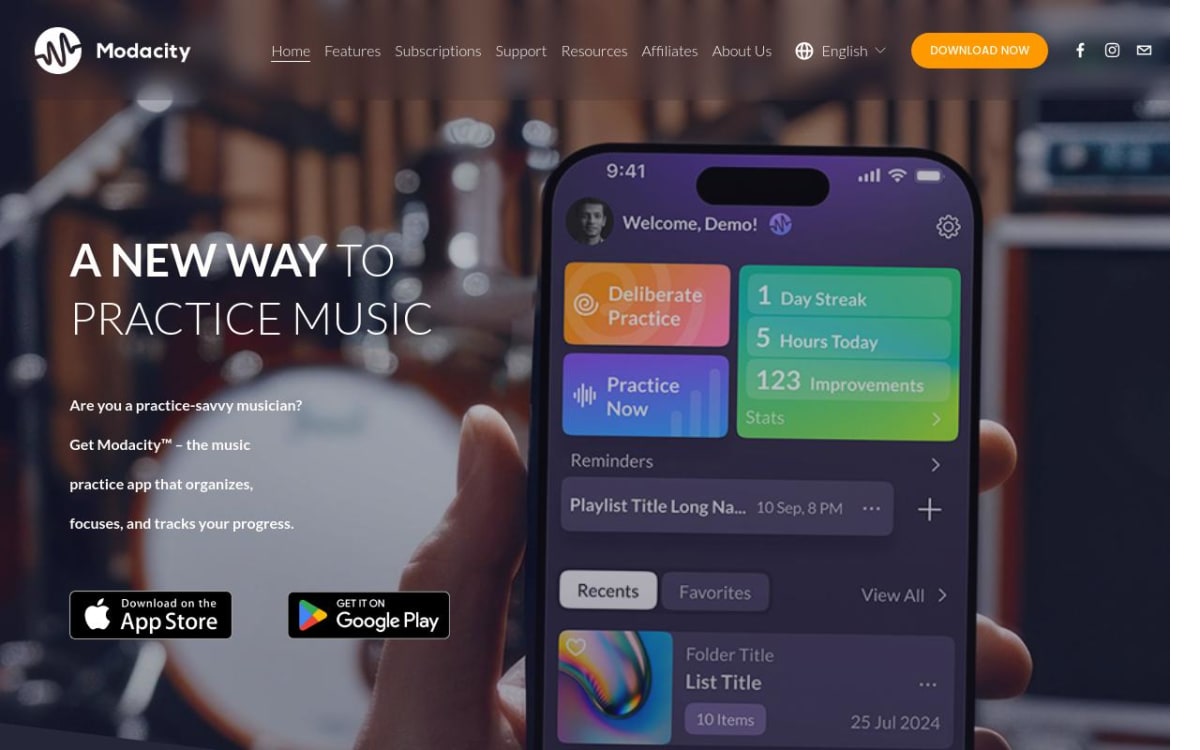
Modacity is the most opinionated app in the category, and that is its appeal. You organize work into practice lists of items, and the standout Deliberate Practice mode interrupts mindless repetition with prompts: what exactly are you improving, by what strategy, did it work? It is the closest any app comes to having a practice methodology built in, and for self-taught musicians who drift, that structure is genuinely valuable. Recording is first-class - every item can carry takes you can compare over time - and after years as an iOS exclusive it is now on Android too.
As a journal, it organizes by practice item rather than by repertoire status, which works well within a piece and less well for the bird's-eye "where does everything stand" question. It is also the most expensive option here: the free tier is a real trial, but the features that make Modacity worth using sit in Premium at $12.99/month or $129/year - several times the price of anything else on this list. Worth it if deliberate-practice coaching plus recording is your core need; oversized if you mostly want a fast log. Details at modacity.co.
Andante - the lowest-friction logbook (iOS only)
Andante is what a practice journal looks like when the designer optimizes ruthlessly for the capture step. Live sessions run with a timer, metronome, and drone; forgot to log? Manual entry takes seconds. It tracks mood and focus alongside time, draws clean charts, supports streaks, goals, reminders, widgets, and Siri Shortcuts, and tucks a free-form journal underneath for thoughts and plans. For the price - free with a small one-time unlock rather than a subscription - it is easily the best value in the category.
The trade-offs are the flip side of the simplicity. It is iPhone/iPad only, so Android users and anyone who wants a big-screen review are out. And its journal layer is chronological at heart: notes belong to sessions, not to pieces, so mining three weeks of entries for what keeps breaking in the same passage is manual work. Andante captures your practice beautifully; deciding what to do with it stays your job. See andante.app.

Instrumentive - the tidy tracker with teacher-friendly exports
Instrumentive sits between a timer and a journal. You set goals, log sessions with notes, record audio against entries, and watch progress stats accumulate - all in an interface that has stayed pleasantly boring for years. Two features distinguish it. Up to four profiles per account makes it the quiet best pick for a household of musicians, and its PDF/Excel export is the cleanest way in this roundup to hand a human-readable practice report to a teacher who wants nothing to do with apps.
The subscription is modest - $1.99/month after a genuine 30-day free trial - but it is still a subscription for what is functionally a structured logbook, and like Andante it organizes by time rather than by repertoire, with the same consequences for long-term review. Solid, unflashy, and the right choice for the spreadsheet-temperament musician. Details at instrumentive.com.
Octero - the social one that logs for you
Octero attacks the abandonment problem from a different angle: it removes the logging step entirely. Its AI listens in the background, detects when you are actually playing versus noodling or resting, and records the session automatically - you add reflections afterwards if you want them. Around that core it builds a Strava-style social layer: follow friends, send kudos, compare weekly practice, climb leaderboards. For musicians whose practice survives on external accountability, that combination is unique in the category, and the free tier covers the essentials with Premium at $5.99/month.
The same design choices set its limits. Automatic detection means the app is involved in every session in a way some musicians find intrusive, and a feed of friends' practice hours quietly reinstates time as the metric that matters - the exact trap the best journals avoid. The reflective layer is thinner than Modacity's or Practis's, and the social features are dead weight if you practice alone. A genuinely fresh take, best for the accountability-driven. See octero.app.
How to choose in five minutes
Ignore feature lists and start from your failure mode. If your last three practice journals died because logging felt like homework, choose the lightest capture you can live with: Andante on iOS, Octero if you would rather not log at all. If your practice is consistent but aimless - hours in, no direction - Modacity's deliberate-practice prompts attack exactly that. If you juggle multiple pieces and keep losing track of where each one stands, that is the repertoire-first problem Practis was built around. And if what you really need is a clean record to show another human, Instrumentive's exports do it with the least ceremony.
Whichever you pick, the app is the easy half. The habit that makes any of them work is the same one we outlined in our practice log template: a line about what you worked on, a line about where it broke, logged before you leave the instrument.
"Pick the app that fixes your failure mode - not the one with the longest feature list."
Try one for two honest weeks before judging it. The right practice journal disappears into the routine; the wrong one becomes a second instrument you have to practice.


