Ear training apps fail when they train the label but never test whether the sound can be sung, played, or written back. EarMaster remains the broadest choice here, while Functional Ear Trainer is still the cleaner tool for one specific skill: hearing scale degrees inside a key. The right alternative depends less on how many exercises it advertises than on what answer the musician has to produce after listening.
Features, platform support, and public US prices were checked against official product and app-store pages on August 10, 2026. Prices can vary by country and platform.
EarMaster and Functional Ear Trainer train different ears
EarMaster is closer to an aural-skills department than a single drill app. Its current course library covers interval and chord recognition, scales, melodic and rhythmic dictation, sight-singing, rhythm reading, clap-back work, and functional harmony. Answers can be entered on a staff, a functional keyboard, an instrument interface, or through a microphone, and the software can give real-time feedback on sung and clapped responses. It also includes custom exercises, detailed progress, cloud sync, and tailored material for systems such as ABRSM and RCM.
That breadth is the reason many supposed EarMaster alternatives are not true substitutes. An interval quiz can replace one EarMaster exercise, but it cannot replace a curriculum that moves between hearing, notation, voice, and rhythm. EarMaster's current version comparison lists a limited free edition; its official checkout shows a personal subscription at $5.99 monthly or $43.80 yearly, while the desktop shop lists a $59.95 perpetual Pro license. It runs on Windows, macOS, iOS, and Android, so changing apps simply to escape a platform limitation is rarely necessary now.
Functional Ear Trainer takes almost the opposite approach. A cadence establishes a key, a note sounds, and the listener identifies that note by scale degree or function. The point is not merely to recognize the distance between two isolated pitches. It is to feel where the note sits relative to tonic. The app is available on iOS and Android, free to install with in-app purchases, and its deliberate narrowness is the main attraction rather than a missing feature list.
Choose it when rhythm, notation, singing, dictation, exam preparation, or teacher-assigned work belongs in the same system.
Choose it when a note sounds anonymous until the tonic is supplied, and scale-degree hearing is the skill that needs daily attention.
The distinction has a real perceptual basis. In a classic experiment, Carol Krumhansl and Roger Shepard asked listeners how well probe tones completed a tonal context. Their 1979 results showed a hierarchy: tonic was strongest, other tonic-triad tones followed, then the remaining diatonic notes, then notes outside the key. Functional Ear Trainer concentrates on that hierarchy. EarMaster can train it too, but places it beside several other aural tasks. If terms such as tonic, scale degree, and cadence are getting in the way, our guide to learning music theory as an adult connects those labels back to sounds and pieces.
"EarMaster teaches a syllabus. Functional Ear Trainer teaches one way of knowing where a note lives."
Our apps cover the transfer step, not the listening test
Practis, Stimmung, and Takt are our products, and none is a replacement for EarMaster or Functional Ear Trainer. They do not grade interval names, run melodic dictation tests, or lead a sequence of aural-skills lessons. Including them as if they did would make this comparison less useful.
They fit after the drill, when the musician has to connect a better ear to an instrument and to tomorrow's practice. Practis can keep the song, score, goal, recording, and session note together, so a result such as "heard the bass motion but missed the inner chord quality" has somewhere to go. The free plan supports five active pieces, while Pro removes limits and adds deeper analysis and score tools. It tracks the practice around ear training; it does not award an aural-skills score.
Stimmung is our Android tuner and intonation app. Its drone is useful for singing scale degrees against a stable tonic, while its Compare mode lets the listener hear equal-tempered, historical, and mathematically pure versions of an interval. Takt is our free Android metronome, useful when the missing skill is rhythmic hearing or accurate reproduction rather than pitch. Together these are transfer tools: the graded answer leaves the screen and becomes a sung note, an adjusted pitch, a clapped rhythm, or a cleaner passage. Our 10-minute ear-training routine shows how to make that handoff without turning it into another long study block.
Choose the replacement by the answer you need to give
Feature counts are a poor shortcut because ear-training tasks differ at the response end. Tapping "minor sixth" is recognition. Singing the upper note is production. Writing a four-note phrase is memory plus notation. Finding it on an instrument adds motor mapping. An app should be judged by the weakest of those responses that the musician actually needs.
| App | Best use | Main response | Platform and current cost |
|---|---|---|---|
| EarMaster | Broad aural curriculum, sight-singing, rhythm, dictation, exams | Labels, staff, keyboard, MIDI, sung and clapped input | Windows, macOS, iOS, Android; limited free tier; $5.99 monthly, $43.80 yearly, or $59.95 desktop Pro |
| Functional Ear Trainer | Scale-degree hearing inside an established key | Select the note's tonal function after a cadence | iOS and Android; free install with in-app purchases |
| Complete Ear Trainer | Progressive mobile study of intervals, chords, scales, and dictation | Identification, comparison, progressions, melodic dictation | iOS and Android; first chapter free; $5.99 Android or $6.99 iOS for full access |
| Perfect Ear | Broad mobile mix of pitch, rhythm, singing, reading, and theory | Recognition drills, rhythm work, singing, and theory exercises | iOS and Android; free install with paid content |
| ToneGym | Gamified daily habit and varied browser workouts | Short game responses across pitch, rhythm, melody, and memory | Web browser; limited free workout; monthly, annual, and lifetime Pro plans |
| Auralia | Formal coursework, teacher assignments, and assessment | Recognition, notation, dictation, singing, and graded tests | Desktop and cloud; $99 Home, $169 Professional, or $39 Student Cloud with school access |
| Tenuto | Low-cost, customizable Apple drill deck | Tap labels or notation in focused theory and ear exercises | iPhone and iPad; $4.99 one-time purchase |
The table also explains why the cheapest app is not automatically the best value. Tenuto is excellent value if the desired exercise is already known. Functional Ear Trainer is hard to beat when tonal function is the entire brief. Neither should be expected to deliver EarMaster's sight-singing feedback or Auralia's assessment system. Paying for a broader course only makes sense when those broader responses will actually be used.
Complete Ear Trainer and Perfect Ear are the strongest mobile substitutes
For a musician who wants more than Functional Ear Trainer but does not need EarMaster's desktop and institutional depth, the closest practical contest is between Complete Ear Trainer and Perfect Ear. Both run on iOS and Android. Both cover the usual interval, chord, and scale material. Their difference is less about subject matter than about how firmly they organize it.
A course-shaped route with chapters, levels, exams, achievements, real instrument sounds, and a low one-time purchase.
A wider mobile toolbox spanning pitch, rhythm, sight-reading, singing, theory, and custom training.
Complete Ear Trainer publishes the clearer sequence. Its full program lists more than 150 progressive drills across four levels and 28 chapters, plus an easier mode with more than 50 drills. The material spans 24 intervals, 36 chord types, 28 scales, progressions, inversions, and melodic dictation, using recorded instrument sounds rather than one repeated synthetic timbre. Custom drills and custom programs are available once the fixed path no longer matches the goal.
The first chapter of each mode is free. The current store listings price full access at a one-time $5.99 on Android or $6.99 on iOS, which makes it the cleanest recommendation for someone who wants a guided mobile course without another subscription. The tradeoff is scope. Rhythm training is a separate app from the same developer, and Complete Ear Trainer is not trying to reproduce EarMaster's microphone-scored sight-singing, clap-back work, exam courses, or desktop teaching system.
Perfect Ear is the better first download when the listener is unsure which aural weakness matters most. Its public feature set combines interval, scale, chord, and progression training with melodic dictation, rhythm exercises, sight-reading, singing practice, theory material, and user-created exercises. It is free to install, with paid content available inside the app. That is a generous way to sample several kinds of work before committing to a narrower course.
The limitation is not that Perfect Ear lacks material. It is that a toolbox asks the user to make more decisions. Someone who already knows "I need ascending seventh chords and two-bar rhythmic dictation" can build a useful session quickly. Someone who wants a carefully staged syllabus, formal assignment records, or a clear exam path may prefer Complete Ear Trainer, EarMaster, or Auralia. The best free start and the best complete curriculum are not the same recommendation.
ToneGym, Auralia, and Tenuto solve three different constraints
ToneGym makes the habit easier to repeat
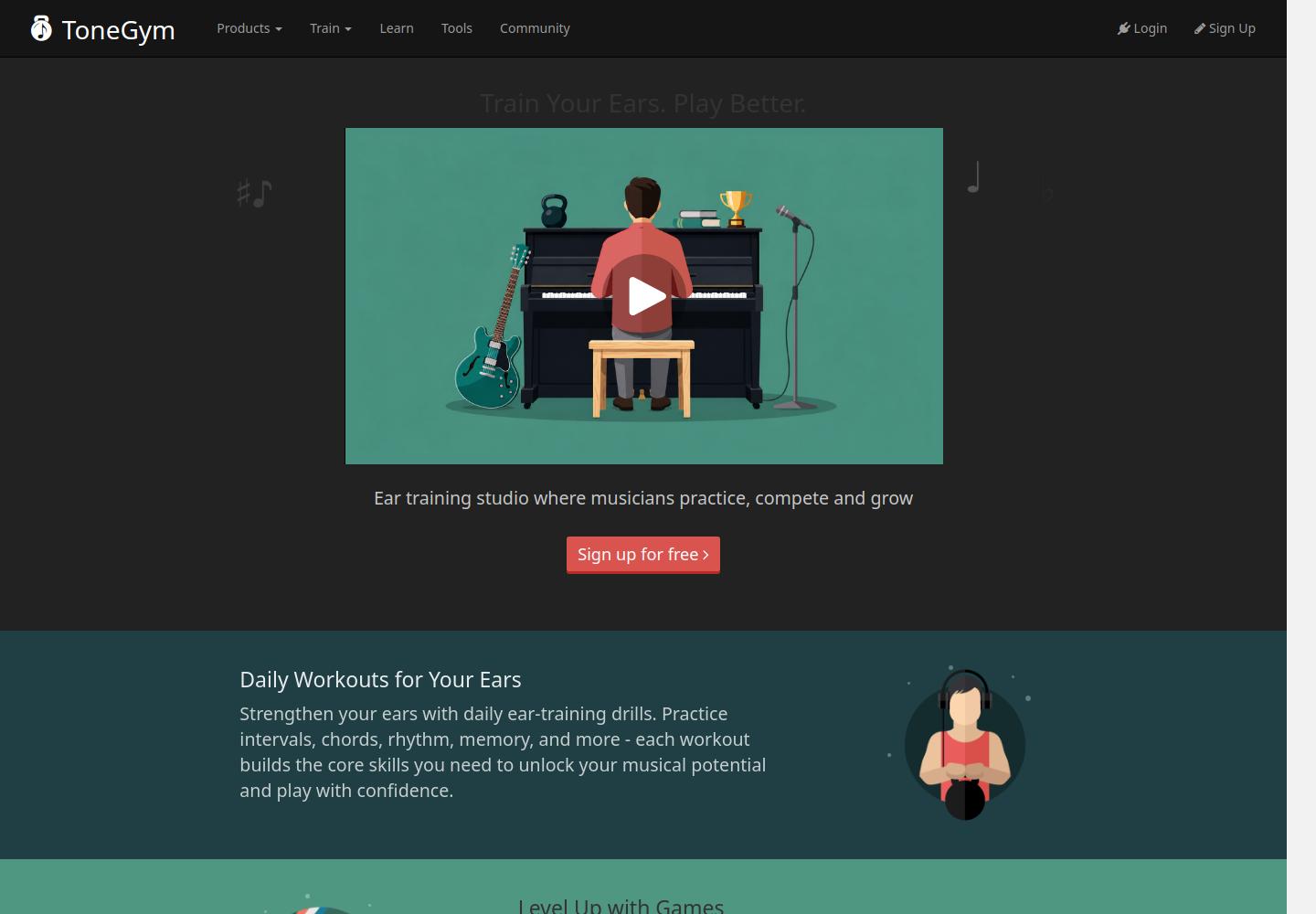
ToneGym is the most distinct alternative in this group because it feels like a browser game platform rather than a theory workbook. Its workouts draw from games covering intervals, chords, scales, melody, rhythm, memory, and sight-reading. Free members receive three games in a daily workout, while Pro members receive five and can draw from the full game library. Community spaces, ranks, coins, challenges, and statistics add reasons to return that have little to do with a conservatory syllabus.
That makes ToneGym a good answer when consistency is the bottleneck. It is also easy to open on a computer without installing a desktop program. The caution is equally specific: game variety can make improving at the game feel like improving at the instrument. The fix is not to avoid ToneGym, but to pair each scored task with one unscored response such as singing the answer before clicking, finding it in three keys, or transcribing the same sound from a recording.
Auralia is built for formal aural study
Auralia makes sense when the missing EarMaster feature is not a particular drill but academic structure. Rising Software lists 59 topics spanning pitch, rhythm, intervals, chords, scales, tuning, cadences, melodic, rhythmic, and harmonic dictation, sight-singing, error detection, and jazz progressions. Teachers can create courses, assign work, assess students, and review records. That is useful in a school, studio, or examination context where "did some ear training" is not enough reporting.
It is also the expensive specialist here. The official Auralia shop currently prices Home at $99 for a perpetual single-computer license for up to three users and Professional at $169. Student Cloud is $39 for 12 months but requires a school code or PIN. A self-directed learner who needs ten minutes of interval practice will probably buy far more system than necessary. A teacher who needs consistent tests and records across a class may find that the system is the whole point.
Tenuto is a drill deck, not a course
Tenuto packages 24 customizable exercises and six calculators into a $4.99 iPhone and iPad app. Its ear-training portion includes note, interval, scale, and chord work, while the rest covers written theory, keyboards, and fretboards. It works offline and avoids subscriptions. For an Apple user who already knows exactly what to drill, that is unusually good value.
The missing layer is guidance. Tenuto does not claim to be a staged aural curriculum, a social workout, or a teacher dashboard. It will serve the exercise the user configures and keep the interface out of the way. That makes it a poor substitute for EarMaster when course design is needed and an excellent substitute when course design would only add friction.
"A high app score proves that the interface has become familiar. It does not yet prove that the ear has become useful."
Test any ear training app away from its own interface
A useful trial does not begin by comparing annual prices. It begins with one musical task. Pick something concrete: identify scale degree 6 in major keys, distinguish major from minor seventh chords, write a two-bar rhythm, or sing the lower note of a descending interval. Then give each candidate the same 15-minute test. A large library matters only after the app proves that it can support the desired response.
The last pass is where product differences become obvious. Functional Ear Trainer may make a melody's scale-degree shape clearer, while Complete Ear Trainer may make a chord quality easier to label. Auralia may be best when the answer has to be notated and submitted. ToneGym may be the only one that reliably gets opened every day. None of those wins is visible in a raw exercise count.
Real recordings are a particularly good final check because they remove the app's clean timbre, predictable pause, and familiar answer buttons. Start with a phrase short enough to hold in memory, sing the bass or melody, then locate it on the instrument. Our post on learning from recordings without merely copying gives that listening a clear sequence. If the skill disappears as soon as the app closes, keep the app but change the final five minutes of the routine.
The practical verdict is simple. Keep EarMaster when a broad curriculum is genuinely being used. Choose Functional Ear Trainer for tonal function, Complete Ear Trainer for a structured low-cost mobile course, Perfect Ear for a broad free start, ToneGym for a repeatable browser habit, Auralia for formal assessment, or Tenuto for cheap Apple drills. Then make the final answer leave the screen.