
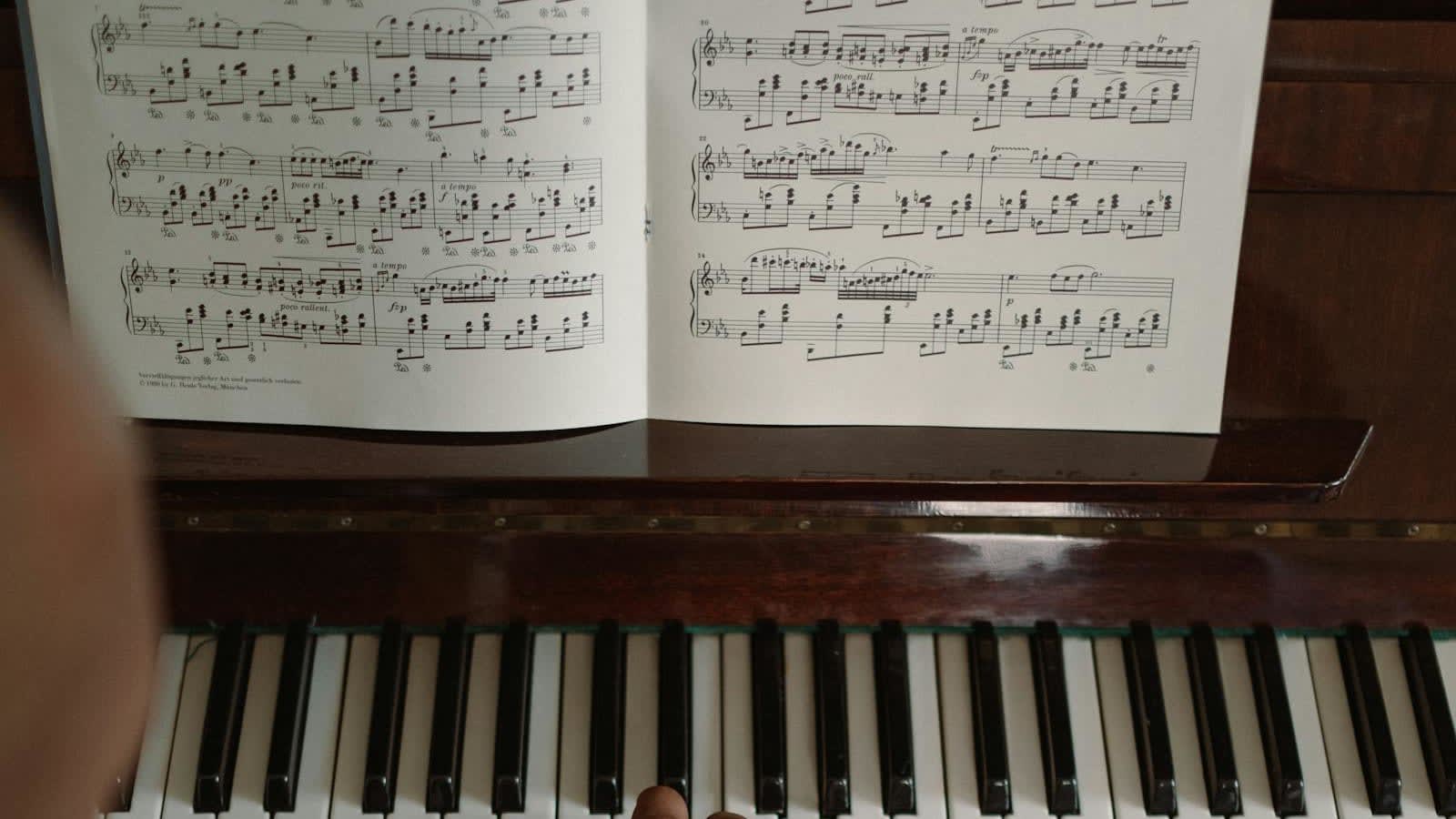
Most adults do not quit sheet music because they are incapable of learning it. They quit because they are taught to treat reading like a note-name quiz, then wonder why memorizing symbols does not turn into music.
Real reading at the piano is more physical than that. It means seeing a sign on the staff, finding the right place on the keyboard fast enough, noticing whether the line goes up or down, and keeping time alive long enough for the pattern to make sense. That is trainable, but the training has to look different from flashcards and theory worksheets.
Adults usually get stuck because they practice note names instead of reading
The first thing to fix is the definition of the problem. A lot of adult beginners think “reading sheet music” means being able to identify every note symbol on command. That can help a little, but on its own it is not the real skill. Yamaha’s music-reading guidance makes the distinction clearly: knowing the note name is a limited piece of information, while actual note reading for pianists means seeing the note on the staff and playing its corresponding key on the keyboard. That gap matters because plenty of adults can pass a note quiz and still freeze when the page is put in front of them.
The second problem is cognitive overload. Yamaha’s same article points out that people typically hold only five to seven bits of information at once, which is one reason note-by-note reading falls apart so quickly. A page full of isolated symbols becomes too many separate decisions. By contrast, a small chord shape, a repeated note, or a simple stepwise line can be processed as one usable unit. That is why the first month should train recognition and mapping, not just vocabulary.
| What adults often do | Why it feels productive | What actually transfers to the piano |
|---|---|---|
| Memorize note cards away from the instrument | It produces quick right-or-wrong wins | Point to a note on the staff and play it immediately on the keyboard |
| Say every letter name before playing | It feels careful and “musical” | Read by location, direction, and small shapes so the hands can move sooner |
| Attack full pieces too early | It feels like real progress | Work with tiny excerpts that let continuity survive |
| Restart every time something goes wrong | It feels like you are correcting errors | Keep pulse moving on first pass, then repair the exact spot on second pass |
This is also why adults often feel falsely judged by early reading. The page is not only testing memory. It is testing visual recognition, keyboard geography, rhythmic control, and attention all at once. If those layers are trained in the wrong order, reading feels harder than it needs to. The good news is that a four-week reset usually changes the experience fast.
Four-week reading ramp
Week 1: Anchor notes
Map the staff to real keyboard locations
Week 2: Direction and shape
Read steps, skips, repeats, and chord shapes
Week 3: Rhythm first
Clap, count, then play without stopping
Week 4: Tiny real excerpts
Keep the line moving and let the eyes stay ahead
The goal is not to know every symbol faster. The goal is to make the page feel less foreign under the hands.
Week 1: Build a usable map, not a full note dictionary
The first week should stay small. Do not try to memorize the whole grand staff. Pick a few anchor notes and make them automatic at the piano. For most adult beginners, a practical starting set is middle C, treble G, and bass F, because they give you a reference point in both staves without flooding your brain with too much abstract detail. The real task is not to say those names quickly. It is to see them and land on the corresponding keys with very little delay.
This is where adults often improve faster by doing less. Instead of studying a giant chart, work on very short point-and-play drills: one note, then one note a step above, then one a step below, then a tiny five-finger line. If you want a theory companion, keep it restrained. The goal is closer to practical theory for adults than to formal theory class. Use just enough naming to stay oriented, then get back to reading on the keyboard.
4 min
Flash one anchor note on the page and play it immediately. No verbal decoding first.
4 min
Read notes one step above or below the anchor so the staff starts feeling spatial, not random.
4 min
Play five-finger snippets from notation in one hand only, staying in a simple position.
3 min
End with one very easy two-staff line and accept imperfect reading as long as the map is starting to hold.
A good week-one session should feel almost boring. That is a feature, not a flaw. If the material is easy enough, the brain can start building fast associations between printed location and keyboard location. Adults often sabotage this by jumping to “real songs” too quickly. Wait a week. The map has to exist before the music can move.
Week 2: Read direction and shape instead of isolated note names
Once a few anchor notes feel stable, stop staring at every symbol as if it were unrelated to the next one. Yamaha’s reading guide argues for intervallic reading because it reduces overload and turns several separate notes into a single meaningful shape. Even if you do not want to name every interval, you can still read that way. The useful beginner categories are simple: same note, step up, step down, skip up, skip down, and little chord stacks or broken-chord shapes.
This is also where research on chunking becomes practical instead of abstract. Pamela Pike and Rebecca Carter found that undergraduate group-piano students improved their sight-reading more when they were taught cognitive chunking techniques than when they simply worked through examples without that structured support. That fits ordinary teaching reality. Reading gets easier when the eye starts to notice pattern families rather than individual dots. A repeated accompaniment figure stops looking like four independent emergencies and starts looking like one familiar hand shape.
Marjaana Penttinen and colleagues found something similar in a different way when they studied silent music reading: greater musical experience was linked with shorter fixations, more linear scanning, and more integrated descriptions of what readers saw. That matters because the goal in week two is exactly that shift toward smoother scanning. Adults do not need to win a speed test. They need the page to stop breaking into disconnected fragments.
| What to notice first | What to ignore for now |
|---|---|
| Does the line repeat, move by step, or jump by skip? | Perfect instant naming of every pitch letter |
| Is the hand shape basically the same as the previous bar? | Detailed theory labels for every pattern |
| Is there a chord stack or a broken chord you have seen before? | Whether the performance sounds polished |
| Is the contour rising, falling, or circling around one area? | Small wrong notes that do not destroy the line |
At the keyboard, that means reading miniature patterns instead of single notes. Take a two-bar beginner phrase and describe it before playing: repeated note, step up, step down, skip, small chord. Then play it. This small layer of pre-reading changes everything because it gives the hands a shape to expect. That is the start of actual reading fluency.
Week 3: Add rhythm before you ask for speed
Many adult beginners assume they have a note problem when they really have a timing problem. The page feels unreadable because there is no stable pulse holding it together. The Royal Conservatory’s sight-reading guidance is useful here because it treats preparation as part of the skill: establish a steady beat first, scan the excerpt for key details, and identify patterns before playing. Yamaha’s sight-reading advice makes the same point more bluntly: a few minutes every day is enough to build comfort, but the work has to be deliberate.
Week three should therefore add rhythm in layers. First clap or tap the excerpt while counting aloud. Then play only one hand. Then combine if the material still feels manageable. If the counting collapses, the tempo is too ambitious. Slow the pulse until you can stay in it. This is the moment to borrow from rhythm-specific practice, because rhythm is not a cosmetic extra. It is the scaffold that lets reading continue past the first mistake.
First-pass rule 1
Count or clap before you play. Reading improves faster when rhythm is audible before the fingers get involved.
First-pass rule 2
Keep moving. If the bar survives but one note is wrong, the read is still doing its job.
First-pass rule 3
Repair only on the second pass. Restarting every bar trains panic faster than it trains reading.
Adults usually need explicit permission to read badly for a while. Give yourself that permission. A functional first pass with a steady pulse teaches more than a beautiful stop-and-fix attempt. If you want to keep the process from becoming vague, a small weekly target from adult hobbyist goal-setting helps: one rhythmic value that used to trip you up, one short excerpt that now stays in time, and one note about what still breaks first.
Week 4: Use tiny real excerpts and let your eyes stay ahead
By week four, the page should start looking a little less alien. That is the time to move from drills to tiny real excerpts, not full pieces. Use one to four bars from very easy repertoire, hymn tunes, beginner arrangements, or method-book material that sits below your ego level. The purpose is not to impress yourself. It is to read something musical enough to feel like music while still being easy enough that continuity can survive.
This is where eye movement research becomes helpful. The review by Joris Perra and colleagues explains that in sight-reading the eyes are usually ahead of the note currently being produced, which allows musicians to identify upcoming notes and difficulties in time to plan gestures. Earlier work by Furneaux and Land found that professional pianists could buffer more notes ahead than amateurs. A beginner does not need a professional eye-hand span. But the principle is still worth training: if your eyes stay glued to the exact note under your fingers, the hands are always waiting for new information at the last second.
Photo: Alina Vilchenko via Pexels
So in week four, add one more rule: scan one small beat-group ahead whenever possible. Do not force it dramatically. Just stop looking down after every single note, and do not choose excerpts so difficult that the eyes have no spare capacity. Yamaha’s sight-reading guidance for keyboard players says this directly: not looking down is a learned skill. The easiest way to learn it is not bravery. It is choosing material easy enough that you can trust the keyboard a little more.
Your material is about right if ...
- you can finish the excerpt without stopping
- the beat stays alive even with wrong notes
- your eyes occasionally get ahead of the hands
- the same shapes start showing up again
It is still too hard if ...
- you restart almost every bar
- both hands lose their place after one error
- you stare down at the keyboard most of the time
- you cannot describe any pattern before playing
After four weeks, you do not need to be fluent yet. You need to be functional. That means the page is no longer a wall of symbols and your practice now has a repeatable method: map, read direction, hold rhythm, and keep moving through small real excerpts. From there, the next step is not more flashcards. It is deliberate reading volume, which is where structured sight-reading practice starts to make real sense.
Reading sheet music gets easier when it stops being a trivia test. Train it at the piano, keep the units small, and let recognition outrun memorization.


