Good teaching advice should leave fingerprints on your week. If the lesson felt insightful but your practice still looks the same, the advice may be impressive without yet being effective.
That is the standard this article uses. Not whether your teacher sounds experienced. Not whether the correction felt smart in the room. The real question is whether the lesson is changing what happens when you are alone: how quickly you diagnose problems, how often you repeat the same mistake, how well you listen, how you practice, and whether the fix starts showing up in other music too.
This is not an argument for distrusting teachers. It is the opposite. Strong teaching should be visible in the student's week, not just audible in the teacher's voice.
The right test is change between lessons
Research on feedback in music points in the same direction. In their 2022 review Feedback in Music Performance Teaching, Gary McPherson, Jennifer Blackwell, and John Hattie argue that students often experience feedback as useful only when it helps them understand where to next. That is a better standard than "my teacher told me a lot of things."
The broader research base is also revealing. In a 2023 PRISMA review of 4,499 records narrowed to 153 relevant studies, Blackwell, Matherne, and McPherson found that music-feedback research has mostly focused on teacher comments about immediate behavior rather than on cognition, affect, or self-regulation. In other words, music teaching has often been studied as a stream of corrections, not as a system for building independence.
That matters because most students only see a teacher once a week. A lesson can sound authoritative and still be weak if it does not change what the student does the other six days.
So judge the advice by these signs:
| Signal | What working advice looks like | What weak evidence looks like |
|---|---|---|
| Diagnosis | You can identify the real problem faster and more accurately | You can repeat the teacher's wording but still do not know what is wrong mid-practice |
| Repeated mistakes | The same error happens less because your approach changed | You keep having the same breakdown and only get reminded of it again next lesson |
| Practice habits | Your between-lesson work becomes more targeted and less random | You still run the piece from the top and hope repetition will rescue it |
| Listening | You hear more of what is off before the teacher points it out | The teacher always hears the issue first and you only recognize it after being told |
| Transfer | The fix shows up in other passages or pieces | The correction only works in the exact bar discussed in the lesson |
The simple rule: advice is working when it makes you more capable between lessons, not just more corrected during them.
1. Useful advice makes diagnosis clearer
One of the first signs that teaching is landing is that problems stop feeling vague. Instead of "this section is bad," you start hearing or feeling something more exact: the rhythm compresses before the shift, the left hand is covering the line, the articulation disappears when the tempo rises, the memory slip starts only from a cold entry. That is real progress, even before the passage is fully solved, because it changes the quality of your attention.
McPherson and Blackwell's 2025 study of collegiate instrumental lessons is useful here. Looking at six expert teachers and 18 students, they found that about 83% of comments were "feed-back" on what just happened, while only about 16% were "feed-forward" comments telling the student what to do next, and less than 1% concerned goal-setting. Even more striking, around 85% of comments stayed at task level, with only 9% at process level and under 1% at self-regulation level. Their conclusion was not that teachers are useless. It was that lessons can easily overproduce correction and underproduce independent learning if they do not move beyond task remarks. Source: Teacher Feedback in Collegiate Instrumental Music Lessons.
For a student, that means the lesson is working when the teacher's comments become usable categories in your own practice. If a correction gives you a clearer way to name the problem later, the advice has started to transfer into your self-monitoring. If you want a sharper framework for that part, it connects naturally to diagnosing what is actually going wrong in your practice.
2. The same mistakes should happen less for a reason
A lot of students judge teaching by whether they sound better in the last five minutes of the lesson. That is too easy a standard. The better test is whether the same mistake starts to happen less often during the week because something about your process changed.
This is where weak advice and strong advice separate cleanly. Weak advice often sounds like correction without method: "watch the rhythm," "support the phrase," "do not rush," "keep the hand round." Strong advice usually changes what you do next: regroup the rhythm, isolate the shift, sing the line before playing, write the fingering, compare two versions, record the attempt, start from the trouble spot instead of the beginning.
That distinction fits the self-regulation literature. In their 2020 Frontiers study of conservatory musicians preparing for an exam, Antonini Philippe and colleagues found that organizational and self-regulatory skills were not consistently exploited well, even by serious students. Amanda Leon-Guerrero found something similar earlier in younger instrumentalists: in her study of 16 players, repetition dominated the strategy mix. So if the lesson is working, one practical thing you should notice is that you are relying less on blunt repetition and more on a deliberate fix.
If week after week the same problem returns in the same form, that does not automatically mean the teacher is weak. Some issues are genuinely stubborn. But it does mean you should ask whether the advice is changing your method enough. If not, you may simply be hearing accurate comments without getting an effective route out of the loop. That overlaps directly with why repeated mistakes keep coming back in practice.

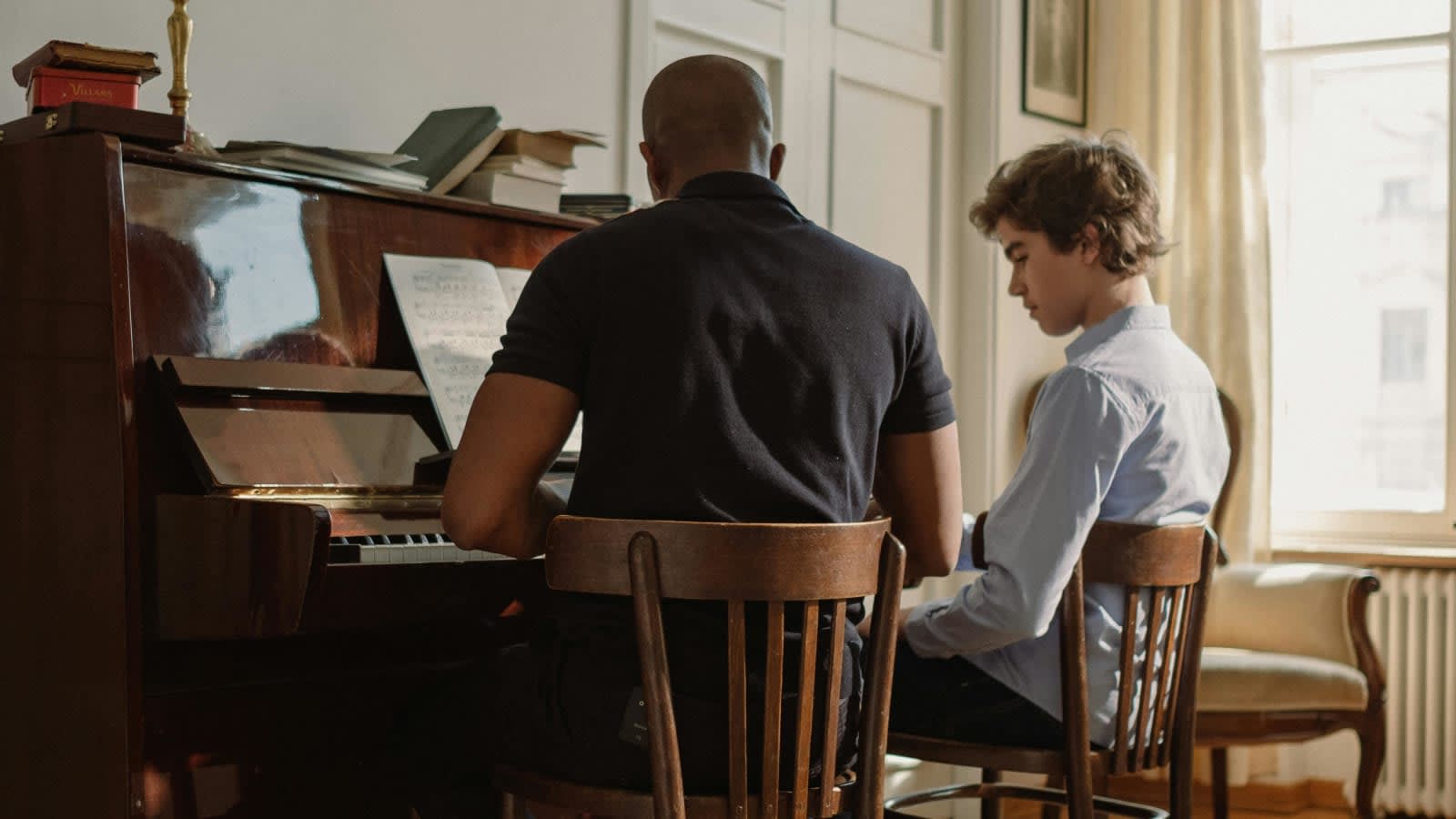
Photo: Boris Pavlikovsky via Pexels
3. Your ear should get better, not just your obedience
Another strong sign is that you begin hearing more before the teacher says it. Not perfectly, not all at once, but enough that the lesson feels less like a sequence of revelations and more like a refinement of what you were already noticing.
That matters because obedient students can still remain dependent students. They respond well inside the lesson but do not build an external ear for themselves. McPherson, Blackwell, and Hattie make this point clearly in Feedback in Music Performance Teaching: the more teaching stays under teacher control, the more feedback tends to remain at the task level and the more it can hamper student growth. Useful feedback should move students toward dialogue, self-observation, and "where to next," not permanent dependence on an authority figure.
The listening side has direct support too. In 2025, Nusseck and colleagues studied 25 advanced piano students using short audio-feedback interventions and found measurable shifts in self-ratings after playback. That does not prove every recording instantly improves performance, but it is a strong reminder that auditory feedback helps students notice things they miss in the act of playing. So one sign that lesson advice is working is that it pushes you toward better listening habits: slower replay, more honest self-assessment, clearer contrast between what you intended and what actually happened.
If your teacher keeps encouraging that shift, the lesson is likely doing real work. If every problem still has to be imported from outside, the musical ear is not becoming independent enough. That is exactly the territory covered in listening more critically while you practice.
Strong lesson advice usually creates a new listening task. It does not just tell you what was wrong. It changes what you listen for on the next attempt.
4. The advice should start transferring into other music
This may be the cleanest long-term sign of all. If a lesson really taught you something, the result should not remain trapped in one bar forever.
Transfer does not have to be dramatic. It can be small. Maybe a rhythm-grouping idea starts helping in another piece. Maybe a balance correction starts showing up in your scales, your accompaniment patterns, or your sight-reading. Maybe a release cue that fixed one leap begins helping other jumps too. That is what instruction looks like when it is teaching a principle rather than patching a spot.
Marc Bangert and colleagues give a useful lens for this. In their 2014 Frontiers study, 36 music students practiced piano interval leaps under different practice conditions, and the work was explicitly interested in transfer to a novel task. The findings were nuanced rather than simplistic, but the broader point stands: practice design matters partly because some forms of work generalize better than others. If teaching advice never generalizes, it may be fixing surfaces without building a more durable schema underneath.
This is why students should watch for even modest transfer across repertoire. If the teacher's advice improves only the exact example used in the room, keep listening. If it starts to show up elsewhere, that is much stronger evidence that the teaching is changing your musicianship rather than just editing a moment.
Run a four-week check before you judge
You do not need a dramatic epiphany to evaluate whether lessons are working. A short review over three to four weeks is usually enough to see the pattern.
| Question to ask after 4 weeks | Healthy sign | Concerning sign |
|---|---|---|
| Do I diagnose issues faster now? | I can usually name the problem category without waiting for the next lesson | I still only know something is wrong, not what kind of wrong it is |
| Are the same mistakes happening less often? | Yes, because I changed how I practice them | No, the same correction keeps returning with no method change |
| Is my listening sharper? | I catch more errors, balance issues, or instability before being told | The teacher still hears everything first every week |
| Am I practicing more intelligently? | More targeted starts, fewer blind run-throughs, clearer next steps | My practice still drifts the same way it did a month ago |
| Has anything transferred to new material? | At least one lesson idea now helps outside the original example | Every fix dies inside the exact bar where it was taught |
You are not looking for perfection here. You are looking for trend. One rough month does not prove a teacher is ineffective. But no movement at all across these categories is worth noticing.
Authority is not the same thing as impact. If the advice is accurate but nothing in your week is becoming clearer, more independent, or more transferable, the teaching may need a different shape.
When to be patient, and when to start asking harder questions
Not all good teaching produces immediate visible gains. Some technical changes get worse before they get better. Some interpretive or movement changes need weeks before they stabilize. That is normal, and students should not panic every time progress looks nonlinear.
But students are also allowed to notice patterns. If after a month or two you can describe the teacher as knowledgeable, kind, experienced, or inspiring, yet your diagnosis is not clearer, your mistakes are not reducing, your listening is not stronger, and your practice is not changing, then it is fair to ask whether the feedback is actionable enough. A good teacher should not be threatened by that question.
In fact, the best teachers usually welcome it, because the whole point of the lesson is not to make the student admire the correction. It is to make the student more independent next time. If you are also thinking at a wider level about fit, structure, and professionalism, our guide to red flags and green flags in choosing a teacher covers the broader picture.
The best lesson advice does not just sound right. It changes what you can notice, what you can fix, and what you can carry forward when the teacher is no longer in the room.