
How to Restart an Instrument After Months or Years Away
Returning to an instrument is usually faster than starting from zero, but slower than your memory wants. This guide shows what comes back first, what lags, and how to rebuild without overreaching.
Pract.is Editorial
Research-based practice guidance for musicians from the Pract.is editorial team.
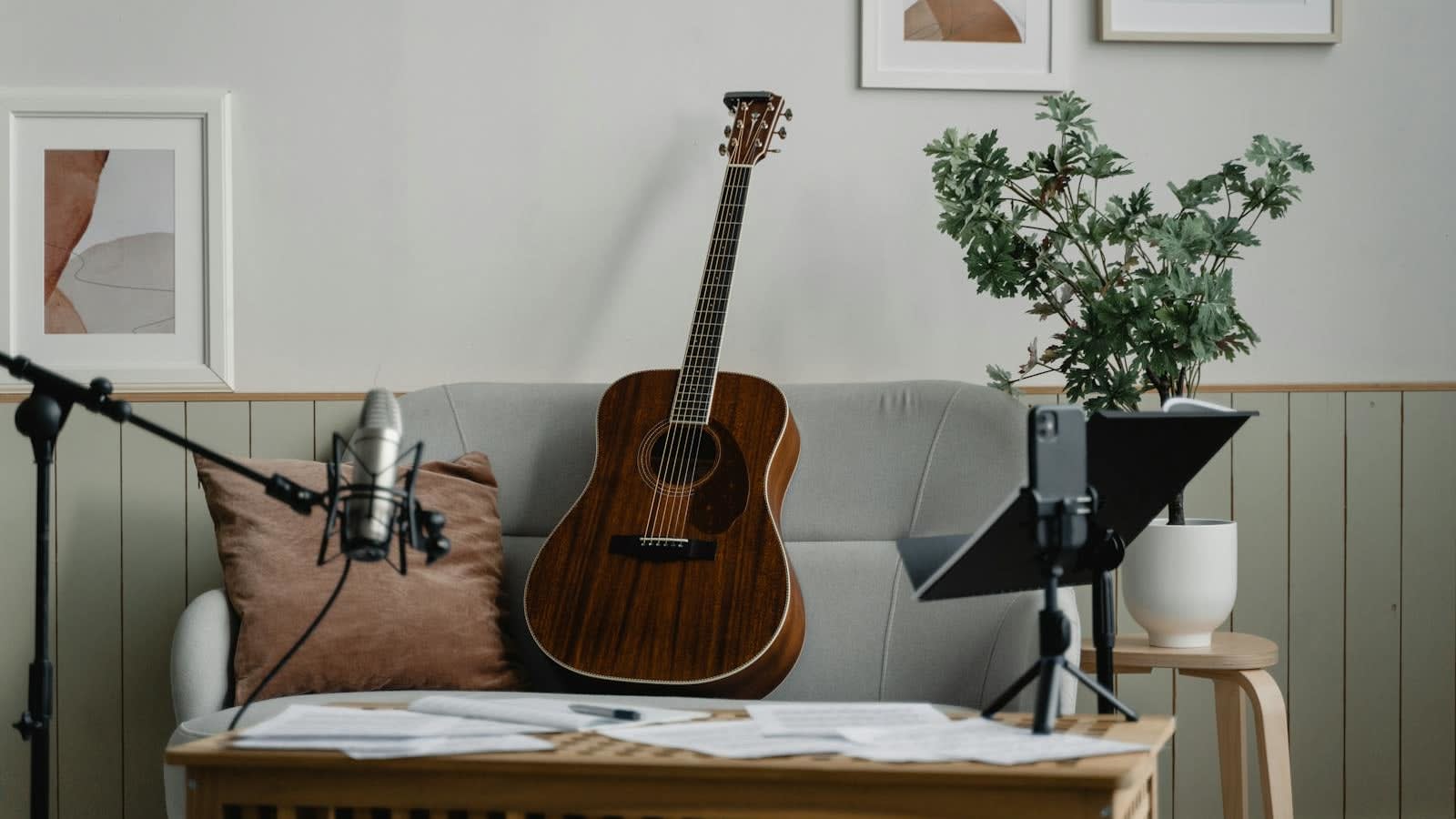
Coming back to an instrument is usually less like starting over and more like waking up a system that is partly there and partly out of shape. That is why the first week can feel so strange. Some things return almost immediately. Other things that used to feel automatic suddenly feel clumsy, small, or embarrassingly expensive.
The useful frame is not “I used to be better than this.” It is “which parts of the skill are still stored, and which parts need tolerance and timing rebuilt?” Once you look at it that way, returning becomes much easier to manage and much less dramatic.
| What often comes back faster | What often lags | What to do about it |
|---|---|---|
| Recognition of familiar patterns, songs, shapes, and sections | Stamina, load tolerance, and fine control | Keep sessions short at first and leave before form collapses |
| Reading habits or note-naming fluency | Speed, consistency, and clean recovery under pressure | Use simple material and treat steadiness as the main target |
| General musical judgment and phrasing ideas | Embouchure, calluses, finger endurance, or vocal stamina | Rebuild physical tolerance separately from musical ambition |
| A sense of “I know this world” | Confidence that the skill is still really usable | Choose early tasks you can complete cleanly, not heroically |
What usually comes back faster than expected?
People are often surprised by how much familiarity survives a long break. You may not play well on day one, but you often still recognize patterns, remember the sound of pieces you used to know, and feel your way around the instrument faster than a true beginner would. That is not wishful thinking. It lines up with what learning research calls savings: faster relearning after earlier learning, even after a gap.
In Two Ways to Save a Newly Learned Motor Pattern, Ryan Roemmich and Amy Bastian describe savings as faster relearning after initial learning. The study is not about instruments, but the principle still matters here. Prior learning leaves behind something usable, even when current performance looks rusty. By inference, that is one reason returning players often feel “not good, but weirdly not new.”
There is also music-specific evidence that at least some learned automaticity survives long periods without practice. In Does a Non-Practiced Cognitive Automatism Withstand the Test of Time?, previously trained musicians who had stopped practicing for at least three years still showed automatic note-naming effects, including some who had stopped for more than ten years. That does not mean full playing skill stays intact. It does mean you should not assume the whole system has vanished.
Returning musicians are usually not rebuilding from zero. What survives first is often recognition, orientation, and familiarity. What lags is physical and timing reliability.
What usually feels worse at first?
What feels worse is usually the part that depends on tolerance, not the part that depends on recognition. Fingers fatigue earlier. The voice tires sooner. Embouchure control gets unreliable. Calluses vanish. Timing gets less trustworthy when concentration drops. A passage you still remember can feel oddly expensive to execute because the body has stopped paying the cost smoothly.
BAPAM’s Return to Play guidance for instrumental musicians is blunt about this: after time away, capacity is reduced, and sudden increases in playing load are a common trigger for symptoms. Their guidance is framed partly around injury recovery, but it explicitly includes extended leave and long breaks from normal playing schedules. That matters because the underlying principle is broader than injury. Familiarity can return before tissues, muscles, and movement tolerance are ready for your old schedule.
The same idea shows up in the physical-therapy literature on musicians. In evidence-informed management of performance-related musculoskeletal disorders in musicians, the authors note that after periods of minimal playing, musicians should build intensity and duration back up before returning to full workloads. My inference from that is straightforward: even if you are not injured, a long layoff should be treated as a load-management problem, not just a motivation problem.
Feels worse first
Endurance
You may still remember what to do, but not for as long as you used to do it.
Feels worse first
Precision
Fine control often comes back later than broad familiarity with the piece or instrument.
Feels worse first
Confidence
The mismatch between what you remember and what you can currently execute can feel harsher than the actual decline.
If you are returning to singing specifically, voice stamina deserves special care. NIDCD’s voice-care guidance reinforces the basics: hydration, avoiding strain, and respecting signs of hoarseness or fatigue. The broader lesson still holds across instruments. The system that tires first is usually the system that has to be respected first.
Why is overreaching the main risk?
Because returning players usually underestimate what still exists mentally and overestimate what still exists physically. That combination is dangerous. You remember being able to play forty-five minutes, so twenty minutes feels modest. You remember a piece as manageable, so it feels reasonable to pull it back out on day two. Then the body tells a different story later that evening or the next morning.
BAPAM’s schedule is useful precisely because it refuses drama. It starts absurdly small by ego standards and practical by tissue standards. Five-minute playing bouts separated by long rests can look ridiculous to someone who once played seriously. They also make sense if the goal is a sustainable return rather than emotional whiplash.
This is one place where adults often sabotage themselves by trying to prove they still “have it.” A better target is leaving the session wanting a little more, not proving you can survive the old amount. That is especially true if your life is already busy. The same low-friction logic that helps adults learn with a full-time job also helps them return after time away.
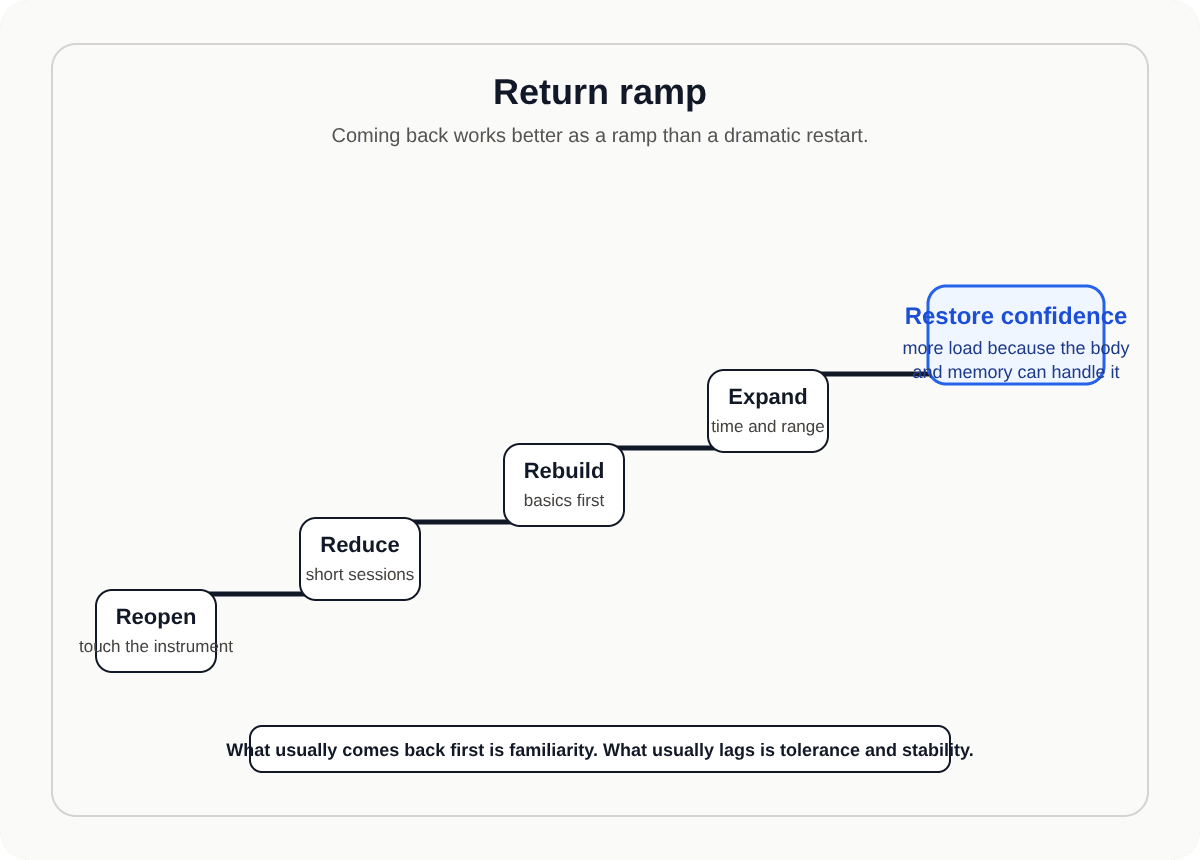
What should the first few weeks actually look like?
The first few weeks should be built around recovery, not nostalgia. Use material that is easy enough to let timing, tone, posture, and comfort settle back in. Avoid treating old peak repertoire as your starting point unless it still fits your current capacity. You are not trying to prove identity in week one. You are trying to create evidence that coming back is viable.
Reopen the routine
Short sessions. Familiar material. Lots of stopping before fatigue. The win condition is “I can do this again tomorrow.”
Rebuild tolerance
Add a little duration or a second daily block if the first week felt easy and symptom-free. Keep repertoire below ego level.
Expand range, not just time
Bring in slightly more demanding material, but only after the basic routine feels emotionally and physically normal again.
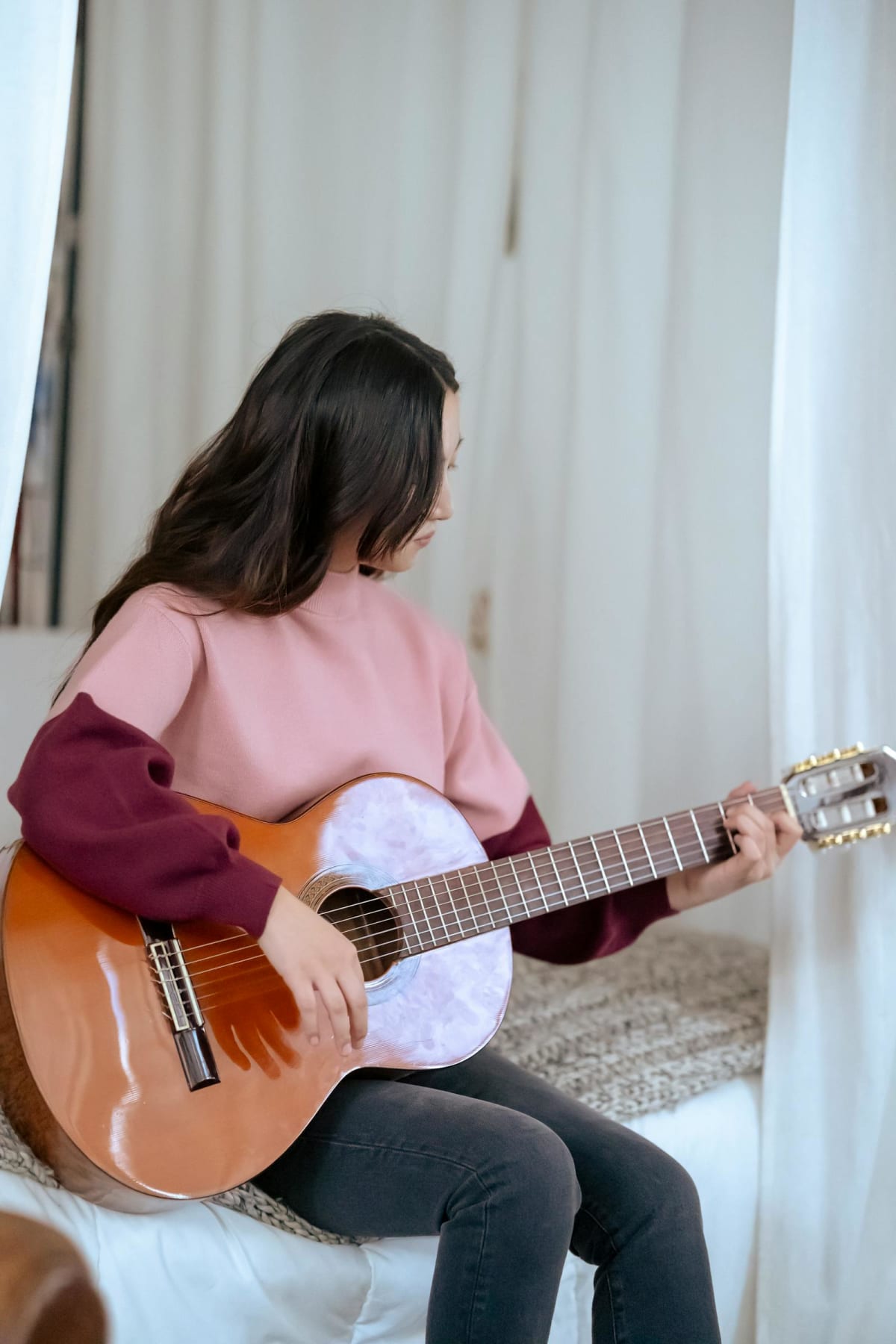
Photo: Charles Parker via Pexels
A practical way to choose material is simple: start with things that remind you who you are musically without requiring your old level immediately. That might be scales, easy pieces you once loved, chord patterns, sight-reading below your old standard, or technical work done for quality rather than range. Many of the mistakes adults make at the beginning also show up on the way back: too much difficulty too early, random practice, and confusing effort with progress.
How do you make the return sustainable instead of emotional?
The key is to build a repeatable routine before you build ambition. Returning players often have a strong emotional day one, then a discouraging day three, then a week off again. That cycle has less to do with discipline than with scale. If the comeback is sized around what feels meaningful instead of what fits current life and capacity, it becomes fragile.
This is where routine beats excitement. Give the instrument a consistent place in the week, however small. Decide in advance what counts as a successful session. Track whether the return is creating more steadiness or more soreness. If the answer is more soreness, shrink. If the answer is more steadiness, expand carefully. A sustainable practice routine matters even more when the habit is being rebuilt, not less.
Bottom line
Coming back to an instrument works best when you trust what stayed, respect what faded, and rebuild the load more slowly than your memory wants.
The encouraging part is that the awkward first phase is often temporary. If you keep the return small enough to survive, it usually gets better faster than it felt on day one.
More on practice methods.
A Practice Diary for Pianists: Turning Hours at the Keys Into Results
A piano practice diary can expose plateaus, strengthen memory, and protect sight-reading time. Learn what to record so each session changes the next.
Pract.is Editorial

Reading Your Practice Data: What the Numbers Actually Tell You
Practice statistics reveal coverage, spacing, effort, and trends. Learn to track practice progress without mistaking activity for musical improvement.
Pract.is Editorial

How to Build a Practice Routine You Actually Keep
A practice routine is easier to keep when its order stays fixed and its length can change. Build a schedule for sessions of 10, 25, or 45 minutes.
Pract.is Editorial