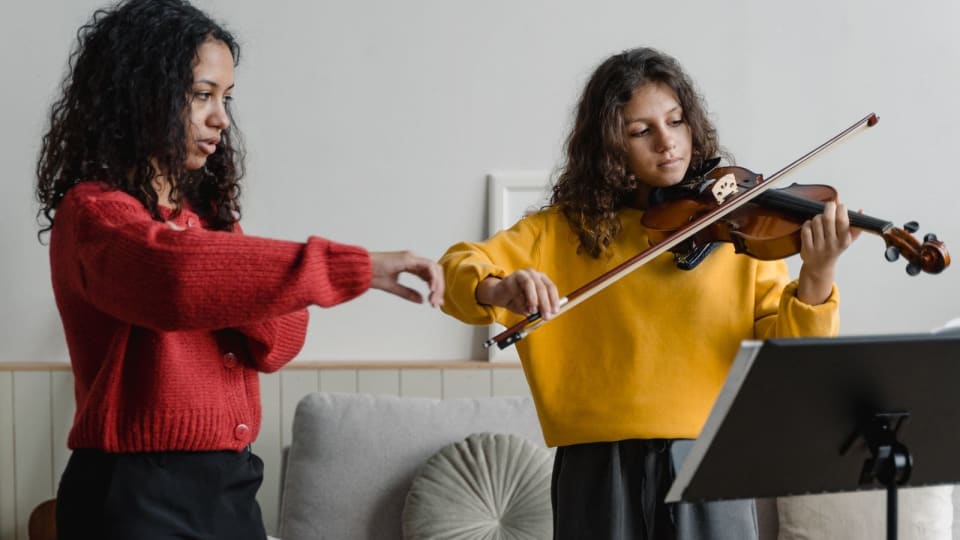
Ask five music teachers what belongs in a student practice log and you will collect five different forms with forty fields between them: minutes per exercise, mood ratings, metronome marks, hydration reminders, sticker charts, weekly word counts. Ask the same five teachers how many of their students are still filling those forms in by November and the number drops fast.
Here is the position this post argues for: a useful practice log tracks five things, ignores almost everything else, and takes less than thirty seconds per session. Everything below is the case for that - which five, why those, and what to do with them.
A practice log has exactly one job
A student practice log is not a diary, not a gradebook, and not an accountability contract. Its job is to change what happens next - the student's next session and the teacher's next lesson. Every field on the form should pass one filter: will someone act differently because this was written down? If the answer is no, the field is decoration, and decoration has a real cost.
The cost is abandonment. Self-monitoring research outside music has measured this directly. A randomized pilot in JMIR Formative Research compared detailed versus simplified daily self-monitoring and found engagement favoring the lighter version - detailed tracking is consistently described by participants as burdensome. In two mobile self-monitoring interventions analyzed in the Journal of the Academy of Nutrition and Dietetics, fewer than half of participants were still tracking by week ten - and those were adults who had volunteered for the study. A twelve-year-old with a forty-field practice form was never going to make it past September.
Music teachers see the same curve every year: enthusiastic logging for two weeks, patchy entries for two more, then a notebook that lives permanently at the bottom of the lesson bag. The usual diagnosis is that the student lacks discipline. The better diagnosis is that the form lost the cost-benefit calculation. We took apart the failure modes in why most music practice journals fail; the short version is that journals die when writing them costs more than reading them returns.
"Every field on a practice form should pass one filter: will someone act differently because this was written down?"
The five signals worth tracking
1. Days practiced, and how they were spread. Not minutes - days. A week of practice that happened on four spread-out days beats the same minutes crammed into the night before the lesson, and spacing is the first thing a teacher should read. It explains the most common studio mystery ("it was perfect on Thursday") and it is the cheapest possible data point: the student taps that a session happened, and the calendar does the rest.
2. What got worked on - against what was assigned. The gap between the assignment list and the practice list is where most weekly problems hide. Students drift toward what already sounds good, so the étude gets five visits while the assigned rhythm spot gets none. A log that captures "which pieces, which sections" makes avoidance visible in seconds. The teacher stops discovering it in week four and starts addressing it in week two.
3. Where it broke down. One sentence per session: "bar 24 uneven at 60," "B section collapses hands together." This is the highest-value sentence in the entire system, because problem-handling is precisely what separates strong practicers from weak ones. When Duke, Simmons, and Cash filmed advanced pianists learning a difficult Shostakovich passage for their study "It's Not How Much; It's How" in the Journal of Research in Music Education, neither total practice time nor number of repetitions predicted next-day performance quality. What ranked the top players was how they handled errors: locating the exact source, fixing it - usually by changing speed - and not letting it recur. A log that records where things break is a log that teaches students to notice their errors, which is half the skill.
4. Whether assignments got finished. Distinct from signal 2: not "was it touched" but "did it reach the target" - the tempo goal, the hands-together milestone, the memorized page. A simple done / partly / stuck marker per assignment tells the teacher in one glance where the lesson should start and keeps assignments from silently rolling over for a month.
5. One reflection per week. Not per session - per week. What felt easier? What do you think is wrong? Reflection is the phase of the practice cycle that beginners skip entirely, and it is where self-regulated learners are made: when Hatfield, Halvari, and Lemyre tested the forethought-performance-reflection cycle with 204 music academy students in Musicae Scientiae, the reflection phase is what closed the loop between one session and the next. One honest sentence a week is enough to coach it.
What to ignore, even though it is easy to track
Everything in this section is trackable, popular, and mostly noise. The pattern to notice: each one measures the logging, the clock, or the mood - not the learning.
Total minutes as a quality measure. Minutes are the most natural thing to track and the least informative. The Duke study above is blunt about it: time spent did not predict retention quality. Minutes still have one legitimate use - confirming that practice happened at all and how it was spaced - but the moment minutes become the goal, students learn to sit at the instrument longer rather than practice better. Track days; let minutes be incidental.
Per-exercise stopwatch data. Timing each scale, étude, and piece separately quadruples the logging burden and produces data nobody reads. No lesson decision changes because arpeggios got seven minutes instead of nine.
Mood and effort ratings every session. A daily 1-to-5 "how did it feel" score generates a tidy chart of nothing. Students normalize their own scale within weeks, and the teacher cannot act on a Tuesday 3. The weekly reflection sentence captures everything the mood score pretends to.
Streaks as a goal. A streak counter measures consecutive logging, not learning, and it punishes exactly the wrong people - the honest student who skipped Wednesday for a school concert loses everything, while the student who taps the box without opening the case keeps the badge. Consistency matters; streak worship corrodes the data that proves it.
Recordings of every session. Recording is a powerful tool in small doses - one clip of one assigned passage per week. Mandatory full-session audio turns every practice day into a performance, and most students respond by practicing less. Save recording for the spots where hearing it changes the fix.
Put side by side, the split looks like this:
| Data point | Verdict | Why |
|---|---|---|
| Days practiced + spacing | Track | Predicts retention; costs one tap |
| Pieces and sections touched | Track | Exposes avoidance against the assignment |
| Where it broke down | Track | Error handling is what predicts quality |
| Assignment done / partly / stuck | Track | Tells the lesson where to start |
| One weekly reflection | Track | Builds the self-monitoring habit |
| Total minutes as the goal | Skip | Doesn't predict quality; invites clock-sitting |
| Per-exercise stopwatch data | Skip | High burden, no lesson decision changes |
| Daily mood scores | Skip | Unactionable; the weekly sentence does it better |
| Streak counters as goals | Skip | Measures logging, punishes honesty |
| Recording every session | Skip | One weekly clip of one passage is enough |
Reading the log in two minutes
The five signals exist so the teacher can answer four questions before the student walks in: did practice happen and how was it spread, what got avoided, where did it keep breaking, and what does the student think is going on. That read takes about two minutes per student, and we covered what it replaces - the opening interrogation - in how teachers can see what happened between lessons.
The filter that produces those five signals from the universe of trackable things is worth making explicit, because it is also the filter for every future "should we add this field?" conversation:
The practice log filter
One question filters forty fields down to five. It also settles every future "should we track this?" debate.
Reading patterns matters more than reading entries. A single week of log data answers the four questions above; a month of it starts answering better ones. The student whose breakdowns cluster in the same four bars for three weeks needs a different practice strategy, not another reminder. The student whose practice always dies on school-concert weeks needs a lighter assignment those weeks, not a lecture. Patterns like these are invisible in any single lesson and obvious in any four-week log.
"One week of log data tells you what happened. Four weeks tell you what keeps happening - and that is where teaching gets cheap."
Keeping the system alive past November
The five-signal log survives on three rules. First, the per-session cost stays under thirty seconds: tap that practice happened, tap the pieces, one optional sentence about where it broke. The done / partly / stuck markers and the reflection are weekly, not daily. If a field starts taking longer than that, it is drifting toward the forty-field form, and the forty-field form always loses.
Second, the teacher visibly uses the data. The strongest predictor of whether a student keeps logging is whether the log changed last week's lesson. "I saw bar 24 kept breaking - we're starting there" renews the habit for a month. A log that is never mentioned is homework about homework, and students are right to drop it.
Third, the data is never used against the student. The moment "you only practiced twice" becomes an accusation, the log stops being a shared record and starts being evidence for the prosecution - and the entries quietly become fiction. Read patterns, adjust assignments, and let the student see that honest logging buys better help, not better-documented guilt.
The minimal log, as a spec
Format matters less than these rules, but it is not nothing. A paper log is better than no log; its weaknesses are that it stays home on lesson day and the teacher only sees it after the student arrives. A shared digital log fixes the timing - the teacher reads the week before the lesson instead of during it. If you are building the student-facing side, our practice log template post covers the same five signals from the student's chair.
Whatever the format, resist every future temptation to add a field. The forty-field form is always one good idea away. The log that is still being filled in come spring is the one that stayed almost empty.