

Most practice routines fail because they were designed for your best day. Plenty of energy, long attention span, clean schedule, strong willpower. That is not a serious design standard.
A routine you can sustain long-term has to survive ordinary days and low-energy days too. That usually means less friction, clearer cues, smaller starting demands, and fewer decisions between sitting down and actually beginning. Consistency tends to come from good routine design, not from trying to feel inspired every afternoon.
Build the routine for repeatability, not for fantasy
Music practice research keeps pointing back to self-regulation and organization. In the 2020 Frontiers study on conservatory exam preparation, Roberta Antonini Philippe and colleagues found that organizational and self-regulatory skills were not consistently exploited well, even by serious students. The issue was not simply commitment. It was weak planning, weak reflection, and uneven use of strategies across the preparation period.
Amanda Leon-Guerrero found something similar in her study of 16 middle-school instrumentalists: repetition showed up more often than other self-regulation strategies. That matters because a sustainable routine is not just “show up and repeat.” It has to lower decision fatigue and make the right action easier than the wrong one.
That is why generic habit advice often misses musicians. A practice routine is not just another wellness ritual. It has to account for warm-up, technical load, repertoire choices, physical fatigue, and the fact that a session can still count even when it is not glamorous.
A sustainable routine is one that still works when motivation is average. If it only works when you feel heroic, it is not sustainable yet.
Pick a session length you can protect
The first design decision is not what scale system, piece list, or tracker you use. It is the default session length you can repeat without bargaining with yourself every day.
The broader learning literature still supports this direction. A 2025 meta-analysis of applied research on distributed practice found a moderate effect in favor of distributed over massed practice in classroom learning. Music is not identical to classroom study, but the practical lesson travels well: smaller repeated blocks often beat oversized bursts that are hard to maintain.
Musician-health guidance points the same way. The University of Wisconsin’s musician health guidance, drawing on NASM and performing-arts medicine resources, recommends regular breaks, a reasonable daily amount of practice, gradual increases in load, and one day off per week. That is not anti-discipline advice. It is long-term load management.
A good default block is usually modest enough that you do not need an argument with yourself before starting. For many musicians that means something like 20 to 40 minutes as the everyday baseline, not because longer sessions are impossible, but because the baseline has to be protectable.
| Routine type | How it feels on day one | What happens by week three |
|---|---|---|
| Ambitious routine | Exciting, serious, impressive | Skipped often, renegotiated constantly |
| Sustainable routine | Almost too modest | Repeated often enough to become normal |
If you want the shortest version of the rule, it is this: choose a session you can defend on a tired Tuesday, not just on a motivated Sunday.
Give the routine a fixed cue and a tiny starting ritual
A lot of musicians rely on a vague intention like “I’ll practice later.” That is not a routine. It is an open negotiation.
BJ Fogg’s behavior model is useful here because it strips the idea down to mechanics: behavior happens when motivation, ability, and a prompt meet. On the companion prompts page, Fogg states even more bluntly that without a prompt, the target behavior will not happen. For practice, that means a fixed cue matters more than many musicians think.
That cue can be time-based, but routine-based cues are often better because they piggyback on something that already happens. The 2021 randomized trial by Jan Keller and colleagues found that both routine-based and time-based cue planning increased automaticity, and that repeated plan enactment was a key predictor of habit formation. Their participants who successfully formed habits reached peak automaticity at a median of 59 days. In other words, cues matter, but repetition of the cue-action pairing matters even more.
For musicians, that often sounds like this:
after coffee  -> open case and sit down -> 90-second warm start -> first target block
after work    -> fill water bottle       -> one scale or drone   -> bars 17-24
after dinner  -> set stand and timer     -> one easy read-through -> main task
The starting ritual should be tiny on purpose. Open the case. Put the instrument out. Set the stand. Start the timer. Play one scale, one drone, one easy line, or one minute of breathing and setup. A small starting ritual lowers the first barrier, which is usually where routines die.
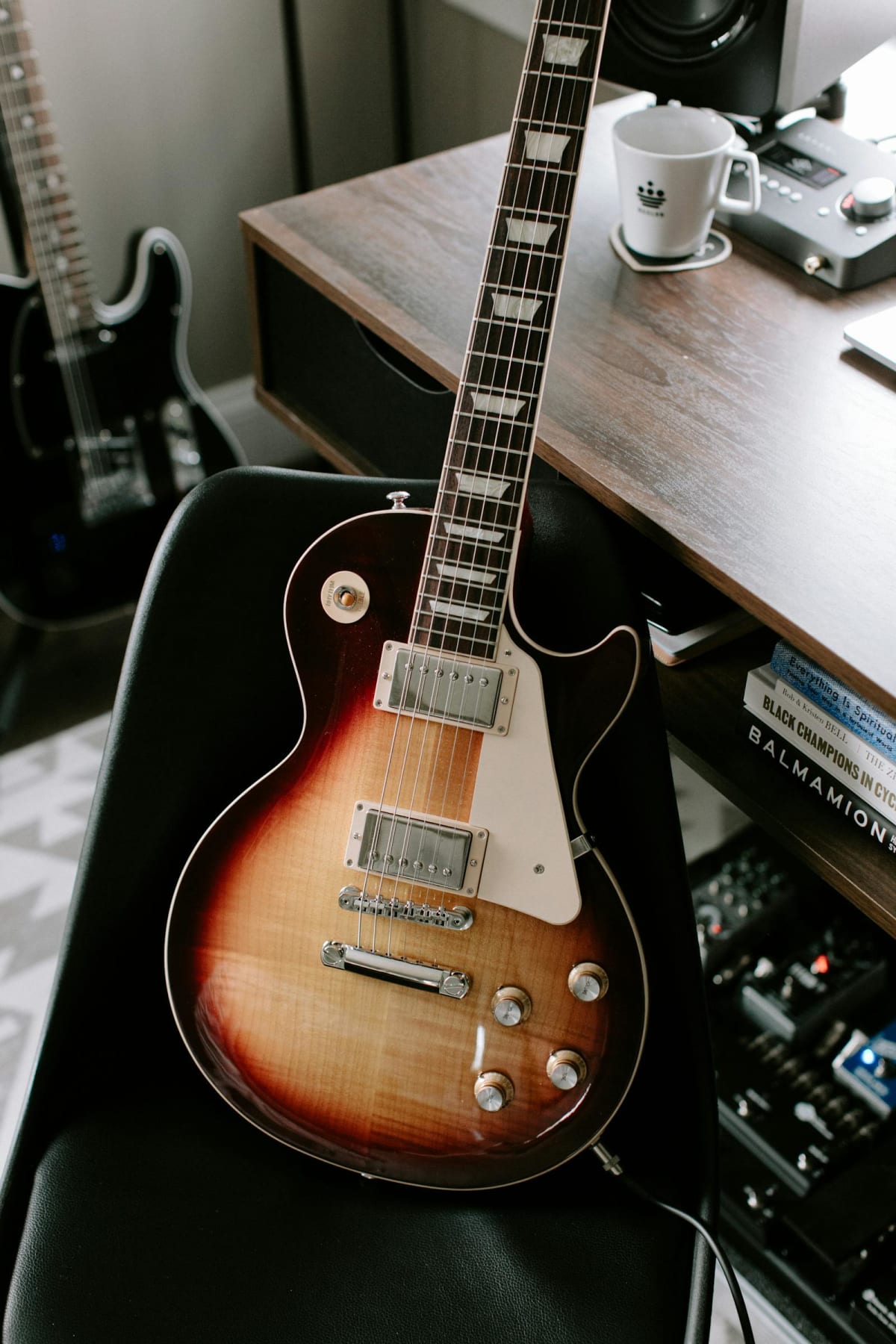
Photo: Dylan Spangler via Pexels
Limit priorities before the session starts
One reason routines feel fragile is that the player sits down and has to decide everything from zero. Warm-up or piece? Technique or repertoire? Which excerpt? Which tempo? Which problem? That much decision-making creates drag before any musical work has started.
A sustainable routine solves some of that in advance. Give each session only a small number of priorities. Usually that means one main target, one secondary task, and one easy exit task. The 20-minute routine article on this blog makes the same point in a shorter format: one clear target usually beats a vague full-program session.
That structure also protects low-energy days from turning into random wandering. If the session has three jobs instead of nine, you are far more likely to begin. And if the first job reveals a deeper issue, you can shift intelligently instead of drifting. That is where diagnosing what is actually going wrong in practice becomes useful: fewer priorities makes better diagnosis easier.
Good default: one main target, one support task, one easy closer. More than that and the routine starts depending on exceptional energy again.
Design the routine for low-energy days now
Do not wait until you are tired, stressed, or busy to decide what “counts” as practice. By then the decision is emotionally loaded, and musicians tend to swing between two extremes: skip completely or force a session so overbuilt that it becomes aversive.
The better design is a fallback version. Same cue, same place, same ritual, smaller demand. That way the routine survives even when the full session does not.
Examples of fallback sessions:
- 10 minutes instead of 30
- one technical problem instead of full repertoire rotation
- slow cleanup and one note for tomorrow instead of a full program run
- score study, rhythm work, or mental practice when playing load needs to be lower
This is not cheating. It is what makes the routine durable. Wisconsin’s musician-health guidance explicitly warns against sudden load spikes and stresses reasonable daily amounts, breaks, and gradual increases. A low-energy version fits that logic much better than the all-or-nothing cycle of overdoing it on one day and disappearing the next.
A simple fallback checklist can keep this concrete:
[ ] same cue as usual
[ ] same starting ritual
[ ] one target only
[ ] stop before the session turns resentful
[ ] write tomorrow's first task
If all five are there, the routine is still alive.
Make continuity visible
The final piece is carrying information forward so the next session starts faster than the last one. That can be one line in a notebook or one note in a tracker. It does not have to become a private essay.
This is where recent posts on what to track besides time and how to review a practice session fit naturally. If the session ends with one useful carry-forward note, the next session begins with less friction. “Start with bars 22-26 at 68.” “Drone first, then intonation check.” “Do not begin from the top.” That is enough.
If you already use Pract.is, this is where it makes sense: not as a motivational crutch, but as a low-friction place to keep the routine visible from one day to the next. The value is not the timer by itself. The value is reducing restart cost.
Long-term consistency usually looks less dramatic than people expect. A protected default length. A fixed cue. A tiny start. Limited priorities. A fallback version for tired days. One carry-forward note. That is not glamorous, but it is how routines survive long enough to become real.


