
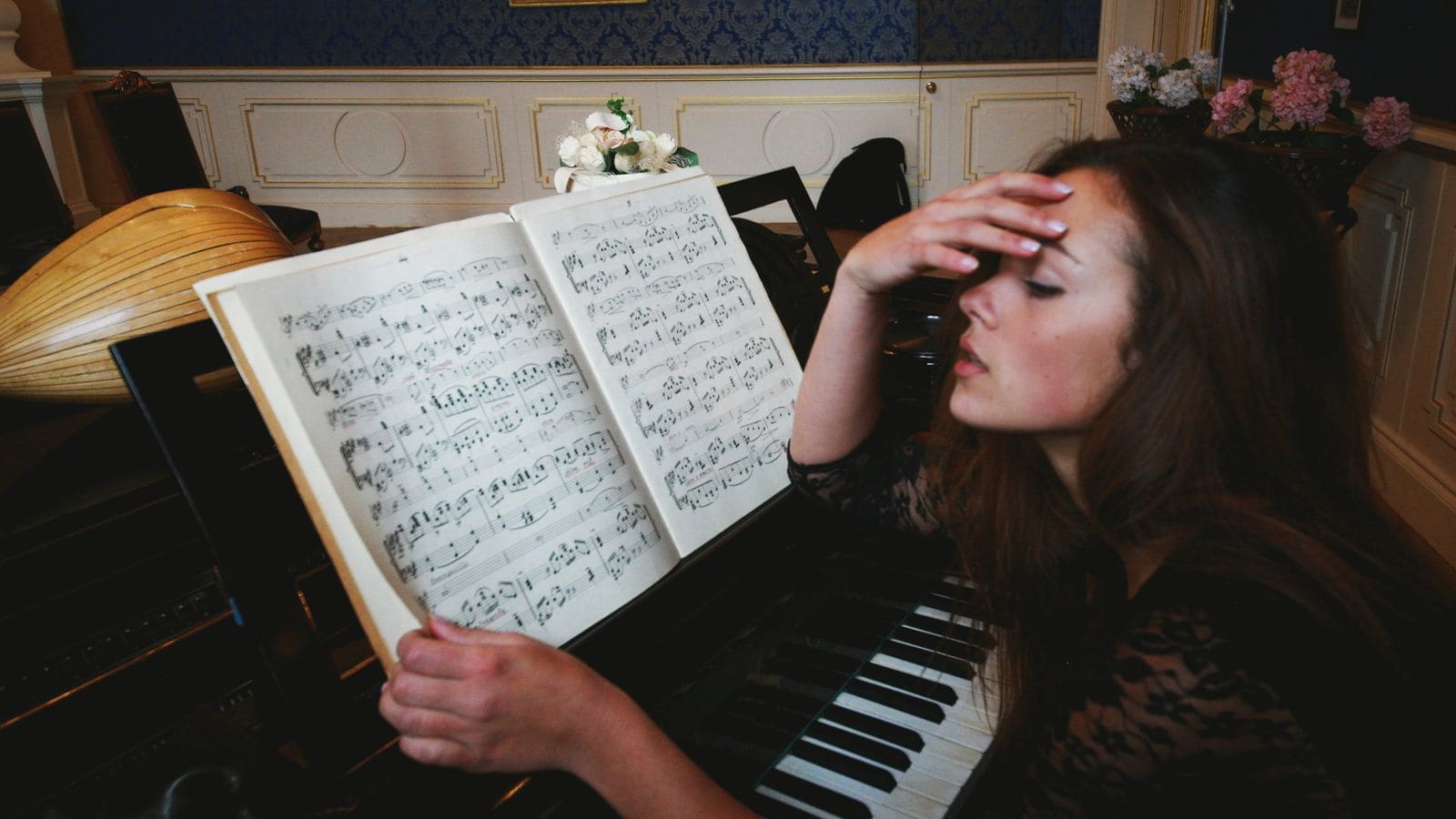
It's the most demoralising experience in music, and almost everyone has had it. You put in a genuinely good week — focused, unrushed, you sat down every day and worked. By Friday the tricky passage finally sang; you ended the session playing it beautifully and went to bed feeling like a real musician. Then the lesson comes, or you sit down on Monday, and it's gone. The passage falls apart as if the week never happened, and you're left wondering whether you're just not talented, or whether practice simply doesn't work for you.
Here's the reassuring part and the uncomfortable part in one sentence: the problem usually isn't talent or effort — it's that how practice feels in the moment is a famously bad guide to whether it's actually working. The two come apart more often than anyone admits, and once you can spot the gap, you can close it.
The gap between effort and progress
Picture two lines running across a week of practice. One is how productive each session felt — and for most of us that line rides high, because effort feels like progress and finishing things feels like winning. The other is how much you actually, durably improved — and that line is often nearly flat. The space between them is the illusion, and it's where a startling amount of practice time quietly disappears.
Feeling vs. progress, over a week
The feeling of a great week is real. It just isn’t evidence — and the bigger the gap, the more of your effort is going into the feeling instead of the playing.
Psychologists call the engine behind that top line task-completion bias: we get a hit of satisfaction from finishing things — running the whole piece, "getting through" the étude, ticking the box — and that satisfaction registers as productivity whether or not anything improved. The most productive-feeling sessions are often the ones where you covered the most ground, which is exactly the kind of session that tends to skim everything and fix nothing.
Why good-feeling practice lies to you
The deeper culprit has a name too: the illusion of competence. When you drill a passage over and over in one sitting, you genuinely do get better at it — within that sitting. The gains pile up in short-term memory, and by the tenth repetition you're playing it cleanly, which feels like mastery. But most of that improvement is a temporary loan, not a deposit. Sleep on it and a large chunk evaporates, because massed, repetitive practice doesn't force your brain to do the effortful retrieval that builds durable memory. You always play your best at the end of a repetition session — and that peak is the trap, because it's the moment you mistake "I can do it right now" for "I have learned this."

A few other habits quietly inflate the feeling while flattening the result. Autopilot is the big one: the hands move, the metronome ticks, the page turns, and the mind is somewhere else entirely — muscle memory going in circles, which feels like work and teaches nothing. Playing up to speed too soon is another; the run sounds impressive and exciting, but the errors baked into it get rehearsed as if they were correct, so the brain quietly files the mistakes as normal. And blocked practice — one thing for a long stretch before moving on — feels efficient and orderly, yet study after study finds it produces worse retention than mixing things up, even though the mixed approach feels messier and slower in the moment.
"You always play it best at the end of the session. That peak isn't proof you've learned it — it's the exact moment the illusion is strongest."
How to tell the difference
The good news is that fake-productive practice has a recognisable fingerprint. Once you know the tells, you can catch yourself mid-session — and each one comes with a fix that costs nothing but a change of habit.
| What it feels like | What's really happening | The fix |
|---|---|---|
| It sounded great by the end | Short-term memory; gains fade overnight | Test it cold the next day before re-drilling |
| You ran the whole piece a few times | Task-completion bias; covering ≠ fixing | Spend the time on the two bars that break |
| You played it ten times in a row | Massed repetition; feels good, retains poorly | Interleave: switch spots and come back later |
| Hands moved, mind wandered | Autopilot; muscle memory in circles | One concrete goal per rep; stop when focus drops |
| You kept it at full speed | Mistakes rehearsed and filed as normal | Slow down until accurate, then climb |
The single most useful tell: can you play it cold? Not after a warm-up run, not after three tries — first attempt, the next day. If it holds up cold, you learned it. If it doesn't, yesterday's "mastery" was the illusion, and that passage needs a different approach, not just more repetitions.
The honest fix: stop trusting the feeling, measure instead
The reason this trap is so persistent is that you genuinely cannot detect it from inside the session — the feeling is too convincing in the moment. So the fix isn't to try harder to "feel" whether practice worked; it's to build in a couple of cheap external checks that don't care how you feel. The cold next-day test is the simplest. Recording yourself and listening back a day later is the next, because the microphone hears what your in-the-moment optimism edits out. And tracking where your time actually goes catches the most common version of all — the hour that felt thorough because you touched everything and improved nothing.
That last check is the hardest to do by hand, which is where a tool earns its place. Our own app, Practis — so weigh accordingly — exists partly to make these checks automatic: practising from a score on the web or Android, it shows where your time really landed on the page, so the "I worked so hard" week and the "I only ever played the easy bits" week stop looking identical. We dug into the mechanics in how to track music practice effectively, what separates real quality from busywork in what better practice actually means, and which numbers are worth trusting in the practice data worth collecting. None of it replaces your ears — it just stops the feeling from being the only witness.
"You can't fix what you can't see — and the feeling of a productive session is precisely what hides the problem from you."
Common questions
Why can I play it perfectly at night but not the next morning?
Because the night-time version lived mostly in short-term memory, propped up by all the repetitions you'd just done. Durable learning comes from effortful retrieval — recalling the passage cold, after a gap — not from polishing it while it's still fresh. The overnight loss is normal; the fix is to test and rebuild it cold rather than assuming last night's peak carried over.
Does this mean repetition is bad?
No — repetition is essential; mindless, massed repetition is the problem. Repeating a passage with a specific change in mind each time, spacing those repetitions out, and mixing in other material all keep the brain working and the learning durable. The same number of reps, spread out and focused, beats them clustered and on autopilot.
Is a plateau the same as fake-productive practice?
They overlap. A real plateau is a natural pause while skills consolidate; fake-productive practice is a self-inflicted one, where effort goes in but the method wastes it. The tells above are how you distinguish them — if you're playing things cold, spending time on the hard parts, and still stuck, that's a genuine plateau and usually a sign you're close to a breakthrough.
The feeling of a good session is worth having — it keeps you coming back, and motivation matters. Just stop letting it be the judge. Trust the cold test, the recording, and the record of where your time actually went, and you'll close the gap between practice that feels productive and practice that is. The week you described at the top doesn't have to vanish by Monday.


