
Dorico vs Sibelius
Both are notation apps. Dorico professional music notation software from steinberg; Sibelius music notation software for writing and publishing scores. Here is how they compare on the things that decide it.
About Dorico
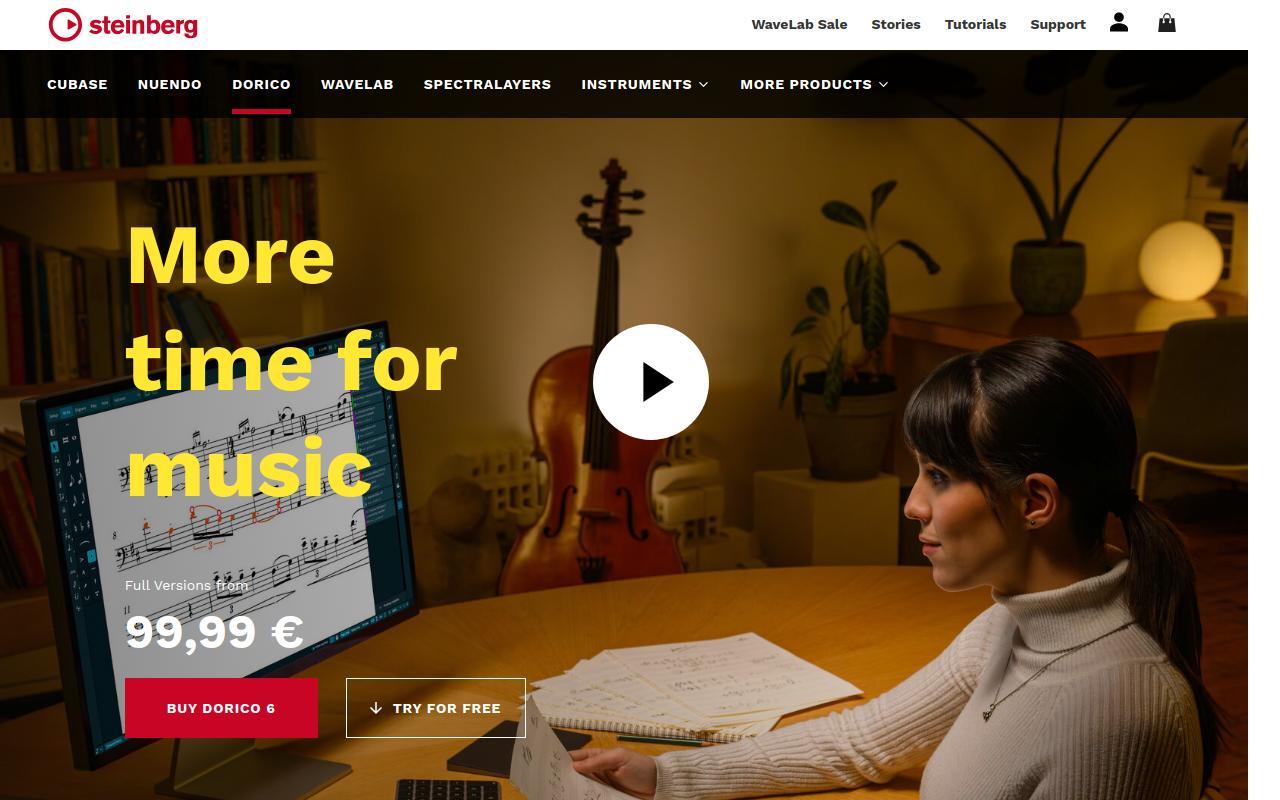
Dorico is music notation and composition software from Steinberg, built from the ground up around the composing process and intended to take a project from initial idea through to professionally engraved, published scores. It is offered as a family of desktop editions plus an iPad app, scaling from beginners to professional publishers. Dorico provides flexible note input and editing that lets you revise decisions at any stage, along with arranging tools to move music between players, explode or reduce parts onto more or fewer instruments, change tonality, perform inversions, remap scales, and generate voiced parts from chord symbols. For playback it bundles hundreds of high-quality sounds, more than 30 effects processors, a full audio mixer, and an integrated Key Editor for fine-tuning performance. It imports MIDI and MusicXML and exports MIDI, MusicXML, audio, and graphics, automatically formats scores with extensive engraving and customization options (most extensive in Dorico Pro), and keeps projects compatible between desktop and iPad. Dorico suits composers, arrangers, publishers, educators, and students, and runs on Windows, macOS, and iPad. Its pricing model is tiered: free editions (Dorico SE and Dorico for iPad) alongside paid editions (Elements and Pro) sold as one-time purchases, with academic pricing available.
About Sibelius
Sibelius is Avid's music notation software for composing, arranging, editing, printing, publishing, and sharing scores. Long established as an industry-standard tool in areas such as film scoring, orchestral publishing, and music education, it is offered in multiple editions to suit different needs. Sibelius provides note input and editing, playback through bundled sounds, and engraving and layout tools, with capabilities scaling by edition. The free Sibelius First is limited to a small number of staves for newcomers, Sibelius Artist increases the staff limit and toolset for hobbyists and aspiring composers, and Sibelius Ultimate adds unlimited staves, full engraving and layout control, advanced articulations, cross-staff notation, condensed scores, video sync with timecode, a large professional sound library, and an educational worksheet creator. It includes Sibelius Cloud Sharing for sharing scores online, supports MIDI copy/paste with Pro Tools, and offers optional add-ons for audio transcription and music scanning. Sibelius targets composers, arrangers, publishers, educators, and students from beginner to professional level. It runs on Windows and macOS desktops plus mobile apps for iPhone/iPad, Android, and Chromebook. Its pricing model is freemium and subscription-based: a free entry tier alongside paid Artist and Ultimate editions available as subscriptions or perpetual licenses, with academic discounts.