
nkoda vs Soundslice
Both are sheet music apps. nkoda subscription sheet music library with thousands of licensed scores; Soundslice create, sync, and practice living sheet music. Here is how they compare on the things that decide it.
About nkoda
nkoda is a digital sheet music subscription service, often described as a streaming library for scores. It offers access to a very large catalogue of licensed sheet music from many major publishers, readable on tablets, phones, and computers without buying each edition individually. Beyond reading, nkoda lets musicians annotate scores, build and reorder setlists, sync markings across devices, and share parts for rehearsal and performance. The breadth of licensed repertoire, from classical and contemporary to method books, is its main draw for players who would otherwise carry stacks of physical editions. nkoda is aimed at students, teachers, professional performers, and institutions such as conservatories and orchestras. It runs on iOS, Android, and desktop, and uses a subscription model with individual and institutional plans and a trial.
About Soundslice
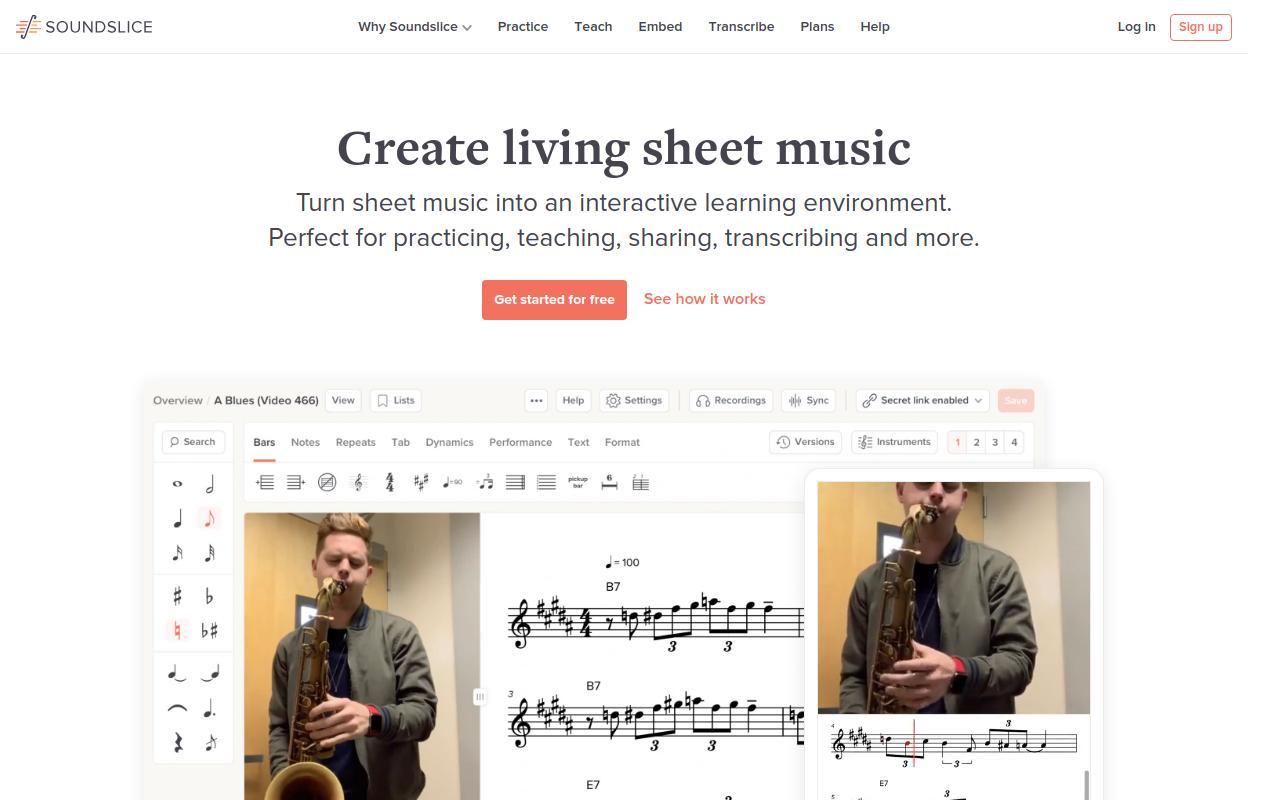
Soundslice is a web-based platform for creating and using "living" sheet music, combining standard notation and tablature with synced audio and video so musicians can practice, teach, transcribe, and share interactively. It runs entirely in the browser on any device, with scores saved in the cloud. Its notation and tab editor lets you create music from scratch or import it via MusicXML, Guitar Pro, and other formats, and it includes a sheet-music scanner that converts PDFs or photos into editable notation. Sheet music can be synced to YouTube videos, MP3s, and other recordings, and the player offers practice tools such as clicking a note to jump to that moment, dragging to set loops, slowing down playback, transposing, and soloing individual parts. Soundslice also supports embedding and licensing its player technology into external music-education websites. It is aimed at students, teachers, transcribers, and music-education businesses, and works on phones, tablets, and desktops through any modern web browser with no installation. Pricing follows a freemium model: the notation editor and core features are free for basic usage with no cap on how much music you can store, while paid plans and commercial licensing unlock additional capabilities.