A mistake repeated enough times stops behaving like a mistake and starts behaving like the version your hands expect. That is why a stubborn passage can feel glued in place even when you know exactly what is wrong. The bad version has been rehearsed, prepared, and given timing. It has become easy to launch.
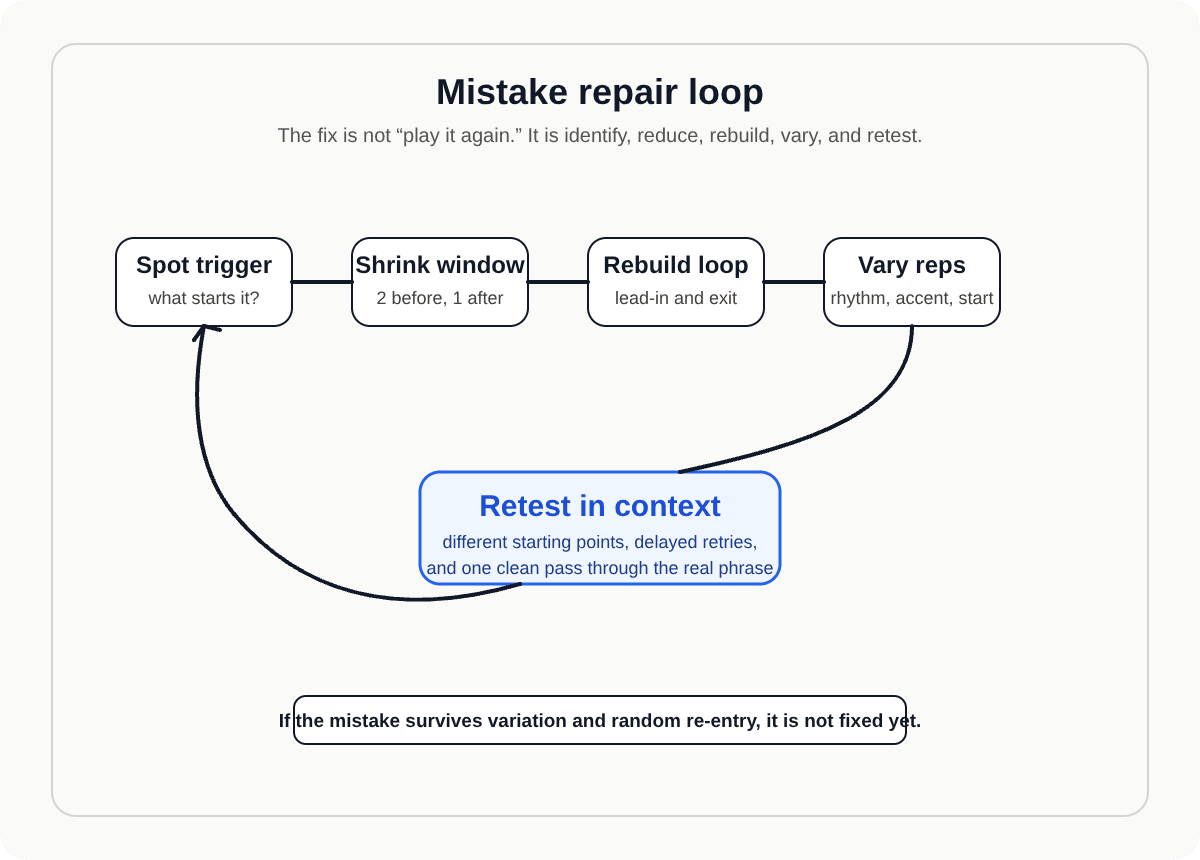
The way out is not brute force. You need to replace the old pattern with a more specific one. That means finding what triggers the error, shrinking the passage harder than feels natural, rebuilding the lead-in and exit, and then testing the fix in conditions that do not let the old habit hide.
| What people usually do | What actually works | Why it works better |
|---|---|---|
| Restart the whole phrase | Loop only the trigger and its landing | You train the exact failure point instead of spending reps on easy material |
| Play slower and slower forever | Slow down enough to change the motion, then scale back toward context | Tempo becomes a tool for repair rather than a permanent hiding place |
| Repeat the same fix the same way | Use variation in rhythm, accents, and entry points | The old habit loses its monopoly on the movement pattern |
| Assume one clean try means success | Retest after delay and from random starting points | You find out whether the passage is actually stable |
Wrong repetitions get learned too
It helps to stop treating repeated mistakes as a weird moral failure. They are a learning outcome. Motor behavior is shaped by recent movement history, and repeated actions bias later actions toward the same direction or solution. In Movement Repetition Facilitates Response Preparation, Firas Mawase and colleagues showed that repeating a movement reduces the time needed to prepare it again. In Motor Learning Enhances Use-Dependent Plasticity, the same lab showed that repeated successful movements strengthen this bias even further. That does not come from music specifically, but the implication for practice is obvious: if your hands keep launching the same wrong move, the system is doing what repetition taught it to do.
That is why “I know it is wrong” is not enough. Conscious knowledge and prepared movement are not the same thing. A musician can hear the right version internally, even describe the error clearly, and still fire the old motion because it is the one that has been rehearsed with the lowest friction. The fix has to be physical and attentional, not just intellectual.
This is also why the first real question is not “how many times have I missed it?” It is “what, exactly, have I been practicing?” If you have been giving the same mistake the same runway, you have been strengthening its launch conditions. That should change how you respond. More attempts are not neutral. They are votes.
A repeated mistake is not random noise. It is usually the most practiced version of that moment, whether you meant to teach it or not.
Find the exact trigger, not just the wrong note
Most players define the problem too late. They name the wrong note, the blurred rhythm, or the missed leap, but the mistake often starts one event earlier. The real trigger might be a hand shift that arrives cramped, an inhale that comes late, a fingering choice that collapses under tempo, or a moment where attention drops because the passage “should” work by now. If you only name the visible error, you tend to repair the aftermath instead of the cause.
That is where detailed self-observation matters. In the 2024 music microanalysis study, Guadalupe López-Íñiguez and Gary McPherson tracked what musicians planned, did, monitored, and evaluated while practicing. The useful takeaway is simple: strong practice depends on noticing what changed and why. For a stubborn passage, that means writing down or saying what happens immediately before the miss. If you cannot describe the trigger, you are probably still practicing too large a chunk.
Mistake type
Note error
Usually a reading, mapping, or shape-recognition failure. Ask what pattern you misread, not just which pitch was wrong.
Mistake type
Rhythm slip
Usually starts earlier than the audible stumble. Check subdivision, pulse ownership, and where the count stopped being active.
Mistake type
Fingering collision
The old fingering may still be launching even after you “changed” it. Mark the new one and rehearse the lead-in separately.
Mistake type
Leap target
The miss is often an arrival problem. Train the distance, landing shape, and visual cue before restoring the full phrase.
Mistake type
Attention drop
If the passage works when watched and fails when trusted, the issue may be cueing, not mechanics. Give yourself a precise thought to land on.

Photo: Tima Miroshnichenko via Pexels
This is one place where a short note helps more than another emotional rep. If you already use a practice log, write the trigger in a line or two. If you do not, a margin mark on the score is enough. The point is not bureaucracy. It is forcing the problem into language clear enough that you can target it. That is also why a useful practice log tracks what broke and why, not just minutes spent.
Rebuild the passage with a smaller loop than you think
Once you know the trigger, make the loop smaller than your instincts want. Not a bar. Not a phrase. Usually two notes before the failure, the failure itself, and one or two notes after the recovery point. That is small enough to keep attention exact and large enough to include the launch and exit. Anything larger often lets the old habit hide inside easy material.
This is also where many players waste time by restarting from the beginning of the line. Restarting can feel thorough, but it gives most of the repetitions to music that is already working. The repair target does not need more scenery. It needs more precise landings. That principle lines up with the same idea behind isolation practice: fix the unstable joint, not the whole machine.
Practical teaching advice says the same thing in plainer language. NAfME’s guidance for incoming music majors recommends isolating trouble spots, writing counts in the part, simplifying the passage, and trying alternate fingerings or articulations until the technical issue is solved. Yamaha educator Stephen Pierce makes a related point in 12 Practice Tips, Suggestions and Strategies: mindless repetition can reinforce bad habits, while “repetition with variety” keeps the work mentally active. Both point toward the same repair logic. Break the passage down until the target is unmistakable, then rebuild from there.
Circle the trigger
Name the event that starts the failure: the shift, breath, fingering, rhythm cell, or visual jump.
Shrink the loop
Keep only the launch, the hard moment, and the first clean continuation. Cut everything else.
Slow to change the motion
Use a tempo where the new motion, count, or cue is genuinely different, not merely delayed.
Expand only after clean exits
Do not widen the loop just because one try succeeded. Widen it when the exit feels predictable three times in a row.
Add variation so the old habit loses control
If you repair the passage the exact same way every time, the old habit can sit just offstage and return the moment context changes. Variation is what strips it of control. This does not mean random experimentation. It means keeping the same target while changing the route: dotted rhythms, reversed dotted rhythms, different accent points, starting on the note before the miss, starting on the note after it, pausing on the arrival, or changing which beat receives the click. Each variation forces the passage to survive under a slightly different demand.
There is solid music-practice evidence behind that instinct. In Optimizing Music Learning, Christine Carter and Jessica Grahn compared blocked and interleaved practice schedules in advanced musicians. Interleaved work was harder during practice, but it produced advantages on delayed retention tests. That is useful here because the goal is not merely to get one clean repetition in the room. The goal is to make the repaired version retrievable later, under pressure, and after interference.
The same principle shows up outside music. In The Consistency of Prior Movements Shapes Locomotor Use-Dependent Learning, Jonathan Wood and colleagues found that movement consistency shapes use-dependent learning. The practical inference is straightforward: if the old error was built by repeating one narrow solution, carefully controlled variability is one way to weaken that dominance. You are teaching the passage to survive more than one entry condition.
This is also where musicians often discover that they do not need more repetition in the abstract. They need a better kind of repetition. If you want a broader framework for that decision, our post on repetition versus strategy picks up exactly where this one leaves off.
Variation menu
Use one change at a time. Keep the target passage small.
Test the fix under real conditions before trusting it
A repaired passage is not trustworthy just because it worked twice in a row at the same speed from the same entry point. That only proves that one launch condition has improved. A stronger test is to leave it, come back later, start from different places, and then place it back into the full phrase or section. If the passage only works when you approach it in one rehearsed way, the old habit is still alive.
Performance-memory research gives a useful model for this. In Recording Thoughts While Memorizing Music, Tania Lisboa, Roger Chaffin, and Alexander Demos describe why simply running from the beginning creates associative chains that can only start in one place. Roger Chaffin and Gabriela Imreh’s Practicing Perfection study, along with later work on recovery from memory failure, shows why retrieval landmarks and multiple access points matter. Even when your problem is not a memory slip, the practice lesson still applies: test the passage from more than one doorway.
A good retest sequence is simple. First, play the repaired loop cold after a short break. Second, enter from two different starting notes or beats. Third, restore the surrounding phrase at a realistic tempo. Fourth, do one pass where you refuse to stop if something feels uncertain. If the passage survives all four, you probably changed the habit. If it only survives the first, you probably changed the rehearsal condition.
This is also why a passage can feel fine in practice and still betray you later. Stable performance requires transfer, not just local success. Our performance-transfer post goes deeper on that problem, but the short version is this: if the fix has not survived delay, interruption, and re-entry, it is still fragile.
Bottom line
You do not erase a well-practiced mistake by wishing harder at it. You replace it by shrinking the problem, rebuilding the motion, varying the reps, and testing the new version until it becomes the easiest one to launch.
Once you start treating stubborn mistakes as learned patterns rather than personal failures, the repair process becomes much less emotional. It also becomes much more effective.