Most stage collapses are not proof that you suddenly forgot how to play. They are proof that your practice and your performance are asking for different things. In the practice room you get privacy, repetition, control, and endless do-overs. On stage you get one direction only: forward.
That gap matters more than many musicians realize. A piece can feel stable at home because the room, the routine, and the lack of stakes are quietly supporting it. Then the audience appears, the clock matters, your body speeds up, and the whole thing feels less secure than it did the night before.
The useful way to frame this is not, “I am bad under pressure.” It is, “I trained the notes, but I did not train enough transfer.” If you want your playing to survive performance conditions, your practice has to resemble performance in a few strategically chosen ways. That idea is the spine of this whole post, and it is also why our guide to practicing for performance instead of just for the practice room matters long before a recital week.
The practice room is quietly helping you more than you think
Private practice is good for building skill, but it also gives you protections that live performance will not. You can restart after a slip, repeat the passage until it feels better, ease into the tempo, and let your attention narrow around technical details without having to project anything outward. That is a different task from performing.
The Royal College of Music's Performance Simulator was built around exactly this problem. Their description is blunt: musicians usually rehearse far from their audiences and in rooms that differ significantly from the venues where they hope to perform, which means many students get too little repeated exposure to realistic performance situations. That is not a motivational problem. It is a training-design problem.
Practice-room comfort
You can stop instantly
A small error becomes a pause, a reset, and another try. Continuity never gets tested.
Practice-room comfort
You know the setup
Same bench, same acoustic, same lighting, same time of day. Memory starts leaning on context.
Practice-room comfort
No one is waiting
You can take an extra breath, replay the opening, or fix your entry after the fact. Performance does not grant that luxury.
Practice-room comfort
Attention stays inward
You can obsess over hand feel and micro-fixes without also managing projection, pacing, and presence.
None of this means the practice room is bad. It means the practice room is incomplete. When musicians say, “I sound great at home,” what they often mean is, “I sound great inside a setting that keeps removing risk before it can accumulate.” It is also where a mild form of context-dependent memory can sneak in: the cues that help recall become tied to one familiar setup instead of to the musical structure alone.
Pressure changes control, timing, and attention
Performance pressure is not just a mood layered on top of the same playing. It changes the control problem. In Back to feedback: aberrant sensorimotor control in music performance under pressure, expert pianists showed higher heart rate and larger timing error under high-pressure conditions. The authors argue that stress can push skilled performers away from the low-feedback, feedforward control that normally stabilizes expertise and back toward a more fragile, overcorrecting mode.
That description matches what many musicians feel but do not know how to name. The fingers do not always fail because technique disappeared. They fail because the system becomes more reactive. Adrenaline raises arousal, tiny surprises feel bigger, the beat feels either sticky or fast, and the body starts checking movements that normally run more cleanly when left alone.
If you feel strangely overcontrolled on stage, that does not automatically mean you are underprepared. It often means the performance context is changing how you monitor the skill you already have.
A recent review, Music performance anxiety: Insights from psychological science, makes a related point in a more practical way: adding practice time alone is often not enough, because repetitive drilling can still produce shallow learning and brittle stage results. The question is not only whether you practiced a lot. It is whether you practiced in a way that creates durable recall and resilient control when evaluation enters the room.
Photo: Dawn Lio via Pexels
That is also why a comfortable full run at home can be a false positive. You may be confirming familiarity rather than testing stability. The piece feels easy because the setting is helping you. Then stage conditions strip some of that support away all at once.
Memory often breaks because it was learned as a chain
There is a second reason performances fall apart: the memory was built serially, with each bar depending too heavily on the one before it. That kind of memory works well until the chain snaps. Once the link breaks, the next bit may not be directly reachable.
The 2025 review above is especially useful here because it separates rote serial recall from deeper, more recoverable memory. It notes that retrieval practice produces memories that are more resilient to stress, and it warns that purely associative chaining leaves musicians vulnerable when recall is interrupted. That is a much better explanation of many public memory slips than the vague phrase “nerves got me.”
Roger Chaffin and Gabriela Imreh's classic study, Practicing perfection: piano performance as expert memory, showed how expert performance relies on specific mental landmarks. Later work by Lisboa, Chaffin, and Demos found that thoughts prepared during practice remained stable and functioned as retrieval cues in later reconstruction and performance in Recording thoughts while memorizing music. And the 2023 Musicae Scientiae paper Recovery from Memory Failure when Recalling a Memorized Performance found that recovery tended to happen at structural points that had performance cues, while losses happened where those landmarks were missing.
The practical implication is simple: if you only ever prove that bar 9 follows bar 8, then bar 9 may vanish the moment bar 8 wobbles. If you can also begin from the development, the return, the sequence after the cadence, or the bar after the page turn, the piece becomes much harder to derail. That is one reason our posts on memorizing pieces faster and telling if a piece is ready to perform in public keep returning to landmarks, restart points, and recovery drills.
The fix is not more full run-throughs. It is better transfer
A lot of musicians respond to shaky performances by doing more top-to-bottom playthroughs. That can help endurance and pacing, but it often misses the real issue. If the problem is transfer, then repeating the same safe conditions mostly gives you more evidence that the piece works in those same safe conditions.
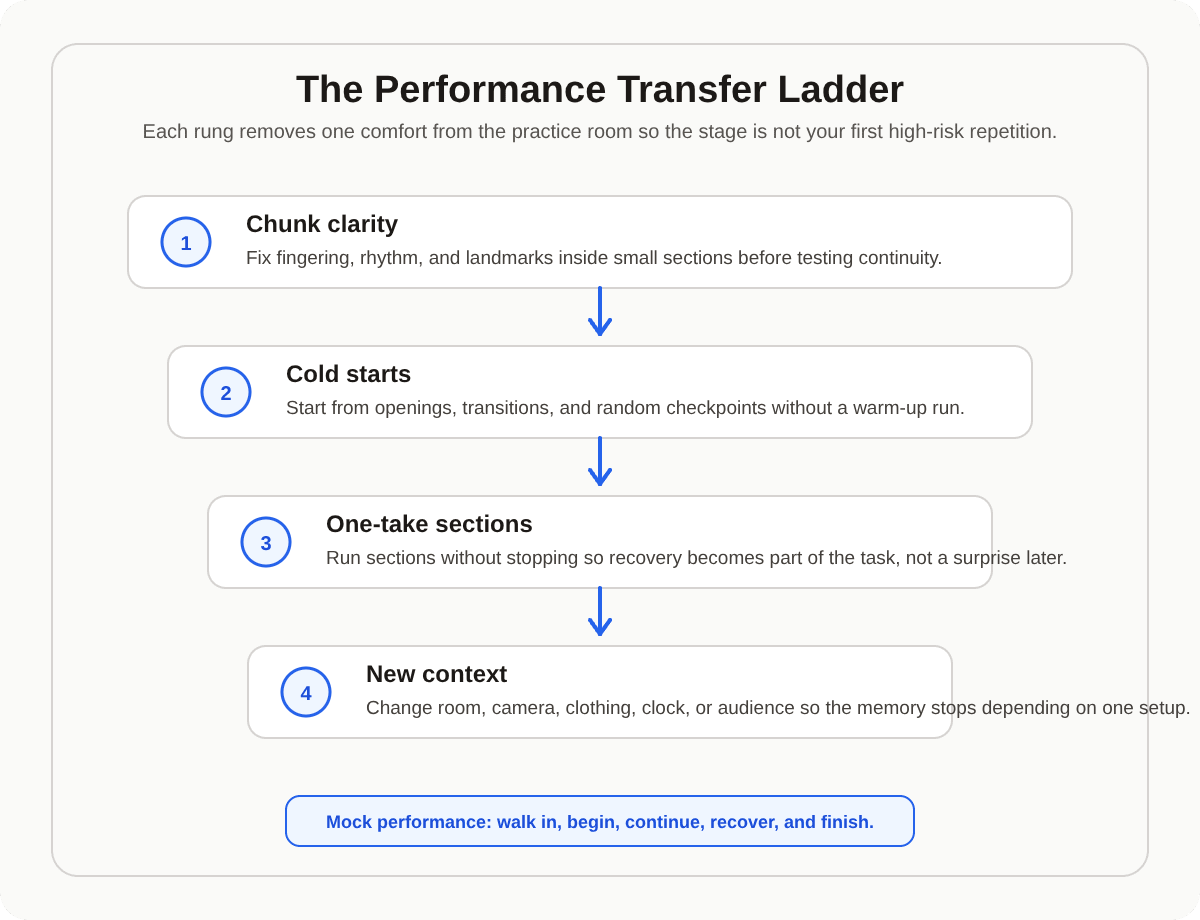
The better approach is to remove comforts one at a time. First make the local material clear enough that it deserves testing. Then make yourself start cold from important places. Then force sections to continue without stopping. Then vary the context: a different room, different clothes, a phone camera running, a friend listening, a fixed start time, or a run at the actual hour of the event. By the time you do a full mock performance, the stage is no longer the first time the piece has faced one-way pressure.
Transfer drill
Cold opening reps
Walk away for three minutes, come back, and play only the first 8 to 16 bars once. No warm-up preview.
Transfer drill
Random-entry starts
Write five structural checkpoints on paper and begin from each one without backing up.
Transfer drill
One-take sections
Run a section with a no-stop rule so recovery becomes part of the repetition instead of a forbidden event.
Transfer drill
Camera or audience rep
Press record or invite one listener. The goal is not perfect comfort. The goal is altered context.
This is where many musicians finally notice that the performance problem is not evenly spread across the whole piece. Usually it clusters around openings, transitions, exposed memory points, and places that were learned by chain rather than by map. If certain passages only work when approached from far earlier in the piece, you do not have a performance problem in general. You have an access problem at specific points. Our post on why difficult passages fall apart at full speed gets at the same principle from the technical side.
A weekly transfer routine that makes stage playing less surprising
You do not need to turn every practice session into a mock recital. Most of your work should still be local, diagnostic, and boring in the useful way. But once the piece is basically learned, you should start giving it a few scheduled transfer reps every week. Otherwise the first serious continuity test happens in public.
Day 1
Landmark session
Choose 5 to 8 structural checkpoints. Start from each one cold and label what cue tells you where you are.
Day 2
Recovery session
Run two sections with a no-stop rule. If something slips, continue and note the exact recovery point afterward.
Day 3
Context-change rep
Change one variable only: camera, room, chair, outfit, time of day, or one listener. Keep the piece the same.
Day 4
Mock performance
Walk in, pause, begin, play through, bow or finish, then write three notes: what held, what rushed, what needs isolation.
That routine is enough to change the shape of preparation. You still isolate hard spots. You still repair technique. But you stop pretending that the piece is performance-ready just because it behaves in familiar private conditions.
The goal is not to eliminate adrenaline. It is to make adrenaline less disruptive because the context is no longer brand new. When a performance goes better, it often looks like confidence. From the inside, it is usually something more concrete: the memory has landmarks, the opening has been tested cold, the body has already handled small doses of evaluation, and the piece is no longer encountering its first real one-way run in front of other people.
If you sound fine in practice and fall apart in performance, assume a transfer problem before you assume a talent problem. That diagnosis is more accurate, and more importantly, it gives you something trainable to do next.