Many pianists dislike practicing with a metronome for a simple reason: they are using it in a way that feels mechanical, frustrating, and musically dead. Then someone tells them to “just use the metronome more,” which usually makes the problem worse.
The metronome is useful, but only if you understand what job it is doing. It is not there to replace your pulse. It is there to reveal where your pulse is unstable, help organize difficult material, and train you to hold time more reliably.
The central idea: good metronome practice should make you less dependent on the click over time, not more dependent on hearing every beat forever.
That distinction shows up in good teaching too. In a Bulletproof Musician interview, Juilliard faculty member Catherine Cho describes using the metronome as a tool, but not as a crutch, and emphasizes practicing both with and without it. She also points out that hearing only tiny equal beats can flatten the sense of larger pulse if you are not careful. Source.

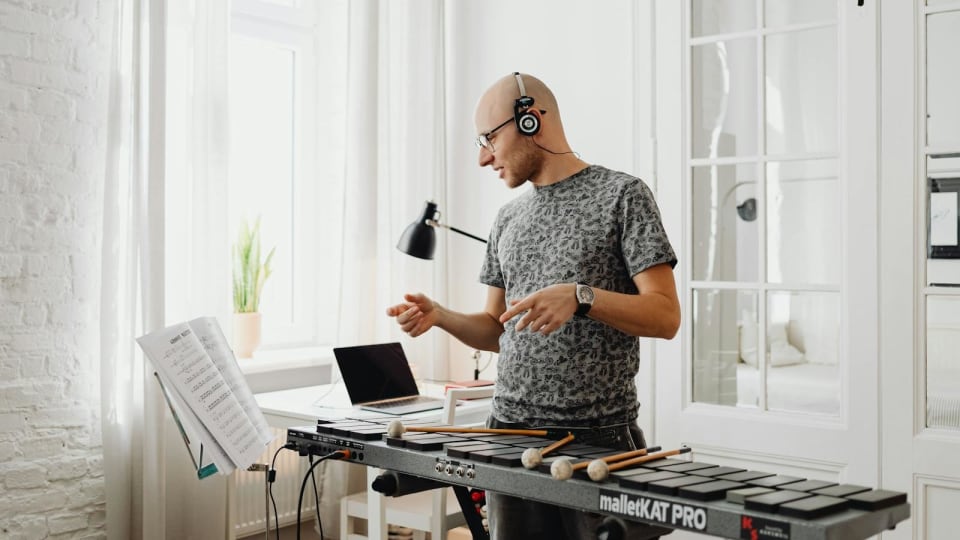
Photo: Thirdman via Pexels
When You Should Use a Metronome
| Use it when... | Why it helps |
|---|---|
| The rhythm is uneven or unstable | It exposes rushing, dragging, and unclear subdivisions |
| You are building tempo gradually | It gives objective tempo targets instead of vague guesses |
| A difficult passage collapses under pressure | It forces cleaner coordination and transition control |
| You need to test internal pulse | Mute, displaced-beat, or drift exercises reveal whether the pulse is really yours |
When You Should Not Use It Constantly
There are also times when the metronome should step back:
- when you are shaping rubato or phrase flexibility
- when you are studying sound, voicing, or pedaling in detail
- when you already know the passage is rhythmically organized and need to reconnect it to musical intention
This does not mean “never use a metronome in expressive music.” It means the metronome is not the right answer to every musical problem.
1. Start by Making the Rhythm Truly Clear
The first useful metronome step is often slower than students expect. If a passage is rhythmically unstable, do not start near performance speed. Start where the rhythm can be placed accurately and calmly.
At this stage, the metronome is mainly helping you answer three questions:
- do I actually know where each note belongs?
- are the subdivisions even?
- does one hand consistently jump ahead of the other?
A common mistake is using the metronome while still playing vaguely. The click does not fix vague rhythm by itself. It only reveals it.
2. Use Small Tempo Increases, Not Heroic Jumps
If the goal is to bring a passage up to speed, work with small tempo steps. For most repertoire, jumps of 2-4 BPM are more useful than jumps of 10 or 12.
| If the passage feels... | What to do |
|---|---|
| Completely secure | Increase by 3-4 BPM |
| Mostly secure but not automatic | Increase by 2 BPM |
| Tense or uneven | Stay at the same tempo or go back slightly |
| Falling apart rhythmically | Drop back and reorganize the passage in smaller units |
Tempo building should feel like controlled extension, not gambling. If each increase creates new errors, the previous speed was not stable enough.
3. Practice with Bigger Beats, Not Only Smaller Beats
One of the easiest ways to start hating the metronome is to let it click every tiny subdivision forever. That can be useful early on, but it can also flatten the sense of pulse and make the playing feel trapped.
A better progression is:
- start with smaller beats if the rhythm is unclear
- move to quarter-note clicks once the subdivision is stable
- then widen the click so it marks larger beats or even the bar
This matters because rhythm is not just a series of equally spaced points. Good playing also depends on how the beats are grouped and directed. Catherine Cho makes this point well: players can become “exactly with the metronome” while still losing pulse and rhythm. Source.
4. Use Displaced-Beat Practice
Once a passage is reasonably organized, one of the best upgrades is to move the click away from the obvious beat.
Examples:
- in 4/4, let the metronome click only beat 2 and 4
- let it click only once per bar
- set it so you feel the click as the off-beat
- keep the same tempo, but imagine the click as a larger pulse than before
This forces you to supply more of the timing yourself. If the passage only works when every beat is spoon-fed by the metronome, the internal pulse is still weak.
5. Test Your Internal Time with Gaps or Drift
At some point, you need the metronome to stop being a permanent guide and start becoming a test.
There are two especially useful ways to do that:
- gap practice: the click disappears for bars at a time, then returns
- drift practice: the click subtly shifts so you have to hold your own pulse instead of following it blindly
This idea is one reason apps like Time Guru became interesting years ago: selective muting shows very quickly whether you rush or drag when the support disappears. Source.
Takt takes this a step further with Drift Mode, where the metronome gradually speeds up and slows down in subtle ways. That is useful because it trains a different skill from ordinary click-following: staying centered when the external cue shifts. Takt also includes a tempo trainer and an accuracy test, which makes it easier to move from simple click-following to more diagnostic rhythm work.
A Simple Metronome Routine for One Difficult Passage
| Stage | What to do | Goal |
|---|---|---|
| 1 | Slow work with clear subdivision | Know exactly where every note belongs |
| 2 | Repeat in short units and fix weak transitions | Stabilize coordination |
| 3 | Increase by 2-4 BPM only when clean | Build tempo without distortion |
| 4 | Widen the beat or click only once per bar | Strengthen larger pulse |
| 5 | Use gaps, off-beat clicks, or drift training | Test internal time |
Common Metronome Mistakes
- using the metronome from the start without first understanding the rhythm
- jumping tempo too quickly
- leaving the click on every small beat for too long
- treating the click as a substitute for counting and listening
- never testing whether the pulse survives when the click becomes sparse or unstable
FAQ
Should I practice piano with a metronome every day?
Not necessarily every minute, but regular metronome work is valuable for rhythm clarity, tempo building, and pulse testing. It should be one tool in the session, not the whole session.
Why do I sound worse with a metronome?
Usually because the metronome is exposing instability that was already there. It can also happen when the click is too fast, too dense, or being used for a problem that is actually musical rather than rhythmic.
What BPM should I increase by when practicing?
For most passages, increases of 2-4 BPM are more reliable than big jumps. If the passage stops feeling controlled, the increase was too aggressive.
What is displaced-beat practice?
It means moving the click away from the obvious beat, such as hearing it only on beat 2 and 4, once per bar, or as an off-beat reference. This forces you to generate more of the pulse internally.
The Bottom Line
If you hate the metronome, the problem is often not the metronome itself. It is the way it is being used.
Use it to organize rhythm, build tempo gradually, widen pulse, and then test whether the pulse is really yours. That is when metronome practice stops feeling oppressive and starts becoming useful.