A metronome should reveal timing problems, not permanently solve them for you. That is the distinction most blanket advice misses. The click is excellent at exposing drift, showing whether the tempo is honest, and stopping the quiet accelerations that musicians barely notice until they listen back. It becomes less helpful when it keeps feeding every beat after the rhythm problem is already clear.
That is where people start calling metronome practice robotic. Usually the metronome did not make the music stiff by itself. The real issue is that it stayed in the room too long. If the click keeps doing work that should have been transferred to the player's pulse, phrasing starts flattening, rubato gets timid, and timing becomes reactive instead of owned.
The better question is not whether to use a metronome. It is what job it is doing right now. In early repair, the click should clarify. In the middle stage, it should challenge. Near the end, it should back off so the time has to stay alive without a constant external prompt.
The metronome should make your time more yours, not less
Good metronome practice is not about obedience. It is about calibration. Bruno Repp's review of sensorimotor synchronization and timing perception is helpful here because it frames timing as an active correction skill, not a passive ability to sit near a beat. Trained musicians tend to synchronize more precisely and adapt better when tempo shifts. That matters in the practice room because strong time is not just matching a click. It is noticing drift early and correcting without panic.
That is also why constant beat-by-beat clicking can become counterproductive. If every moment is externally cued, the player may line notes up accurately while losing the larger shape of the bar. Violinist Catherine Cho makes a version of this point in Noa Kageyama's interview on developing great rhythm: the metronome is a tool, not a crutch, and over-reliance on tiny equal clicks can weaken the broader rhythmic span if the player never graduates beyond them.
This is the first decision rule. The click should not become the source of your rhythm. It should test whether the rhythm was already organized. If the pulse only feels stable when every beat is spoon-fed, the internal layer is still underbuilt. That is one reason many players who "use the metronome all the time" still need the more fundamental repair work in our guide to rhythm being the real bottleneck.
| If the metronome feels bad because... | What is probably happening | Better use |
|---|---|---|
| It makes the phrase feel boxed in | The click is too dense for the current job | Thin the clicks so you supply more of the bar yourself |
| Everything falls apart without it | The internal pulse is not carrying enough weight | Use sparse clicks and return-click tests instead of constant support |
| You still rush certain joins | The click confirms tempo but is not targeting the weak transition | Move the click or isolate the transition window |
| You sound accurate but stiff | The click stayed on after the timing problem was already solved | Turn it off and reconnect timing to breath, articulation, and phrase direction |
Use dense clicks briefly, for diagnosis rather than permanent accompaniment
The most useful dense-click phase is usually the shortest one. If a passage is rhythmically unclear, start with enough information to expose the problem. That may mean quarter-note clicks, eighth-note clicks, spoken subdivision, clapping before playing, or hands-separate work against the beat. At that stage the metronome is acting like a magnifying glass. It is helping you find whether the issue is note placement, coordination, a rushed pickup, or a transition that keeps shortening under pressure.
The Percussive Arts Society article Subdivide and Conquer is useful because it treats subdivision as measurement rather than as a vague classroom slogan. If the distance between beats is unclear, the player is guessing. Dense clicks and explicit subdivision help remove the guessing. They are especially useful for tuplets, pickups, syncopations, and places where one hand seems to reach the next beat too early.
But this is exactly where many musicians get stuck. They solve the first question, which is "where does the note go," and then never move on to the second question, which is "can I keep it there without external feeding?" Dense clicks are good at decoding and aligning. They are not the final stage of musical timing. Left on too long, they start doing work your body should now begin to absorb.
Dense clicks are a diagnosis phase, not the finished state. If the metronome is still carrying every beat after the rhythm is already clear, the click is now overhelping.
Use dense clicks for
Rhythm decoding, subdivision, aligning hands, cleaning tuplets, and proving where a pickup or syncopation actually lands.
Do not stay here if
The notes are now placed correctly, but the line has become tight, square, or dependent on the next click to keep moving.
Move on when
The target window is rhythmically clear enough that the next challenge is ownership, not decoding.
That handoff matters because plenty of passages feel fixed with dense clicks and then collapse later. Usually the metronome did not fail. The player simply stopped at the diagnosis phase. That is one reason a passage can still keep plateauing in the same place even after a lot of disciplined repetition.
Thin the click so the bar starts to belong to you again
Once the rhythm is clear, the click should get sparser. This is where metronome work stops feeling like monitoring and starts feeling like training. Yamaha's guide on developing timing skills with a metronome is strong here because it moves away from permanent quarter-note clicking. Instead it suggests half-note spacing, one click per bar, or silent spans that force the player to carry more of the measure internally.
That changes the demand completely. When the click only lands on two and four, you have to sustain one and three yourself. When it arrives once per bar, you have to feel the whole measure as a shape rather than reacting locally note by note. When it disappears for entire bars and then returns, the metronome stops being a guide rope and becomes a spot-check.
Jerry Kovarsky's Yamaha piece on creative metronome practice makes the same point from another angle. The musical tempo does not need to change for the support to change. You can halve the click rate, displace it, or use bar-level references while keeping the same underlying tempo. That is often the stage where a player stops sounding machine-like, because the bar regains weight and direction.
Click placement ladder
Every beat
Use while the rhythm is still blurry.
Half notes or 2 and 4
Feel larger pulse and stop leaning on constant clicks.
One beat per bar
Carry most of the measure internally.
Gap bars
The returning click checks whether the pulse stayed yours.
Most musicians improve more from climbing this ladder than from staying on rung one forever. The metronome has not been abandoned. It has just been demoted from constant companion to increasingly demanding referee.
Move the click to uncomfortable places when the usual placement stops teaching you anything
One reason metronome work goes stale is that the click always lands somewhere friendly. Downbeats are useful, but they are also forgiving. They do not necessarily expose whether the upbeat is late, whether a syncopation is collapsing inward, or whether the transition after beat three keeps shortening. If the ordinary placement is no longer revealing anything new, move the click.
This is where off-beat work earns its reputation. Put the click on two and four in 4/4. Think of the click as the "and" instead of the downbeat. Use a single click at the start of the bar and force the subdivision to continue underneath it. These setups are uncomfortable for a good reason: they show whether you are actually generating time or merely reacting to the most obvious beat.
| Click setup | What it exposes | Best use case |
|---|---|---|
| 2 and 4 in 4/4 | Weak backbeat awareness and lazy internal counting | Groove, comping, swung styles, or any passage that feels square |
| One click per bar | Whether the measure shape is internally stable | Long lines, repeated patterns, and transitions that rush inside the bar |
| Click on the "and" | Upbeat placement and syncopation honesty | Pickup-heavy figures and phrases glued too hard to the downbeat |
| Gap click | Drift during unsupported bars | Testing whether timing survives after the external cue disappears |

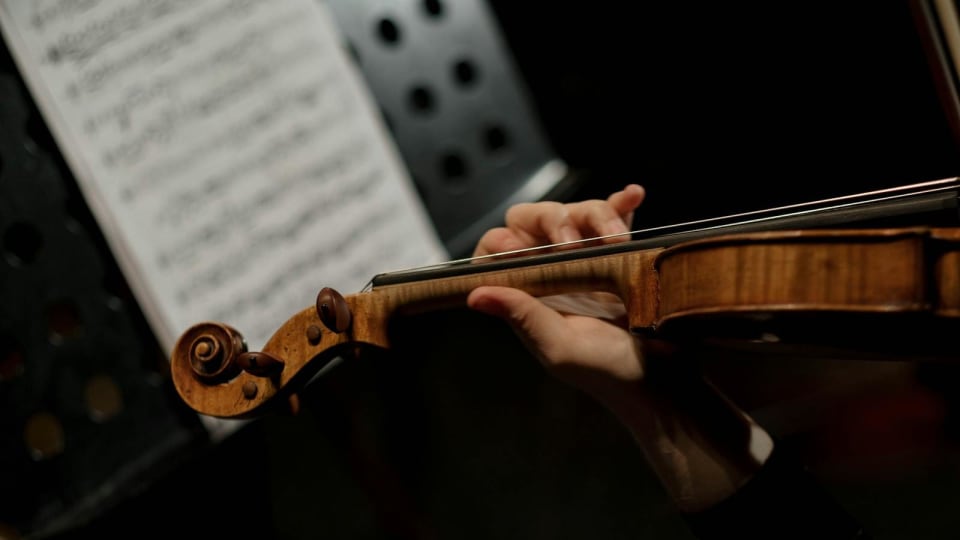
Photo: Leon Jackson via Pexels
The point of these shifted setups is diagnosis. They tell you what kind of instability is actually present. If the bar works on downbeats but collapses when the click moves, the weak point is probably subdivision. If one click per bar works until a join arrives, the real issue may be the join itself rather than tempo. That is the moment to stop asking for more repetitions and ask for a better question, which is the entire shift behind choosing strategy over raw repetition.
Turn the click off before the music forgets how to breathe
Eventually the metronome has to step back. This is not an anti-metronome position. It is the point of the exercise. Once the passage is rhythmically organized, the next job is to reconnect timing to phrase direction, articulation, sound, and breath. If the click stays on past that point, it can start flattening the very musical decisions the practice was supposed to free up.
Research on the transition from synchronization to continuation tapping helps explain why this handoff matters. When the pacing tones disappeared, participants tended to accelerate even when they knew the transition was coming. In other words, staying aligned with an external cue and sustaining the same pulse after the cue vanishes are not the same task. That is why gap bars and return-click checks are so useful. They rehearse the exit, not just the synchronization.
So turn the click off and test the transfer. Record the phrase. Bring the click back for a spot-check. Use a returning click after one or two silent bars. The question is no longer "can I follow it?" but "did I keep the same center after it left?" That is one reason recording is so valuable here: playback makes it easier to hear timing drift without trying to judge and execute at the same time.
Clarify with the click
Use enough metronome detail to make the rhythm undeniable and the weak spot visible.
Thin or move the click
Reduce support or displace the click so the bar starts demanding internal ownership.
Remove it and retest
Let the phrase breathe without the click, then verify later whether the timing stayed centered.
The metronome is most valuable when it leaves at the right moment. Use it to expose dishonesty, to sharpen structure, and to pressure-test the pulse. Then make sure the music can still stand when the click is gone.