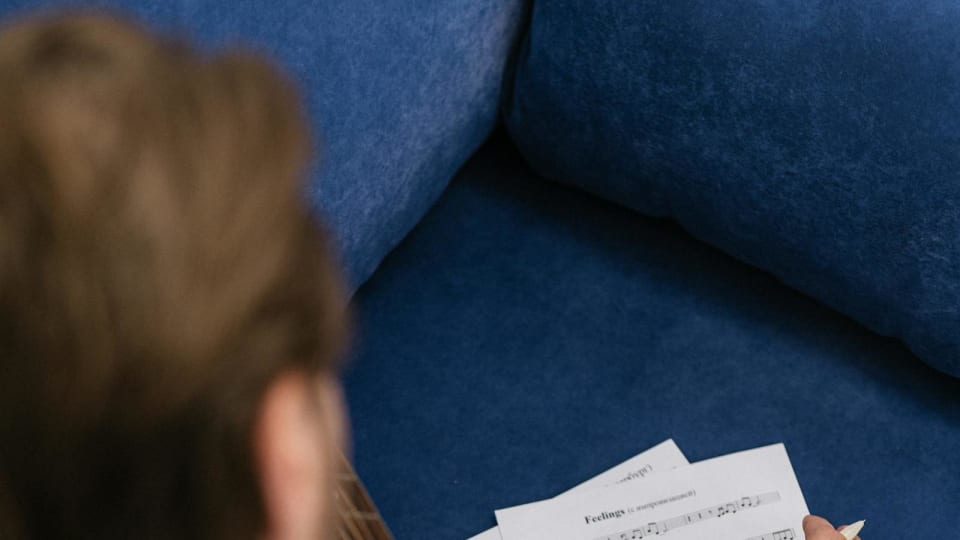
Recording yourself feels brutal mostly because it removes the version of the performance you were hearing from the inside. While you play, attention is split between movement, timing, sound, memory, and whatever emotional weather the session happens to contain. Playback collapses all of that into one blunt outside view, which is useful, but rarely flattering on first contact.
That does not mean the recording is a final verdict. It means it is a different tool. Jason Silveira and Russell Gavin found that instrumental students rated tone, pitch, and rhythm differently after hearing a recording than they did immediately after playing live, which is a good reminder that the feeling in the room and the judgment after playback are not the same event.
The practical goal is not to become emotionally numb to recordings. The goal is to make them usable. If a recording only tells you that you are disappointing, it is being used badly. If it tells you what held together, what did not, and what to test next, it is doing its job.
Why do recordings feel harsher than the live experience?
Part of the shock is acoustical. For singers, Scientific American's explanation of why a recorded voice sounds unfamiliar is straightforward: when speaking or singing, people hear both air-conducted sound and bone-conducted vibration, but a recording strips out the bone-conducted part. The result is thinner, stranger, and often more exposed than the voice heard from inside the body. Instrumentalists do not have the exact same bone-conduction issue, but they do have an under-the-ear version of it: the sound felt at the instrument is not identical to the sound projected into the room.
Part of the shock is attentional. While playing, the brain is busy executing. On playback, it is suddenly free to judge. That switch alone changes what gets noticed. In Noa Kageyama's Bulletproof Musician piece on video feedback, the useful point is not that musicians should obsessively film themselves. It is that trying to perform and diagnose at the same time is cognitively messy, whereas playback lets evaluation happen after the fact, when attention is no longer split between execution and critique.
The harshness also comes from mismatch. Most musicians remember the intention of the take along with the take itself. The recording only gives back the result. If the intention was lyrical, settled, or convincing but the result sounds rushed, flat, or effortful, the gap can feel personal even when it is simply diagnostic. That is why the first job of recording is not to decide how good you are. It is to tell you which gap is currently the loudest.
Useful rule: record to answer a question, not to pass a verdict on yourself.
| First reaction | What it usually means | Better response |
|---|---|---|
| "Everything sounds worse than I thought." | You switched from performing to judging all at once. | Pick one lens for the next listen instead of re-living the whole take emotionally. |
| "My tone sounds thin." | The projected sound is less forgiving than the felt sound. | Compare two phrases only, and listen for consistency rather than beauty first. |
| "The tempo feels wrong." | Playback exposes drift that the body normalized while playing. | Check openings, transitions, and any place you tend to rush into motion. |
| "I hate hearing myself." | The recording triggered self-consciousness before analysis began. | Shorten the excerpt and define a single question before recording again. |
What should you listen for first on a take?
The first listen should answer a big question, not twenty little ones. A helpful starting question is: did the take hold together? In the 2022 Frontiers study Decisions on the Quality of Piano Performance, professional pianists' judgments clustered around elements like overall flow, tone quality, phrasing, pedalling, tempi, and musical expression. That is useful because it suggests that first-pass listening should begin with broad musical stability and continuity, not microscopic self-attack over every note.
If the take does not hold together, start with continuity, pulse, and re-entry. Ignore smaller tone or articulation complaints until the take can survive from one checkpoint to the next. If the take does hold together, choose one narrower lens for the second pass: sound and pitch, timing and transitions, balance and phrasing, or visible mechanics if video is involved. This is also where it helps to know whether you need more repetition or a better strategy. A recording should narrow the diagnosis, not multiply it.
What usually makes recordings unbearable is listening for everything at once. That turns playback into a search for proof that the whole performance is inadequate. A far better method is to tell the first listen what it is allowed to care about. "Did the pulse stay stable?" is a good question. "Was this worthy?" is not.
First-listen filter
Did the take hold together?
No
Listen for the biggest continuity failure first.
Yes
Choose one listening lens for pass two.
The first pass decides the category. The second pass decides the next experiment.
How often should you record in an ordinary week?
Less often than anxious musicians tend to think, and more often than avoidant musicians usually do. Yamaha's practical piece on recording practice and performance makes a useful point that applies well beyond drums: do not record every run-through, record an early attempt, then record again after real work has happened and compare the two. That rhythm keeps recording tied to progress, not surveillance.
For most players, a good baseline is one short diagnostic recording at the start of work on a passage, one comparison take after a specific adjustment, and one larger run later in the week if the material is moving toward performance shape. That is enough to create feedback without making the session revolve around the device. Recording every repetition often makes people self-conscious and oddly passive, as though the phone is practicing instead of them.
The 2024 Frontiers paper on music microanalysis is helpful here because the researchers did not treat recordings as constant background capture. Participants reviewed recordings of their practice and later their concert to judge effectiveness, causes, and outcomes. In other words, the recording mattered because it fed reflection and the next plan. That is the model to copy.
Choose the question first
Record because you want to check pulse, tone, diction, balance, continuity, or movement. Never record just to "see how bad it is."
Keep the excerpt short
Ten to thirty seconds is enough for most technical and musical questions. Whole-piece takes are for continuity, not everyday debugging.
Write one sentence after playback
Name what held, what broke, and what to test next. This is where a light practice log becomes useful instead of bureaucratic.
Change one thing, then retest
Do the real work off mic, then capture one more take to see whether the change actually transferred.
If the problem is mechanical, video is often worth the extra friction. If the problem is mainly musical, audio is usually enough. The simpler setup tends to win because easy capture is what turns recording into a repeatable habit instead of a production ritual.
How do you compare takes without spiraling?
The key is to compare matching attempts, not random moments from your musical life. Compare the same excerpt, at roughly the same tempo neighborhood, with the same listening goal. If take A was a cold read at the start of the session and take B was recorded after fifteen focused minutes on one transition, the comparison is meaningful. If take A was yesterday's exhausted end-of-session run and take B is a memory of how the piece sounded three weeks ago, it is not.
Morijiri and Welch's piano study is helpful again here. Their participants did not judge quality with one giant yes-or-no reaction. They worked through criteria such as tone quality, phrasing, overall flow, tempi, and expression. That is a better comparison model than the instinctive question most musicians ask, which is simply whether the new take feels embarrassing. Break the comparison into one category. Did the opening settle faster? Did the join hold? Did the phrase line remain intact? Those are answerable questions.
This is also where recordings connect directly to not practicing the whole piece by default. Comparing full takes after every small fix usually hides the result of the fix inside too much unrelated material. Compare local to local first. Save whole takes for moments when continuity is the thing being tested.
| Unhelpful comparison habit | What actually works |
|---|---|
| Keeping ten takes and doom-listening to all of them | Keep the baseline and the newest relevant take. Two clear reference points are usually enough. |
| Listening for overall worth | Listen for one target: pulse, re-entry, pitch center, diction, balance, or phrase shape. |
| Re-recording immediately after every slip | Do a block of off-mic work, then retest once. |
| Comparing today's raw take to an idealized memory | Compare to an actual older file with a date, context, and clear question attached. |

If recordings only happen when the piece already feels shaky, they also start to resemble a performance-anxiety trap. In that case, the real issue may be less about playback and more about the same transfer problem behind sounding fine in practice but falling apart in performance. The recording should gradually normalize one-take listening, not turn every review into a mini-audition.
When should you stop recording and go back to playing?
Stop recording the moment playback stops generating a next move. If the take no longer answers a question, the phone is just becoming a witness to indecision. That usually happens when the excerpt is too long, the listening lens is too vague, or fatigue has made the player's standards broader and crueler at the same time.
It is also smart to stop when the recording device starts changing the task itself. Some musicians become so aware of the red light that they stop taking normal musical risks, or they tighten into a fake performance mode that is not representative of ordinary practice. Others end up recording so many takes that the practice turns into collection instead of correction. Both are signs to put the phone down, work normally for a while, and return to capture later.
There is a final emotional reason to stop. If every playback produces the same global self-attack, shrink the frame. Record a bar, not a page. Use audio instead of video. Delay the listen by ten minutes. Write the question before pressing record. The goal is not to toughen up by force. The goal is to make recording specific enough that the nervous system does not treat it like a referendum.
A good recording habit should leave you with three things: one clearer observation, one narrower fix, and one calmer sense of what to do next. If it is not doing that, change the method. Recording is only useful when it becomes feedback. The moment it becomes punishment, the setup needs to change.
These quick rules help keep the tool in the right role:
Audio or video?
Use audio for timing, sound, balance, diction, intonation, and phrasing. Use video when the question is mechanical: posture, bow path, hand motion, breathing habits, or where a movement problem might be causing the sound problem.
Whole piece or short excerpt?
Short excerpts are better for diagnosis. Whole takes are better for continuity, pacing, recovery, and performance transfer. Most ordinary practice benefits more from the short version.
Should every recording be saved?
No. Save the baseline, the meaningful comparison take, and any full run that marks a real change in continuity or confidence. The rest can disappear without any loss.