

A piece can be hard without being too hard. That distinction matters more than most pianists think.
A good stretch piece asks for new skill, sharper attention, and better organization. A bad one floods you with so many unsolved problems that practice turns into damage control. The frustrating part is that both can feel “difficult” on day one, so you need a better test than ego, ambition, or how much you love the piece.
Research note: this article was written on March 16, 2026 from primary and official sources, including Guadagnoli and Lee's challenge-point framework in Journal of Motor Behavior (2004), Drake and Palmer on planning and temporal control in piano performance in Cognition (child and adult pianists ages 9-26, 2000), Andrieux et al. on self-controlled task difficulty in Research Quarterly for Exercise and Sport (2012) and Journal of Motor Behavior (2016), Yaohong Jiang et al. on ability-task matching in piano deliberate practice in Acta Psychologica (90 piano majors, 2026), and G. Henle Publishers' official difficulty guide.
The short answer
A piece is probably too hard for you right now if the hardest passages are so far above your present control that they stop giving useful feedback.
| If the piece is a good stretch... | If the piece is too hard right now... |
|---|---|
| You can identify one or two main technical problems | Every page introduces a different emergency |
| Slow practice makes the passage clearer | Slow practice still feels chaotic and overfull |
| Progress is visible week to week | Weeks pass and the same bars still feel equally impossible |
| The music sounds rough but structurally recognizable | The piece keeps collapsing before the musical shape even appears |
| The challenge is specific | The challenge is total |
That last line is the important one. A piece that is slightly above your level can be excellent. A piece that is above your level in every direction at once usually is not.
What the research says about challenge and fit
Motor-learning research has a clean way to describe this problem. Guadagnoli and Lee's challenge-point framework argues that learning depends on information coming out of performance, and that this information has to be optimized relative to the performer's skill level. If the task is too easy, not much is learned. If the task is too hard, the signal gets noisy.
That logic shows up in piano research too. Drake and Palmer found a strong relationship between temporal control and planning ability as pianists learned a novel piece. That matters because very hard repertoire often does not just produce wrong notes. It overloads planning.
The 2026 Acta Psychologica study by Jiang and colleagues makes the same idea more direct in a piano setting. They assigned 90 piano majors tasks based on ability-task matching and found that better matching improved intrinsic motivation and performance state. That does not mean you should avoid challenge. It means the challenge has to be matched well enough to remain learnable.
There is also a practical lesson in the wider motor-learning literature. Andrieux and colleagues found benefits when performers had some control over task difficulty, especially early in practice. The implication for repertoire is straightforward: better learning usually comes from challenges you can scale, not just admire from a distance.
Henle gets one thing exactly right
Henle's official difficulty guide is useful here for one reason many pianists miss: their grading should be based on the most difficult measures, not the average difficulty of the piece.
That is one of the best practical rules you can borrow. A piece is not “basically manageable” just because most of it looks fine. If three passages require a technique, reach, speed, voicing skill, or control you do not remotely have yet, those bars decide the question.
Henle's own wording is nuanced, which I like. The official guide makes room for the idea that players can grow through pieces that are slightly beyond them. That is the distinction this article is trying to protect. Slightly too difficult can be healthy. Wildly too difficult usually is not.
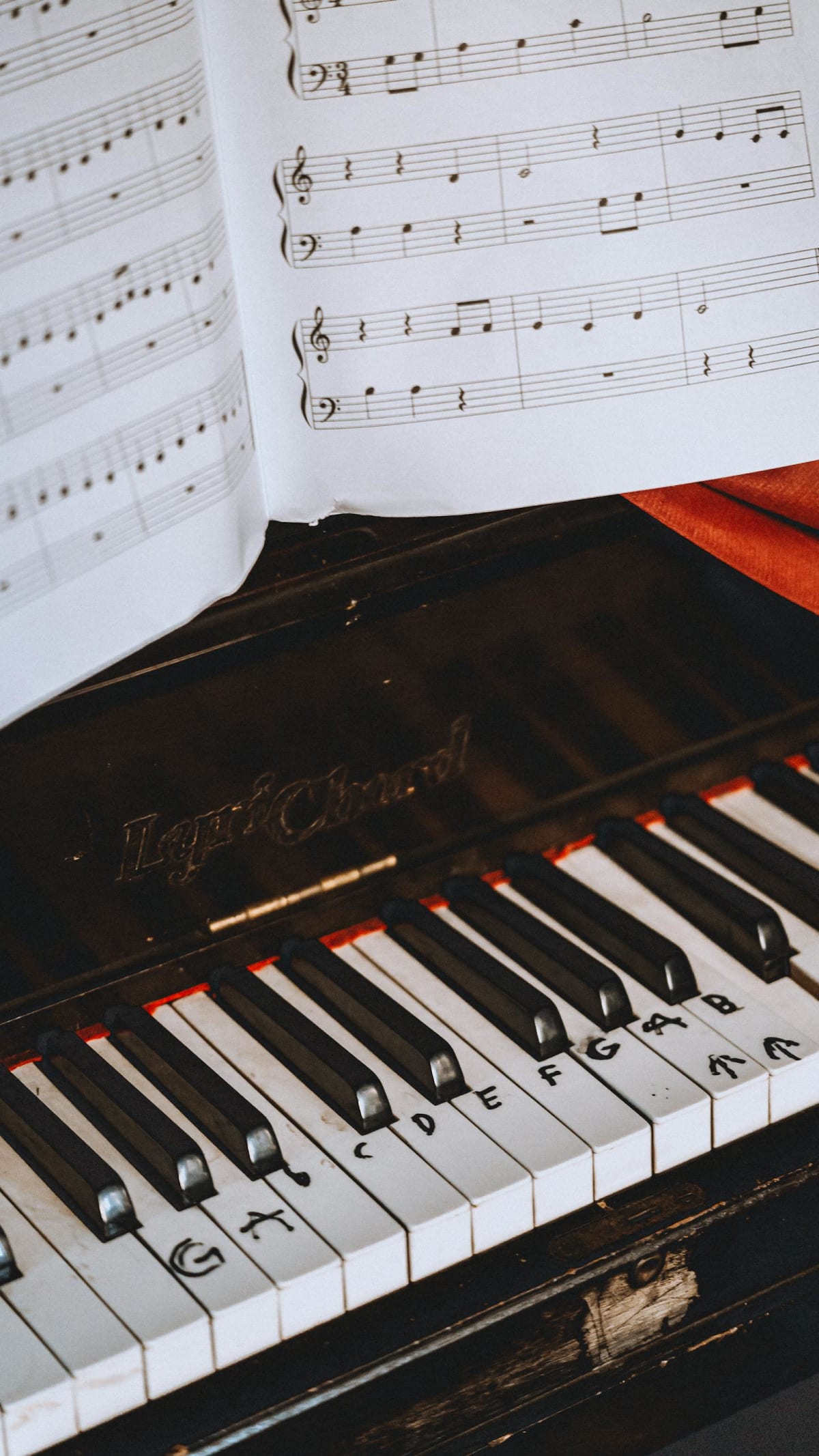
Photo: Rainer Eck via Pexels
Seven signs the piece is too hard right now
1. You cannot reduce it to one main job
If the answer to “what is the real problem here?” keeps changing every five minutes, that is a warning sign. A productive stretch piece might demand better voicing, cleaner left-hand jumps, or more stable trills. A too-hard piece demands all of them, immediately, on every page.
2. Slow practice does not create clarity
Slow practice should simplify the problem. It should reveal where the notes belong, what the fingering needs to do, where the hand has to prepare, and how the phrase is grouped. If slowing down still leaves you with confusion, panic, and constant stop-start playing, the task may be beyond your current processing bandwidth.
3. The hardest bars never get less expensive
Some passages stay hard for a while. That is normal. The question is whether they get more teachable. If the same bars still cost the same amount of attention, tension, and recovery time after two or three focused weeks, the piece may be asking for skills you do not yet own.
4. Your reading collapses before the music starts to exist
If you cannot read through the skeleton of the piece in any workable way, that matters. This does not mean you must sight-read it fluently from day one. It means you need enough reading access to hear the structure and not treat every bar as a separate rescue operation.
This connects directly to why sight-reading material has to be easier than your ego wants. Reading level is not the whole story, but it is one of the fastest red flags.
5. Technique is being replaced by survival
When a piece is too hard, technique often gets replaced by coping strategies: grabbing leaps, locking the wrist, flattening fingers, overpedaling, or memorizing hand shapes without understanding them. You may still get some of the notes out. That is not the same as learning the piece well.
6. You cannot recover from slips inside the piece
A stretch piece still allows partial control. If something goes wrong, you can usually re-enter, find the next landmark, and continue. A too-hard piece tends to have brittle memory and brittle coordination. One slip triggers a chain reaction.
This is one reason I trust restart tests and random-entry tests so much. They reveal whether the piece is becoming organized or just memorized by momentum. That is also why they matter in secure memorization work.
7. The piece is crowding out all your better learning
This is the least glamorous sign, but it may be the most important. If one repertoire choice eats all of your time, kills your confidence, and prevents work on easier music that would build the missing skills, it is probably too expensive right now.
A useful test: if the piece requires you to become a different pianist before you can practice it well, it is probably not your next piece. It may be your future piece.
A better test than “Can I play some of it?”
Plenty of pianists choose repertoire based on whether they can force their way through a few favorite sections. That test is too weak.
Try this instead:
| Question | If the answer is yes... | If the answer is no... |
|---|---|---|
| Can I identify the hardest bars quickly? | The challenge is probably specific enough | The whole piece may be too far above your current map |
| Can I make those bars clearer at a slow tempo? | The piece is likely workable | The underlying skill gap may be too large |
| Can I play simplified versions that still resemble the real task? | The difficulty can be scaled intelligently | You may be skipping too many prerequisite steps |
| Can I hear the musical shape even while it is rough? | You are learning music, not just fighting notes | The piece may still be living above your reading and planning level |
| Is progress visible after 10-14 focused sessions? | Keep going | Reconsider the fit, or use a bridge piece first |
What to do if the answer is yes, it is too hard
Putting a piece aside is not failure. It is often good sequencing.
- Find the bridge skill. Is the real gap octave technique, voicing, fast rotation, left-hand leaps, repeated notes, or reading density?
- Find a bridge piece. Choose something that trains that one gap without carrying all the other burdens.
- Keep a small excerpt if you love it. You do not have to abandon the music entirely. Work on eight bars as a technical project if it helps.
- Track the evidence, not just the mood. A practice log makes it easier to see whether the piece is gradually opening or just draining you. That is one place a tracker like Pract.is can help: it turns “this feels impossible” into visible data about where the time is going.
If you need repertoire ideas after stepping back, the most useful next move is usually not “choose something easy.” It is “choose something that targets the missing skill.” That is exactly the logic behind choosing the next piano piece by level and teaching value.
And if you are trying to estimate whether the project is a reasonable time investment at all, pair this with realistic learning timelines by difficulty.
FAQ
Is it good to learn pieces slightly above your level?
Yes. Slightly above your level is often ideal. The key word is slightly. The piece should stretch one or two capacities, not overwhelm all of them at once.
How long should I try a hard piano piece before deciding it is too hard?
Usually long enough to test focused slow work, simplified versions, and a few restart points over 10-14 serious sessions. If the same hardest bars remain just as opaque, the fit is probably wrong for now.
Does loving the piece make it worth doing anyway?
Sometimes, but love does not erase prerequisites. It can justify keeping a small excerpt alive or returning later with a plan. It does not automatically make the repertoire choice efficient.
Should adults avoid stretch pieces?
No. Adults benefit from stretch pieces too. They just benefit even more from repertoire that is matched well enough to reward analytical practice instead of punishing limited time.
The right piece should make you work harder, not make music disappear. That is the difference.


