
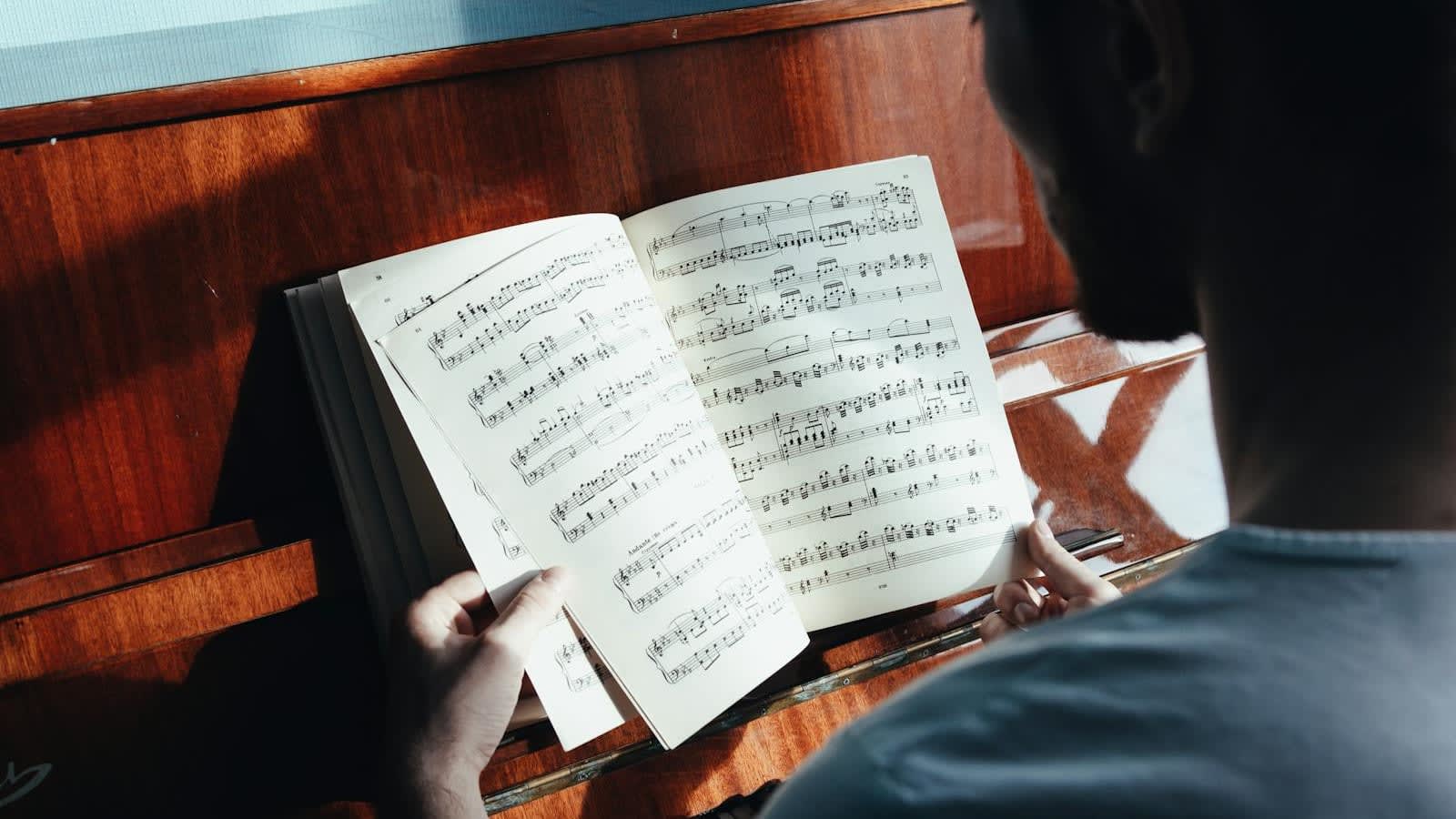
If you are asking “What piano pieces should I learn next?”, the real problem is usually not lack of repertoire. It is lack of appropriate repertoire. Most students either stay too long with music that no longer stretches them, or jump into pieces that are famous but badly mismatched to their level.
A good next piece should do three things at once:
- feel achievable with focused work
- teach one or two clear musical or technical skills
- prepare the ground for what comes after it
How to use this guide: I am using Henle's difficulty framework as a rough orientation. Henle groups piano repertoire into 1-3 easy, 4-6 medium, and 7-9 difficult. This article focuses on the range where most advancing students need the most guidance: beginner through early advanced, roughly Henle 1-6.
Henle's own examples are useful for calibration: Schumann's Album for the Young nos. 1, 2, 3 and 5 sit at level 2, Beethoven's Sonata op. 49 no. 2 sits at level 3, and Mozart's Sonata K. 545 sits at level 5. Their collections of easy piano music also show a practical spread from about levels 1-6. Schumann, Beethoven, Mozart, Volume I, Volume II.
Photo: Raymond Petrik via Pexels
Before You Choose Your Next Piece
| Choose a piece that... | Avoid a piece that... |
|---|---|
| targets one or two new skills | contains five or six new problems at once |
| you can read through in some form | is almost unreadable from the first page |
| fits your current technical coordination | forces tension, fear, and survival practice |
| sounds musically rewarding at your level | is chosen only because it is famous |
If you repeatedly stall, the issue is usually not motivation. It is level mismatch.
Level 1-2: After the First Method Book
This stage is about reading fluency, basic balance, simple phrasing, and getting comfortable with short pieces that actually sound like music.
| Piece | Approx. level | What it teaches | Typical learning time |
|---|---|---|---|
| Mozart: Minuet in F major, K. 2 | Henle 1 | Simple phrase shaping, hand coordination, classical articulation | 3-7 days |
| Mozart: Allegro, K. 3 | Henle 2 | Clear pulse, basic finger independence, quick classical gestures | 4-10 days |
| Schumann: Melodie, op. 68 no. 1 | Henle 2 | Singing tone, phrase direction, balance between hands | 4-10 days |
| Schumann: Soldatenmarsch, op. 68 no. 2 | Henle 2 | March rhythm, articulation contrast, rhythmic steadiness | 5-10 days |
| Schumann: Stückchen, op. 68 no. 5 | Henle 2 | Compact musical form, touch control, short melodic shaping | 4-8 days |
If you are here, do not rush into long sonatas yet. The fastest route forward is usually through many small, well-finished pieces.
Level 2-3: Late Beginner to Early Intermediate
Now the question becomes: can you keep clarity while the texture gets slightly denser? This is where simple counterpoint, sonatina style, and longer phrasing start to matter.
| Piece | Approx. level | What it teaches | Typical learning time |
|---|---|---|---|
| Bach: Little Prelude in C major, BWV 924 | Henle 2 | Pattern clarity, voicing in simple polyphony, finger independence | 1-2 weeks |
| Schumann: Ein Choral, op. 68 no. 4 | Henle 3 | Chord balance, legato control, harmony awareness | 1-2 weeks |
| Beethoven: Sonata in G major, op. 49 no. 2, 1st movement | Henle 3 | Classical phrasing, Alberti-style balance, longer-form continuity | 2-4 weeks |
| Clementi: Sonatina in C major, op. 36 no. 1, 1st movement | Approx. Henle 3 | Classical texture, scale passagework, hand balance | 2-3 weeks |
| Tchaikovsky: selected pieces from Children's Album, op. 39 | Approx. Henle 3 | Character playing, lyrical timing, style contrast | 1-3 weeks |
This is a very important bridge stage. If you skip it, Mozart and Beethoven often feel much harder than their reputation suggests.
Level 4: Clear Intermediate Repertoire
At this level, the pieces begin to sound significantly more “real” in recital terms, but the technical demands are still manageable if your basics are solid.
| Piece | Approx. level | What it teaches | Typical learning time |
|---|---|---|---|
| Chopin: Prelude in E minor, op. 28 no. 4 | Henle 4 | Voicing, harmonic pacing, expressive left-hand control | 1-2 weeks |
| Mendelssohn: Song without Words in E major, op. 30 no. 3 | Henle 4 | Melody projection, accompaniment balance, even flow | 2-4 weeks |
| Liszt: Consolation no. 1 in E major | Henle 4 | Chord voicing, soft sonority, lyrical timing | 2-4 weeks |
| Bach: Two-Part Invention in C major, BWV 772 | Approx. Henle 4 | Independent voices, articulation control, structural hearing | 2-5 weeks |
If you can play this level well, you are no longer in “beginner repertoire.” The focus now should be refinement, not just note learning.
Level 5: Solid Intermediate to Upper Intermediate
This is where pieces start asking more from your sound, structure, and stylistic control. They are often playable before they are convincing.
| Piece | Approx. level | What it teaches | Typical learning time |
|---|---|---|---|
| Mozart: Sonata in C major, K. 545 | Henle 5 | Classical transparency, articulation discipline, clean scale work | 1-2 months |
| Schubert: Moment musical in F minor, op. 94 no. 3 | Henle 5 | Repeated-note control, lightness, phrase continuity | 3-6 weeks |
| Schumann: Träumerei, op. 15 no. 7 | Henle 5 | Voicing, inner hearing, expressive timing without sentimentality | 2-4 weeks |
| Chopin: Waltz in A minor, op. 34 no. 2 | Henle 5 | Rubato control, left-hand waltz balance, ornament fluency | 1-2 months |
| Chopin: Prelude in D-flat major, op. 28 no. 15 | Henle 5 | Long melodic lines, pedaling, endurance in repeated textures | 1-2 months |
This is also where “famous pieces that look manageable” can become deceptive. They often demand much more control than the notes suggest.
Level 6: Early Advanced Entry Points
At this point, repertoire begins asking for real stylistic maturity as well as technique. The right next piece should still be a stretch, but not a breakdown.
| Piece | Approx. level | What it teaches | Typical learning time |
|---|---|---|---|
| Brahms: Waltz in E major, op. 39 no. 2 | Henle 6 | Dense voicing, warm tone, close-position balance | 3-6 weeks |
| Chopin: Nocturne in E-flat major, op. 9 no. 2 | Approx. Henle 6 | Ornaments in tempo, melodic flexibility, accompaniment control | 2-4 months |
| Schubert: Impromptu in E-flat major, op. 90 no. 2 | Approx. Henle 6 | Perpetual-motion evenness, stamina, long-range shaping | 3-6 months |
How to Pick Between Two Good Options
| If you need more... | Choose repertoire that emphasizes... |
|---|---|
| polyphony and independence | Bach or clearer contrapuntal textures |
| classical clarity | Mozart, Beethoven, Clementi |
| lyrical voicing | Schumann, Mendelssohn, Chopin preludes/nocturnes |
| rhythmic discipline and passagework | Beethoven sonatas, inventions, sonatinas |
| pedaling and tonal color | Schubert, Chopin, Liszt consolations |
A Few Repertoire Rules That Save Time
- Do not choose the next piece only by fame.
- Do choose the next piece by what it teaches.
- One well-matched piece often helps more than three overreaching ones.
- If a piece feels impossible to organize after two weeks, it is probably the wrong next step.
If you want to make this practical, track your current repertoire and rotation in Pract.is. That makes it much easier to see whether your pieces are balanced by style, level, and time investment. And if you want realistic expectations, combine this with realistic learning timelines.
FAQ
What piano pieces should I learn after beginner pieces?
A good next step is usually short level-2 or level-3 repertoire: Schumann from Album for the Young, Bach little preludes, or an easy sonatina/sonata movement by Clementi or Beethoven.
How do I know if a piano piece is too hard for me?
If you cannot read through it in any workable way, if every bar introduces a new technical emergency, or if progress stalls completely after the initial note-learning stage, it is probably too hard as a next piece.
Should I learn famous pieces early?
Only if they actually fit your level. Famous pieces are often chosen too early because they are recognizable, not because they are appropriate.
Is Henle difficulty a perfect system?
No. It is a useful orientation, not an absolute law. Reading strength, hand size, stylistic familiarity, and prior training all affect what feels difficult.
The Bottom Line
The best next piano piece is not the most impressive one. It is the one that moves your playing forward without forcing survival mode.
If you choose by level, by skill target, and by realistic learning time, your repertoire starts building in the right direction instead of randomly sideways.


