Short answer: no, it is not too late to learn piano as an adult. But the honest answer is better than the usual internet version. Adults can absolutely become solid, musical, satisfying players. Some adults become very good. What is unrealistic is expecting adult learning to feel exactly like childhood learning or to progress well without a clear plan.
If you are starting at 28, 47, or 68, the question is not “am I too old?” The real questions are:
- what kind of progress do I actually want?
- what is realistically possible with my schedule?
- how should adult practice be structured so it works?
The honest answer in one line: adults usually have less time and more tension, but often bring better focus, clearer goals, and stronger self-direction than younger students.
No, Adult Beginners Are Not “Too Late”
There is no meaningful research basis for the claim that adults are simply “too old” to learn piano. In fact, adult and older-adult piano studies repeatedly show that new keyboard skills can still be acquired well into later life.
For example, a randomized controlled trial found that piano training improved working memory, processing speed, and some psychosocial outcomes in older adults. Source. More recent work also found measurable musical-skill acquisition in older adult novices during a 12-month online training program. Source.
That does not mean every adult beginner will become a concert pianist. It means the basic claim “adults cannot really learn” is false.
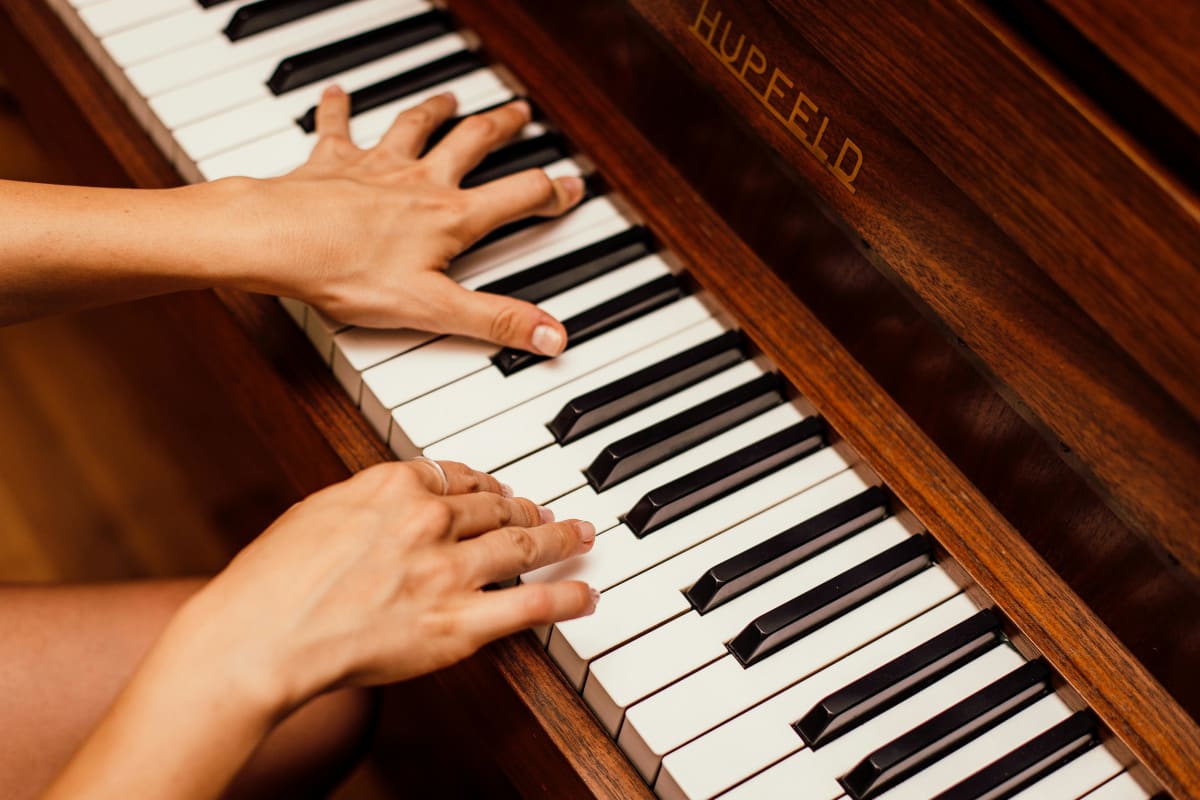
Photo: Juan Pablo Serrano via Pexels
What Is Harder for Adult Piano Learners
Adults are often told that they have “more discipline,” and sometimes that is true. But adults also face real disadvantages that should be stated plainly.
| Common adult challenge | Why it matters | Practical response |
|---|---|---|
| Less practice time | Work, family, and fatigue reduce consistency | Use short daily sessions instead of waiting for a perfect long one |
| More physical tension | Adults often over-control the hands and shoulders | Monitor setup, release, and movement early |
| Impatience | Adults want visible progress fast and may skip fundamentals | Separate “songs I enjoy” from “skills I need” |
| Fear of sounding bad | Self-consciousness can block experimentation | Normalize slow, messy stages as part of learning |
| Unrealistic repertoire choices | Pieces that are far too hard make adults feel falsely untalented | Choose bridge repertoire and level-appropriate material |
The two biggest adult problems are usually time and tension, not age itself.
What Is Often Easier for Adults
This part is under-discussed. Adults do have advantages, and some of them are major.
| Adult advantage | Why it helps |
|---|---|
| Clearer motivation | Adults usually know why they are learning and what they want from it |
| Better analytical thinking | Adults can understand patterns, structure, and practice instructions quickly |
| Stronger self-direction | Adults often respond well to organized, goal-based practice |
| Patience for process, once expectations are realistic | Adults can commit deeply when the method makes sense |
That self-direction matters. A pilot study on adult beginner instrumentalists looked at practice, self-regulation, and self-efficacy, reinforcing the broader point that adult learners benefit from organized, self-regulated practice behaviors. Source.
What Adults Can Realistically Achieve
The internet usually splits into two bad answers:
- “You can do anything, age does not matter at all.”
- “If you did not start at five, forget it.”
Both are useless.
A more honest answer looks like this:
- You can absolutely learn to read music, coordinate both hands, build repertoire, and play beautifully as an adult.
- You can become a solid amateur pianist and get real musical satisfaction from it.
- You can even reach a high level if your practice is excellent and your timeline is long enough.
- What is less realistic is expecting conservatory-level output on a casual schedule.
Adults usually do best when the goal is defined honestly: play well, enjoy the process, and improve steadily, not “catch up to 20 years of childhood training in eighteen months.”
The Best Practice Structure for Busy Adults
Adults often fail not because they lack ability, but because they use a child-student model on an adult schedule. If you only have limited time, the practice needs to be compact and intentional.
A realistic 30-minute adult session:
- 5 minutes: warm-up and setup check
- 10 minutes: one technical pattern or coordination issue
- 10 minutes: one small section of repertoire
- 5 minutes: play through something you can actually enjoy
If you only have 15-20 minutes, that is still enough. Adults make a lot more progress from short consistent sessions than from one giant weekend catch-up block.
If you want a stronger framework, combine this with realistic daily practice times and a structured session plan.
What Adults Should Avoid
- Starting with repertoire chosen purely because it is famous
- Judging yourself against children with years of guided study
- Practicing only by replaying pieces from the top
- Using tension and force as substitutes for coordination
- Waiting for “more time later” instead of building a usable weekly routine now
Most adult frustration comes from comparison and poor planning, not from lack of capacity.
Does Starting Older Still Count as Real Piano Learning?
Yes. This sounds like an odd question, but many adult beginners quietly believe they are doing a lesser version of music study because they started late. That mindset is destructive.
If you are learning rhythm, sound, touch, coordination, style, and repertoire, that is real piano learning. It does not become fake because it started after university, after children, or after retirement.
FAQ
Can I learn piano at 40?
Yes. The more useful question is how you will structure your time and choose repertoire that fits your level. Adults at 40 can make excellent progress.
Can I learn piano at 60 or 70?
Yes. Research on older-adult piano training shows that new piano learning remains possible later in life, and can also support broader well-being and cognition.
Are adults slower than children at learning piano?
Sometimes in raw habit formation or physical ease, yes. But adults often learn concepts faster, understand instructions better, and bring clearer purpose to the process.
The Bottom Line
It is not too late to learn piano as an adult. The honest version is simply this: adults face real constraints, but they also bring real strengths. If your expectations are realistic and your practice is well designed, adult piano study can be deeply rewarding and impressively effective.
You do not need a childhood head start to become a real pianist. You need a good process and enough patience to let it work.