

No, 40 is not too late. But it is too late for a fantasy version of learning that assumes endless free time, frictionless progress, and teenage tolerance for repetition with no clear purpose.
The honest answer is better than the fake-inspirational one. At 40, you can absolutely learn an instrument well enough to make real music, enjoy the process, and keep improving for years. What changes is not the possibility. What changes is the method, the pace, and the standard you should use to judge progress.
What the honest answer depends on
When people ask whether it is "too late" at 40, they are usually asking three different questions at once. Can I still improve? Will I be at a disadvantage compared with children who started early? And will the effort actually be worth it?
The research does not support the idea that adults are locked out of musical development. In a 2025 PLOS ONE study of 68 older adult novices, participants completed a 12-month online program focused on aural and keyboard skills and showed measurable gains in melody detection, replication, and improvisation, with retention over a later follow-up period. That does not mean every 40-year-old beginner will progress at the same rate, or that all instruments feel equally easy. It does mean the door is still open.
A broader review of musical training and the adult brain makes the same basic point from a different angle: adulthood still allows training-related change. So the real question is not whether learning is possible. It is whether your goals, your instrument choice, and your routine line up with the way adults actually learn.
| Question | Short answer | What it really means |
|---|---|---|
| Can you still learn at 40? | Yes | Progress is available, but it depends heavily on structure and regular contact |
| Will you learn exactly like a child? | No | Adults usually bring better analysis and autonomy, but less time and less tolerance for vagueness |
| Can you become "good"? | Yes, if the goal is realistic | Good does not have to mean conservatory-track virtuosity to be musically serious and satisfying |
The mistake is not starting at 40. The mistake is judging year-one adult learning against a fantasy model built for children with lessons, parental structure, and thousands of low-stakes hours.
What adults at 40 often do better than children
This is the part people usually miss. Adults are not just older beginners. They often bring advantages that matter a great deal once the learning environment is set up properly.
Laura Ritchie and Phil Kearney's study of adult beginner instrumentalists is useful here because it frames the issue around self-regulation. Adult beginners were not mainly held back by lack of interest. The deeper issue was whether their practice behavior was structured well enough to support learning. That sounds like a limitation, but it also points to a strength: adults can understand structure, evaluate what they are doing, and adjust it more deliberately than children usually can.
Kaitlyn Leahy and Tawnya Smith's 2021 study on adult music students and self-directed learning supports the same pattern. Adult learners often expect to be more independent and more capable of directing their own study, especially once they have some experience. That does not mean they need no teaching. In fact, the study also found that adults welcomed more direction when the technical demands rose or the style felt unfamiliar. But the baseline difference still matters: many adults learn well when they understand why something matters and how it fits the larger goal.
| Adult strength | Why it helps | What to do with it |
|---|---|---|
| Clearer reasons for learning | Adults often choose music on purpose rather than being placed into it | Use that clarity to pick an instrument and repertoire you actually care about |
| Better self-direction | Adults can usually reflect, plan, and evaluate more consciously | Track what improved, what failed, and what tomorrow's first task should be |
| Higher tolerance for slow foundation work when it makes sense | Adults accept basics more readily if the reason is clear | Ask what each exercise is solving instead of collecting random drills |
| Stronger focus in short sessions | Adults often do well with targeted, efficient work | Build around 15-30 focused minutes instead of waiting for huge practice blocks |
So yes, a child may accumulate more raw years if they begin earlier. But adults often waste less time once they understand the point of the work. That matters. It is also why choosing the right setup matters so much. If you have not chosen an instrument yet, choosing your first instrument as an adult matters far more than people admit.
What usually gets harder at 40
The hard part is not that your brain suddenly stops at 40. The hard part is friction. Adults have jobs, children, partners, fatigue, self-consciousness, old perfectionist habits, and less patience for feeling incompetent in public.
This is where people often want a flattering answer and should not get one. Adult beginners do not usually struggle because they are too old. They struggle because the routine is inconsistent, the repertoire is too ambitious, the instrument setup is annoying, and the practice method is too vague. BJ Fogg's behavior model is useful here because it cuts through the drama: behavior happens when motivation, ability, and a prompt line up. At 40, the biggest missing ingredient is often not desire. It is a reliable prompt and a low-friction setup.
There is also a psychological cost adults feel more sharply. Children expect not to be good yet. Adults often do not. They understand what good music sounds like long before their hands, breath, ears, embouchure, bow, or coordination can deliver it. That gap creates frustration fast. The Leahy and Smith study is useful again here, because even self-directed adults still wanted more teacher guidance when technical difficulty increased. In plain English: adult autonomy is real, but adult beginners still need scaffolding.
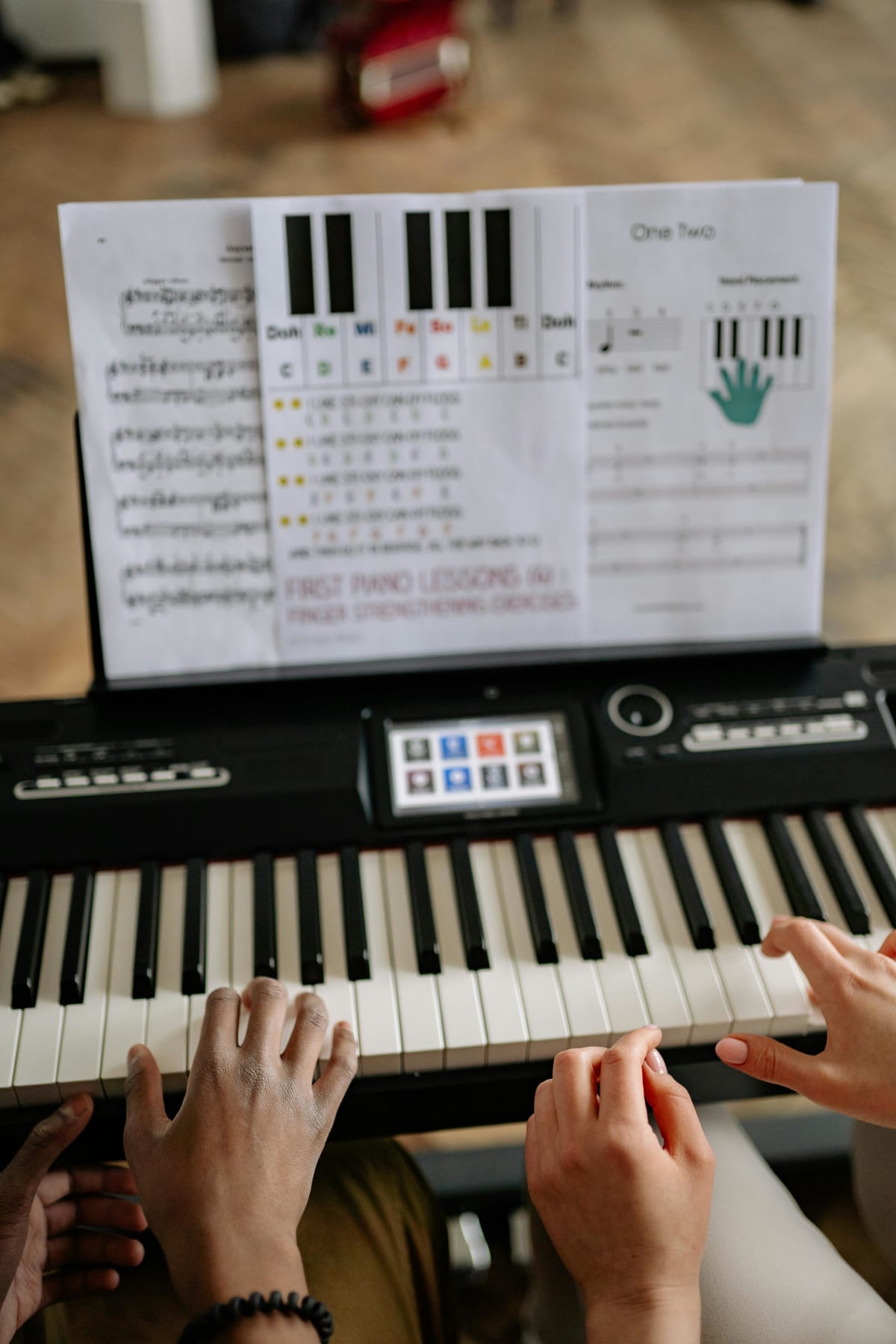
Photo: Yan Krukau via Pexels
| Common adult problem | What it usually looks like | Better response |
|---|---|---|
| Not enough time | Waiting for a perfect 90-minute block that rarely appears | Protect 15-25 minute sessions that can survive ordinary weekdays |
| Low frustration tolerance | Quitting a passage or whole instrument when progress feels slow | Use smaller targets and define wins at the level of one chord, shift, rhythm, or phrase |
| Over-ambitious repertoire | Choosing music that sounds like your taste but is far beyond your current control | Pick music that still sounds musical when simplified |
| Random repetition | Playing what you already know and hoping improvement appears | Diagnose one problem, change one thing, test again |
That is why adults do especially well when the system is explicit. The more clearly you can name the problem, limit the target, and review what changed, the faster the instrument stops feeling mysterious and starts feeling learnable.
What progress can honestly look like
A grounded picture of progress is more useful than an inspiring one. In the 2025 PLOS ONE study, older adult novices made measurable gains over 12 months, but not every musical dimension improved equally. Melody detection, replication, and improvisation showed stronger learning than beat detection and rhythmic precision, which were not the main training focus. That detail matters because it shows something adults often need to hear: progress is uneven. Improvement does not arrive across every category at once.
That is also how adult lessons usually feel in real life. One month you may suddenly tune more reliably, read a bit faster, or change chords more cleanly. Another month the big gain may simply be that you stop avoiding the instrument and start practicing four days a week. Those are all real progress markers. They are just less cinematic than the internet would prefer.
| Rough stage | What progress may actually look like | What it usually does not look like |
|---|---|---|
| First 6-8 weeks | Better setup, tuning, posture, first simple patterns, first recognizable song fragments | Feeling fluent or musically "free" |
| Months 2-4 | Cleaner basic coordination, more reliable rhythm, more stable hand position or tone production | Mastering every foundational skill at once |
| Months 4-8 | A few pieces or songs that genuinely work, stronger reading or ear habits, less panic when things go wrong | Looking advanced to other musicians |
| Months 8-12 | A clearer identity as "someone who plays," not just someone who started | Reaching your long-term ceiling |
If you want a more instrument-specific version of this for piano, starting piano as an adult without wasting the first six months gets more concrete. If your first step is guitar, starting guitar in your 30s follows the same logic from a different angle.
What makes the next year go well
The adults who keep going are usually not the most naturally gifted. They are the ones whose method fits their life. That means a realistic instrument choice, protected session length, repertoire that matches current skill, and a practice approach that does not depend on mood.
A good starting system is not complicated:
- Choose an instrument whose sound you love and whose daily friction you can live with.
- Start with 15-25 minutes, not heroic practice blocks.
- Work on one main target per session.
- Review what improved and what needs a better strategy tomorrow.
- Scale difficulty slowly enough that progress stays visible.
That routine design is exactly why a sustainable practice routine matters more than motivational hype. At 40, consistency beats intensity even more decisively than it does at 14.
The realistic standard: after a few months, you should not ask "Am I impressive yet?" Ask "Is the instrument becoming more familiar, more controllable, and more normal in my week?" That is the metric that predicts whether you will still be playing a year from now.
So no, 40 is not too late. But it is old enough that you should stop expecting music to reward chaos. Give it a believable routine, a believable target, and enough weeks to work, and it can still become a serious part of your life.


