Piano pain is not rare, and treating it like a weird personal failure is one of the reasons it gets worse. Pianists are often surrounded by mixed messages. Serious players are told to work hard, push through, and stay disciplined. At the same time, most formal training still does a poor job of teaching injury prevention directly. The result is predictable: discomfort gets normalized until it stops being small.
The point of this article is not to turn every tired forearm into a medical emergency. It is to correct the opposite mistake. Playing-related problems are common enough that prevention deserves to be built into practice from the start, not added later after pain has already hijacked your work.
The prevalence data is not subtle. In C. Zaza’s systematic review, adult classical-musician prevalence estimates for playing-related musculoskeletal disorders ranged from 39% to 87%. A later systematic review by Kok and colleagues found 12-month prevalence rates among professional musicians ranging from 41% to 93%. Those are wide ranges because definitions and methods vary, but the basic signal is still strong: pain and playing-related musculoskeletal problems are a normal occupational risk in music, not a niche edge case.
The biggest prevention mistake is waiting until pain becomes dramatic
A lot of pianists assume injury prevention starts once something is already going badly. In reality, it starts much earlier, at the stage where the body is giving you small warnings: fatigue that appears too fast, forearm tightness after a certain passage, wrist discomfort that keeps recurring on octave work, fingers that feel clumsy after longer sessions, or soreness that vanishes overnight but returns every time the same workload comes back.
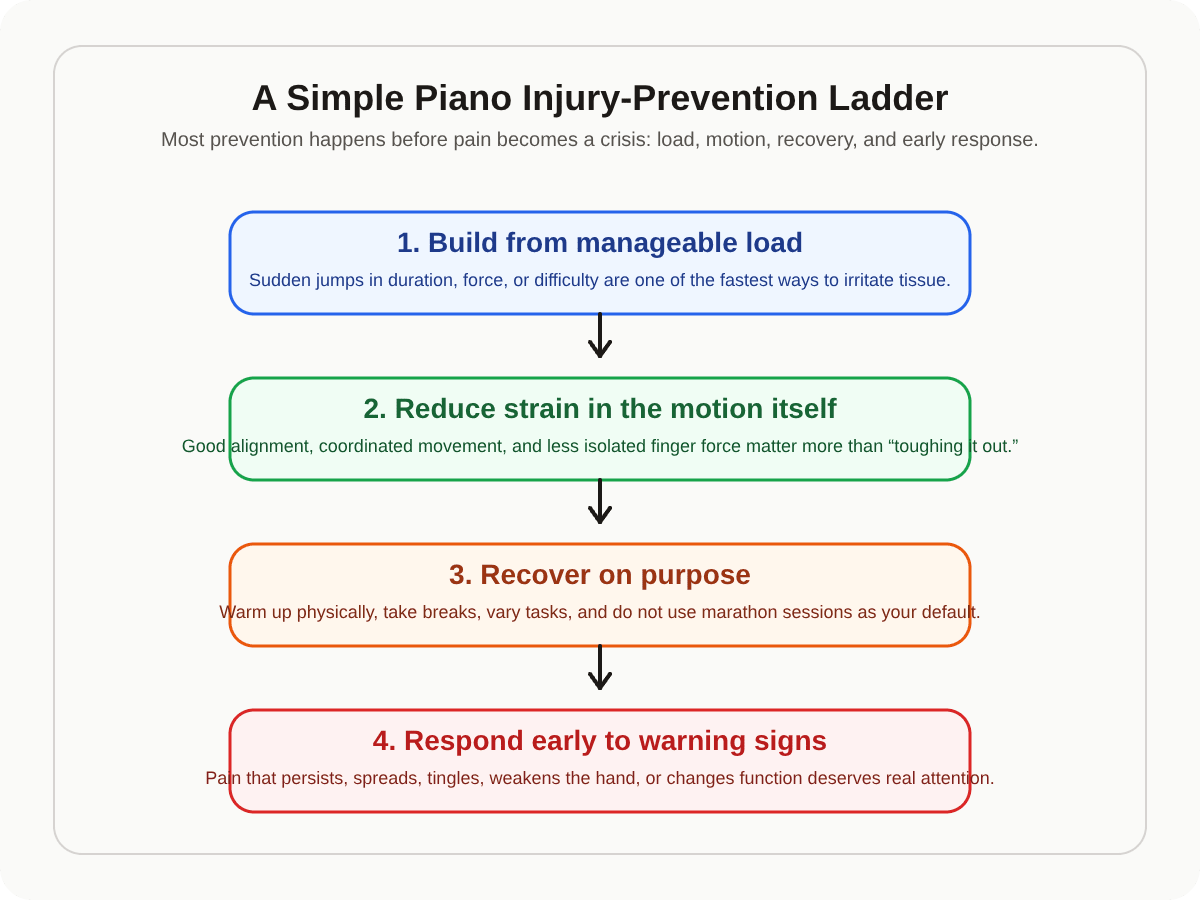
That is why prevention should be thought of as load management plus movement quality plus recovery. Not “stretch more and hope.” Not “relax.” Not “buy a better bench and pray.” A playing-related issue usually develops because the total demand on the body is outpacing what the current technique and recovery habits can tolerate.
This is exactly why the future symptom-focused post about hand pain will need to be different. That article will be about triage after symptoms appear. This one is about building practice and playing habits that reduce the chance of getting there in the first place.
Sudden jumps in load are a major risk factor
One of the clearest ways pianists get into trouble is not exotic technique failure. It is rapid load change. More hours, harder repertoire, denser octave work, heavy chord repetition, or back-to-back rehearsals after a lighter period. The body often handles one of those changes reasonably well. It handles several at once much less gracefully.
Hospital for Special Surgery’s musician-injury guidance makes this point in practical terms: excessive training, highly repetitive movements, and long playing schedules raise risk, and they recommend 10 to 15 minute breaks every hour plus gradual pacing and physical warm-up. That advice may sound basic, but basic is exactly what many pianists skip when a deadline or repertoire list gets aggressive.
This is why “I only practiced more because I had to” is not a reassuring sentence. A big increase in workload is still a big increase in workload even when it is justified by a lesson, juries, an audition, or personal ambition. The body does not care that the deadline was artistically important. If the tissues are getting more repetition, more force, and less recovery than they can currently absorb, symptoms can appear quickly.
| Low-risk load change | Higher-risk load change | Why the second one is trouble |
|---|---|---|
| Add 10 to 15 minutes gradually over days | Double your practice time this week | Tissue tolerance rarely adapts as fast as ambition |
| One new demanding piece at a time | Several hard pieces plus scales plus extra technique blocks | Multiple high-load demands stack on the same structures |
| Alternate heavy and lighter tasks | Long uninterrupted blocks of repeated high-force work | Fatigue climbs while movement quality falls |
This also overlaps with building a sustainable practice routine. Injury prevention is one more reason fantasy schedules usually lose. The session design that survives ordinary weeks is often the same design that protects your hands.
The body often tolerates gradual challenge much better than sudden heroics. Prevention is not about staying easy forever. It is about not spiking the load stupidly.
Good technique is partly an injury-prevention tool
Technique is often taught as if it exists only for accuracy, speed, tone, and artistry. It also matters because inefficient movement is physically expensive. If a passage requires constant isolated finger effort, awkward wrist positioning, locked forearms, or chronic shoulder bracing, the musical problem and the physical problem are often the same problem seen from two angles.
This is where approaches like the Taubman work are relevant, even if you do not treat any one pedagogy as gospel. The Golandsky Institute describes the Taubman Approach as an analysis of coordinated movement intended to help pianists avoid fatigue, pain, and other playing-related injuries. Whether or not a player studies within that exact lineage, the underlying point is important: alignment, coordinated forearm-hand-finger movement, and less isolated finger force can reduce strain. Technique is not only about what sound comes out. It is also about how much physical cost the sound requires.
That does not mean every pain problem is solved by swapping methods overnight. It does mean pianists should take technique-based discomfort seriously. If a certain motion always produces strain, the answer is rarely “just keep practicing it until it strengthens.” Sometimes that works. Often it is exactly how overuse begins.
This is why posts like what good practice looks like across instruments and how to know whether you need more repetition or a better strategy matter here too. When a movement pattern is physically expensive, repetition may be the wrong medicine.
Warm-ups, breaks, and task variation matter more than pianists like to admit
Many pianists warm up by starting to play. Sometimes gently, sometimes not. That is better than beginning with fortissimo octaves cold, but it is still not the same thing as preparing the body to work. HSS recommends a brief physical warm-up before playing to increase blood flow and reduce fatigue, plus those hourly breaks. Their advice is simple because it is usable: move first, stretch lightly, then play.
Just as important is variation inside the session. Long unbroken blocks of one demanding technical demand are usually harder on the body than mixed work. If you have to practice octaves, do not make the entire session octaves. If a fast repeated-note figure is tiring the forearm, change tasks before the quality of motion falls apart. If a technically dense piece is already loading the hands heavily, maybe this is not the day to pile on a separate giant Hanon block afterward.
Breaks also need to be real enough to count. A break where you stay collapsed over the bench staring at the score is better than nothing, but it is not much of a reset. Stand up. Walk. Let the arm and shoulder position change. Let the grip patterns release. Small breaks are not laziness. They are part of how you preserve good movement instead of practicing into compensation.

Photo: Houssam benamara via Pexels
Before playing
Physical warm-up first, then easier playing, then the demanding work.
During practice
Break every hour at minimum, and rotate away from high-strain tasks before form degrades.
After symptoms
Do not immediately “test it again” with the same passage ten more times.
Know the warning signs that should not be normalized
Pianists are good at rationalizing symptoms. “It only hurts after long sessions.” “It goes away by morning.” “It is probably just tension.” Sometimes that is true. Sometimes it is the phase where an avoidable problem is still small enough to catch.
You do not need to panic over every transient ache. But you also do not need to wait for a full breakdown. Cleveland Clinic’s hand and wrist guidance recommends medical evaluation when pain does not improve after a few days, gets worse, limits motion, brings numbness or tingling, or lasts more than two weeks after basic self-care starts. Their orthopaedic advice is similarly clear about more urgent evaluation for severe swelling, redness, high pain, deformity, and functional loss.
| Usually a caution sign | Stronger medical red flag | What to do |
|---|---|---|
| Forearm or hand fatigue that appears unusually fast | Pain that is worsening or persistent over days to weeks | Reduce load, review technique, and do not keep “testing” the same trigger |
| Recurring soreness after the same passages | Numbness, tingling, weakness, swelling, or loss of motion | Stop guessing and seek evaluation from a clinician |
| Tightness that eases with rest but keeps returning | Pain interfering with daily tasks, not just piano | Escalate sooner rather than treating it as a normal musician tax |
If symptoms are persistent or function is changing, the right specialist matters. Ideally that means a clinician with experience in hand, wrist, upper-extremity, or performing-arts issues, not just a generic “rest more” answer from someone unfamiliar with playing demands. The goal is not to get dramatic. The goal is to get specific before the problem gets bigger.
The short prevention plan most pianists can actually follow
Prevention advice is easy to agree with and easy to ignore if it sounds like a second full-time job. So keep it lean. Most pianists do not need a complicated wellness empire. They need a few habits that actually survive real weeks.
1. Build load gradually
Do not let urgent repertoire trick you into doubling your weekly demand overnight.
2. Warm up physically
Move first, then play easier material, then do the heavy technical work.
3. Rotate strain
Do not stack every high-force task in one uninterrupted block.
4. Take breaks that count
Stand up, walk, and change position. Do not sit frozen at the bench calling it recovery.
5. Escalate early
If symptoms persist, spread, tingle, weaken, or limit function, get real help.
Piano injuries are common enough that prevention should be ordinary, not exceptional. You do not need to become fearful. You do need to stop treating pain as proof that you worked hard enough.