
The best Skoove alternative depends on what Skoove failed to do for you. Choose Flowkey for a bigger song-first experience, Piano Marvel for sight-reading and measurable assessment, Pianote for teacher-led explanation, Simply Piano for a gentle family start, and Practis only when you already have music to learn and need a better way to practise it.
That last distinction prevents an expensive sideways move. Skoove is a guided piano course. Some alternatives below are competing courses, while others solve a different problem entirely. A learner bored by the repertoire needs a different answer from one who wants stronger reading, clearer technique help, or less gamification.
Features, platforms, free tiers, and public prices were checked against official product pages on August 9, 2026. Prices are the list prices shown by each company before tax. Currencies, regional offers, and app-store billing can differ.
Start with why Skoove no longer fits
Skoove is not a bad baseline. Its current course advertises more than 1,000 lessons, real-time note recognition, a moving score, backing tracks, monthly content additions, and support from Skoove music instructors. It works in a browser and on iOS and Android, and it can listen through a device microphone or connect to a compatible digital piano. For an adult who wants a sequence rather than a pile of unrelated videos, that is a coherent package.
The current Skoove plans are listed in euros: EUR 29.99 for one month, EUR 19.99 per month on a three-month term, and EUR 12.49 per month on a twelve-month term. The free account contains three lessons with no time limit, and Premium starts with a seven-day trial. The annual rate is reasonable for a structured course. The monthly rate makes a vague experiment expensive.
Before canceling, name the friction in one sentence. "I want more songs" points toward Flowkey. "I cannot tell whether my reading is improving" points toward Piano Marvel. "The app hears notes but does not explain why my wrist hurts" points beyond automated feedback. "I already have a teacher and do not need two curricula" points toward a practice workspace.
Our Skoove review for adult beginners looks more closely at the course itself. The useful question here is different: which replacement removes the exact reason you are leaving?
"Do not replace Skoove with a cheaper copy of the same mismatch."
Flowkey is the better song-first alternative
Flowkey is the closest straightforward replacement when the course format still works but Skoove's repertoire does not hold your attention. It combines step-by-step courses with a large song library, lets a learner isolate either hand, slow a piece down, loop a passage, and follow a scrolling score while the app listens. The experience is built around getting into recognizable music quickly rather than proving progress through formal assessments.
The free Flowkey account includes eight songs plus selected course exercises, with the learning features available inside that sample. Its current US individual plans separate Classic from the full catalog. Classic costs $16.99 monthly or $99.99 yearly and includes courses plus more than 1,000 classical and public-domain songs. The full plan costs $24.99 monthly or $149.99 yearly. Family access is $37.99 monthly or $224.99 yearly. Annual plans begin with a seven-day trial.
Flowkey is better than Skoove when song choice is the main source of momentum. It is not automatically better for a learner who wants reading drills, objective level tests, or close feedback on physical technique. A green check can confirm the right pitch at roughly the right time. It cannot tell whether the phrase is tense, the fingering will fail at tempo, or the pedal is covering a weak connection.
There is also a cost trap: the lowest Flowkey price does not include its full licensed-song library. Before subscribing, search for five pieces you genuinely want to learn and confirm which plan contains them. Our full Flowkey review covers the wait mode, course depth, and where adult learners tend to outgrow the feedback.
Piano Marvel is better for reading and measurable progress
Piano Marvel is the strongest Skoove alternative here for a learner who enjoys a syllabus, wants more reading, or responds well to visible scores. Its Method and Technique tracks contain graded exercises, while songs, performance scoring, progress reports, and the Standard Assessment of Sight Reading make the platform feel closer to a structured practice lab than a streaming course.
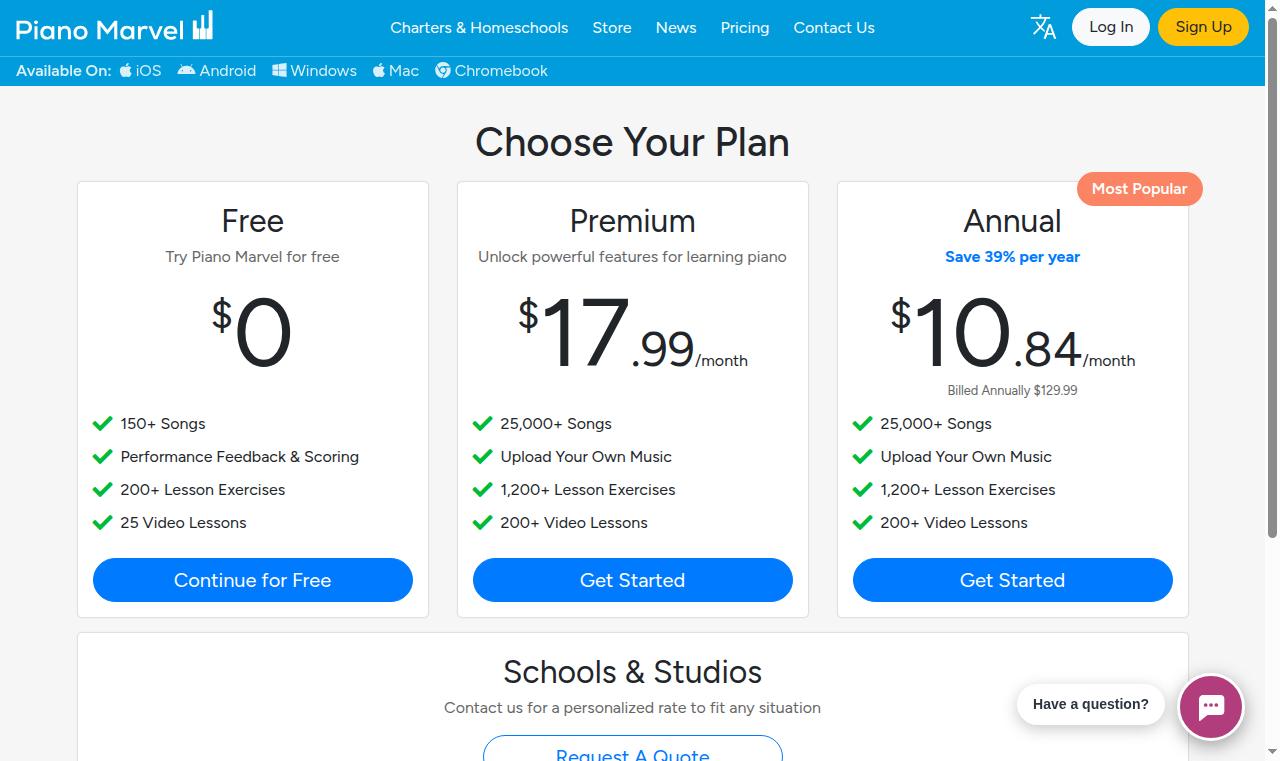
The free account is unusually substantial: more than 150 songs, more than 200 exercises, 25 videos, performance feedback and scoring, and three sight-reading assessments. Premium is $17.99 per month or $129.99 per year. It expands the library to more than 25,000 songs, permits score uploads, includes more than 1,200 exercises and 200 videos, and unlocks unlimited sight-reading assessment.
The Standard Assessment of Sight Reading is the differentiator. It presents short examples across 90 levels and turns reading into something that can be retested instead of guessed. That does not make one number a complete measure of musicianship, but it gives a learner a much clearer answer to "am I reading more fluently?" than a completed lesson count.
Piano Marvel's interface is denser and less lifestyle-polished than Skoove or Flowkey. That is not merely cosmetic. People who want a warm, guided video experience may experience it as homework. People who want exercises, scores, and repeatable tests may experience the same density as substance. Our Piano Marvel versus Flowkey comparison separates those two learning styles in more detail.
Pianote and Simply Piano solve opposite teaching problems
Choose Pianote for explanations that feel human
Pianote is the better move when Skoove feels too dependent on note detection. Its lessons are presented by teachers on video, with more attention to how a movement feels, how a phrase should sound, and why a musical choice works. Members can ask questions, use the community, and follow a progressive Method rather than jumping between random tutorials.
The current Pianote plans start at $25 monthly or $229 annually for the Method-focused membership. The tier that adds a library of more than 950 popular songs is $30 monthly or $279 annually. Both begin with a seven-day trial and advertise a 90-day money-back guarantee. The membership also includes lessons for other instruments, which adds value in a multi-instrument household and very little value to someone who only wants piano.
The tradeoff is that Pianote does not behave like a game that listens to every note. Learners have to judge more of their own playing, record themselves, and bring specific questions to the teachers. That is a disadvantage for someone who needs instant right-or-wrong confirmation. It is an advantage when automated confirmation has become the ceiling.
Choose Simply Piano for an easy shared start
Simply Piano is better for households that want the lowest-friction introduction. It listens to an acoustic piano or keyboard, offers short lessons and songs, gives immediate feedback, and supports multiple learner profiles. Family plans can hold up to five profiles, so progress does not get mixed between a parent and children using the same device.
JoyTunes does not publish one universal price on its help page. Simply Piano pricing varies by country, platform, offer, and individual or family plan, and the current amount is shown inside the app. That is less transparent than the public prices above. It also matters that the app is designed for iOS, Android, tablet, and Chromebook use rather than a Windows desktop workflow. Its Play feedback feature is currently available on iOS, not Android.
Choose it when the household needs an inviting start and separate profiles more than a rigorous long-term reading system. Do not choose it because the interface looks friendlier if the real problem is that app feedback cannot diagnose technique. Our Simply Piano review for adults explains where that friendly beginning helps and where it starts to feel shallow.
"Instant feedback is not the same as useful feedback. The best format is the one that answers the mistake you are actually making."
Practis is better when you no longer need another course
Practis is our product, so the recommendation needs a clear boundary. It is not a Skoove-style piano curriculum. It will not teach a beginner which key is middle C, grade a performance note by note, or replace a teacher. If that is what you need, choose one of the lesson platforms above.
Practis becomes the better alternative when a teacher, method book, score collection, or existing repertoire already supplies the material. At that point, a second course can create more assignments without helping you finish the music in front of you. Practis puts the score, annotations, timer, goals, recordings, practice history, streaks, and progress patterns in one workspace. The question changes from "what lesson is next?" to "what changed in today's practice?"
Stay with a course
You still need lessons to choose and explain the material.
Move to a workspace
You know what to play and need practice to become visible.
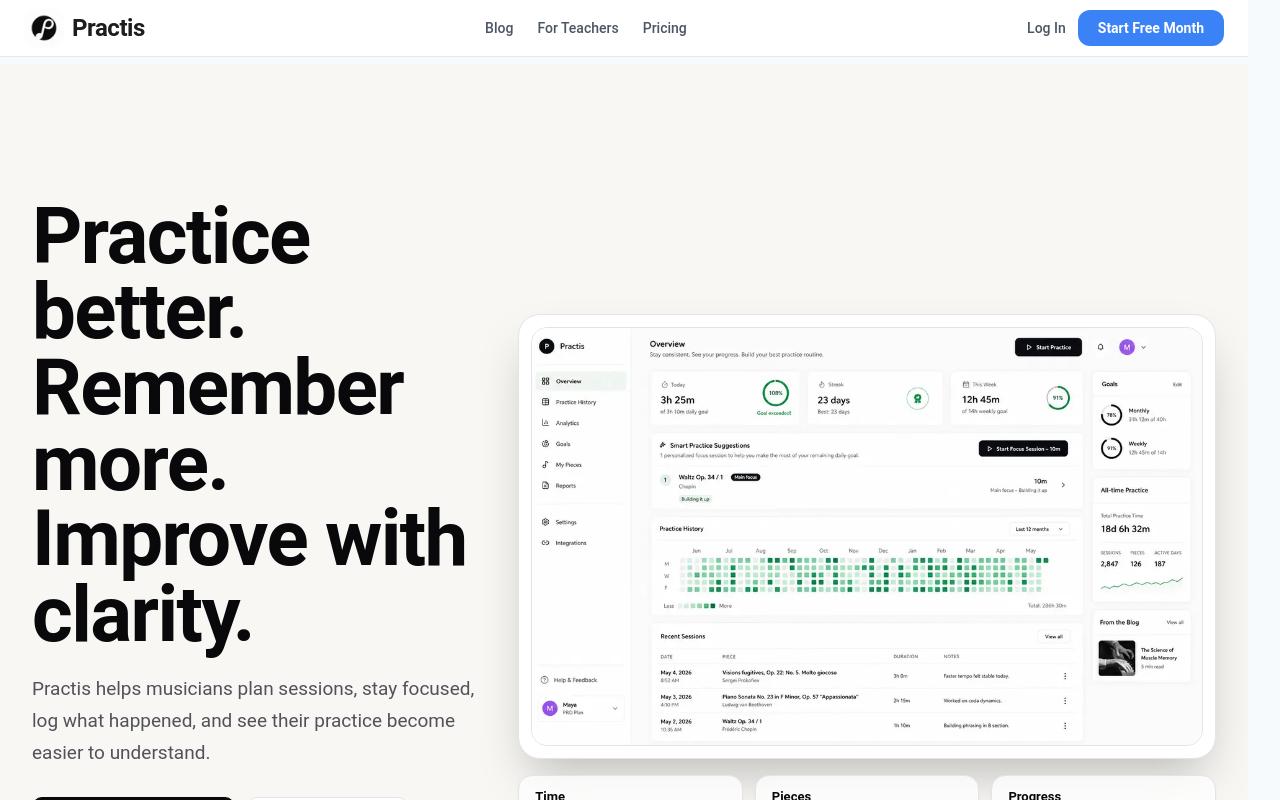
The free plan supports up to five active pieces with practice history, a diary, streaks, and goals. Practis Pro is listed at $39.99 per year, or $4.99 monthly after the first month, and adds unlimited pieces and sessions, recordings, deeper analytics, reports, score sync, and heatmaps. If you are leaving Skoove because you have outgrown app-selected lessons rather than because you need a different course, see how the Practis workspace works.
Compare price, platform, feedback, and the catch
Sticker price alone is a poor comparison because these products sell different things. Piano Marvel's annual rate buys a large exercise and score system. Pianote's higher price pays for teacher-led video and access to humans. Practis costs less because it does not include a piano curriculum or licensed song course. The useful comparison keeps the job and the limitation beside the price.
| Product | Best for | Free access | Public paid price | Platforms | Main catch |
|---|---|---|---|---|---|
| Skoove | One guided beginner path | 3 lessons | EUR 29.99 monthly; EUR 149.88 yearly | Web, iOS, Android | Limited free test; automated feedback ceiling |
| Flowkey | Songs with guided tools | 8 songs plus samples | $99.99 Classic yearly; $149.99 full yearly | Web, iOS, Android | Full song catalog costs more |
| Piano Marvel | Reading, drills, assessment | 150+ songs, 200+ exercises | $17.99 monthly; $129.99 yearly | Web, iOS, Android, Windows, Mac, Chromebook | Denser, exercise-first experience |
| Pianote | Teacher-led explanations | 7-day trial | $229 Method yearly; $279 with songs | Web and mobile apps | Less automatic note-by-note scoring |
| Simply Piano | Family onboarding | Intro access varies | Shown in app; varies by region and plan | iOS, Android, tablet, Chromebook | No Windows desktop; Play feedback is iOS-only |
| Practis | Practising your own repertoire | 5 active pieces | $4.99 monthly; $39.99 yearly | Web, iOS, Android | Not a lesson course |
Skoove publishes euro pricing; the other fixed prices above are US dollar list prices. Do not treat the two currencies as equal. Check the final local amount, renewal term, family access, and app-store conditions before paying.
What should you use instead?
Choose Flowkey if you still want a listening piano app and the main frustration is repertoire. Test the free songs, then verify that the music you want sits inside the plan you intend to buy.
Choose Piano Marvel if reading, exercises, and measurable progression matter more than a glossy interface. Its free tier gives the best no-payment test in this group.
Choose Pianote if you need a teacher to explain movement, tone, rhythm, and musical choices rather than another stream of right-note checks. The higher price only makes sense if you will use the human support.
Choose Simply Piano if several beginners need separate profiles and the goal is to make the first weeks feel easy. Check the exact in-app price and feature availability on the device you own.
Choose Practis if you already have a teacher, method, or repertoire and do not want another course choosing your next piece. It is the practice layer after the curriculum, not a substitute for one.
Use the free version or trial for one normal week, not one enthusiastic evening. Learn a short passage, repeat something difficult, return after a day away, and check whether the product helps you decide what to do next. The best Skoove alternative is not the app with the longest feature list. It is the one that removes the friction that made you search for an alternative in the first place.


