
The first months of guitar in your 30s are not about becoming impressive. They are about becoming repeatable. If the setup hurts, the songs are unrealistic, the rhythm is shaky, and the routine depends on spare weekends that never come, progress stalls fast.
That is why the beginning matters so much. Adults usually do better when they stop trying to recreate a teenage practice life and instead build something tighter: physical comfort, a manageable instrument choice, basic rhythm, workable chord changes, easy songs that still feel like music, and short sessions that survive ordinary weeks.
First priority: make the guitar physically workable
A lot of adult beginners think the first job is learning lots of chords. It is not. The first job is making the instrument physically tolerable enough that you will keep picking it up.
Fender's beginner comparison of acoustic versus electric guitar is useful because it makes the comfort tradeoffs explicit. Acoustic guitars are simpler and self-contained, but they usually have a thicker body and require more pressure at the fretboard. Electric guitars often have a thinner body, thinner neck, and lower action, which makes them easier on many beginners' hands, but they add gear. That tradeoff matters more in your 30s than people admit, because comfort and convenience shape consistency.
Physical comfort also includes the small things that beginners tend to dismiss. Fender's guide on managing finger pain makes a practical point: short daily contact works better than occasional marathons when your fingertips are still adapting. Yamaha's beginner-electric guidance on good hand placement makes the same point from a technique angle: beginners do better when the hands stay relaxed and consistent instead of squeezing and searching. So if your fretting hand feels like it is clamping, your shoulder is rising, or your wrist is collapsing, do not just "push through." Fix the setup first.
| If this is your reality | The smarter early choice | Why |
|---|---|---|
| You want the simplest all-in-one setup | Acoustic guitar | No amp, no cables, easy to pick up and play immediately |
| You are worried about finger pressure and lap comfort | Electric guitar with a small practice amp or headphones | Often physically easier for beginners because of lower action and thinner body profile |
| You live with neighbors or family and late-night practice matters | Electric guitar or acoustic with strict volume expectations | Practice volume shapes consistency more than people think |
If the guitar feels uncomfortable every single day, do not assume the problem is lack of toughness. Sometimes the issue is body size, string type, action height, or simply choosing the wrong type of guitar for your life.
What matters now, and what can wait
Adult beginners drown when everything gets presented at once. Chords, scales, tabs, picks, tonewoods, pedals, amps, string gauges, capos, modes, fingerstyle, bar chords, pentatonics, CAGED, alternate tunings. That is too much.
A better start is to separate urgent skills from later skills. Fender's support material for beginner lessons is tellingly modest: for most early lessons, all you really need is a guitar and a pick. That is a useful correction to the internet's endless gear spiral.
| What matters immediately | What can wait | Why this order works |
|---|---|---|
| Tuning, posture, hand comfort | Pedals, boutique picks, pickup debates | If the instrument is uncomfortable or out of tune, everything else gets distorted |
| Steady pulse and counting | Fancy strumming flourishes and lead fills | Rhythm problems ruin songs faster than lack of flash |
| 4-6 usable open chords | Barre chords in every key | You need enough vocabulary to make songs work, not all vocabulary at once |
| Clean chord changes between a few pairs | Speed for its own sake | Changing well matters more than owning more shapes badly |
| Simple songs and progressions | Dream repertoire that needs techniques you do not yet have | Real songs keep motivation honest and show what still breaks |
That sequence also fits what adult-learning research keeps showing. Laura Ritchie and Phil Kearney's pilot study on adult beginner instrumentalists is useful because it frames progress around self-regulation. Adults do not usually fail because they cannot understand music. They fail because the routine, the task selection, and the week-to-week structure get too fuzzy.
Rhythm and chord changes matter more than most beginners want them to
The fantasy version of guitar usually centers on riffs, solos, fingerstyle patterns, or the big song you have always wanted to play. The real beginning is much less glamorous: staying in time and changing chords without derailing the beat.
Fender's rhythm-guitar guidance keeps this point refreshingly blunt. In its beginner article on learning rhythm guitar, the early priorities are pulse, subdivision, counting, and alternate strumming, not flashy licks. Yamaha's rhythm-guitar practice piece pushes the same idea from a slightly more advanced angle: strong rhythm playing is what makes the rest of the instrument usable.
For beginners, that means two things. First, do not judge progress only by how many chord shapes you know. Judge it by whether you can move between a few important chords while the pulse survives. Fender's short guide to mastering chord changes is useful here because the advice is concrete: think ahead, stay close to the fretboard, keep the hand moving, and use pivot fingers when shapes share notes. Second, do not choose songs that collapse if one change is late every bar. Fender's beginner chord-progression guide points toward exactly the kind of material that makes early learning productive: common progressions, repeated shapes, and real musical payoff.

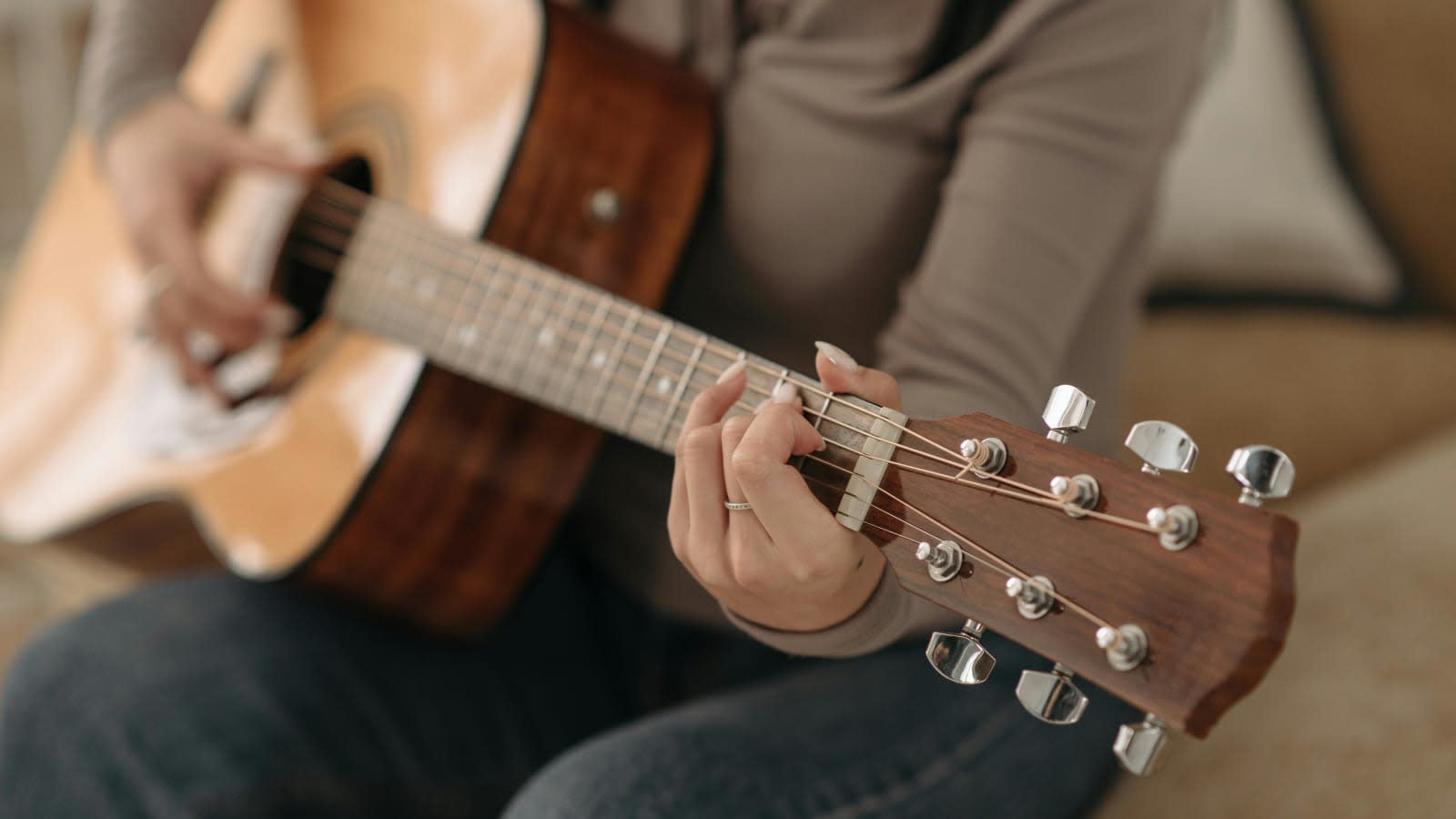
Photo: Caique Araujo via Pexels
Early guitar is mostly a rhythm instrument problem. If the pulse collapses every time the left hand moves, the real practice target is not "learn more songs." It is "keep time while changing less badly."
Choose realistic songs, not identity songs
A lot of adults quietly choose repertoire to prove something to themselves. They pick the song that matches the identity they want, not the skill level they currently have. That usually backfires.
At the beginning, realistic repertoire means songs with a few repeating chords, one main groove, and a tempo that allows the right hand to keep moving. It does not mean childish material. It means material that teaches timing, switching, and musical continuity without overloading the hands. A useful rule is that the song should still sound recognizable if you simplify it.
If a song only works once you can play every embellishment, every suspended chord, every hammer-on, and every fast transition, it is probably not beginner repertoire yet. This is the same logic behind knowing when a piece is too hard right now. The instrument is different, but the trap is the same.
So choose songs that reward partial success. Songs where two or three chords already sound like music. Songs where a slower version still teaches the groove. Songs where the first win is "I kept going" rather than "I perfectly copied the recording."
Build the routine around adult life, not fantasy life
Most adults in their 30s do not have teenager-level free time, and pretending otherwise is one of the easiest ways to quit. The routine has to fit the life you actually have.
Fender's acoustic-versus-electric guide suggests that 15 minutes a day or 30 minutes every other day is a realistic pattern for improvement, and its finger-pain guidance recommends even shorter daily contact at first. That lines up well with the broader self-regulation research: frequent, manageable contact is usually better than huge irregular sessions.
A good adult-beginner guitar session can be very simple:
- 2 minutes: tune, sit properly, loosen shoulders and fretting hand.
- 5 minutes: one chord pair only, moving back and forth slowly enough to stay clean.
- 5 minutes: one strumming pattern with counting or metronome support.
- 5 minutes: one easy song section or progression at an honest tempo.
- 2 minutes: note what still breaks so tomorrow starts cleanly.
That structure is not glamorous, but it works. It also fits naturally with practicing efficiently when you only have 20 minutes, building a sustainable routine, and reviewing a session so tomorrow goes better. The instrument changes, but the adult-life problem does not.
If you use Pract.is, this is exactly the kind of beginning it can support well: log the chord pair, the tempo, the song fragment, and the one thing that still breaks. That gives you evidence of progress instead of vague guilt.
The beginning of guitar in your 30s is not about sounding advanced fast. It is about making the instrument comfortable enough, simple enough, and musical enough that you still want to pick it up next week.


