

A tired practice session does not have to be worthless, but it cannot do every job. That is the distinction that saves a lot of adult musicians from the false choice between ideal work and no work at all. If focus is low, the answer is usually not to force a full deep-work session anyway. The answer is to give the session a different assignment.
Low-energy practice is not fake practice. It can still review, stabilize, map, listen, and hand useful information to tomorrow. What it usually cannot do well is diagnose brand-new technical problems that demand sharp attention, fast feedback loops, and a lot of error detection. Once that difference is clear, tired days stop feeling like moral failures and start becoming manageable.
That matters especially for adults balancing work, family, and irregular energy. The same logic behind learning an instrument with a full-time job applies here too: the real goal is not a fantasy version of perfect consistency. It is a practice system that still functions on ordinary days, not just ideal ones.
Deep work is only one kind of practice, and tired days are usually better for something else
Good deep practice depends on high-quality attention. You are listening critically, changing variables, noticing whether a repetition helped, and deciding what to do next. That is cognitively expensive work. If your attention is muddy, the session often starts looking productive while actually becoming repetitive, sloppy, or oddly stubborn. You play, but you do not really adapt.
That distinction shows up clearly in practice research. Guadalupe López-Íñiguez and Gary McPherson’s music microanalysis framework treats practice as a cycle of planning, monitoring, and evaluation. When energy is low, those monitoring and evaluation phases often degrade first. In practical terms, that means a tired session is a weak place to attempt delicate technical diagnosis, but still a useful place for structured review or planning.
The same caution appears outside music research too. Noa Kageyama’s summary of classic motor-learning work in Practicing When Fatigued points toward something musicians usually feel intuitively anyway: heavy-duty learning work tends to go better in relatively rested conditions than in clearly fatigued ones. That does not mean “never touch the instrument when tired.” It means tired sessions need a different target.
Low-energy decision map
Are you tired, or are you unfocused because the task is vague?
Some focus left
Do one narrow deep-work task for 8 to 10 minutes, then stop before it turns fuzzy.
Mentally flat
Switch to review, score study, memorization checks, listening, or planning.
Physically cooked
Do not push technique. Recover, make one note for tomorrow, and stop.
A useful tired-day question is not “Should I practice or not?” It is “Which kind of work still has a good chance of transferring tonight?” That change in wording is small and surprisingly clarifying.
Low-energy practice still has real jobs it can do well
Some tasks travel well into a low-energy session because they do not depend on constant high-speed correction. Review is one of them. So is slow mapping of form, fingering confirmation, score study, listening for structure, and memory retrieval from landmarks rather than from the top. These are not consolation prizes. They protect continuity when the mind is too dull for sharper problem-solving.
There is also direct support for mental and reduced-load practice as a complement to physical playing. Martin Lotze’s review, Kinesthetic Imagery of Musical Performance, argues that mental rehearsal can support technically difficult passages and reinforce musical representation away from the instrument. Kristian Steenstrup and colleagues found in Imagine, Sing, Play that combined mental, vocal, and physical practice improved performance more than physical practice alone in their design. That does not mean imagery replaces playing. It means low-energy sessions can still do meaningful work when they lean on imagery, singing, score study, or simplified technical contact rather than full-force execution.
That is also why a short tired-day session can still be a productive companion to short efficient practice. Limited energy and limited time are not identical problems, but they reward the same habit: be precise about the job of the session instead of asking it to solve everything.
The menu below is the kind of work most musicians can still get value from when the brain is not at full strength.
Review
Open one known piece and check the opening, one transition, and the ending. The point is retrieval, not improvement theater.
Score mapping
Mark landmarks, fingerings, breaths, bowings, or phrase shapes. Low energy is often enough for map-making.
Mental practice
Hear the passage internally, sing it, mime fingerings, or run cue points without asking the body for maximum precision.
Planning
Leave one clear note for tomorrow: what to start with, what tempo held, what still breaks, and what to ignore.
Use tired sessions for maintenance and retrieval, not for solving new hard problems
The simplest way to rescue a tired session is to narrow the ambition. New technical construction usually asks for high concentration, a lot of immediate comparison between attempts, and the patience to stop the moment the task gets blurry. If that attention is not available, the session often becomes a string of half-corrections. Maintenance work survives low energy better because its job is not to build from scratch. Its job is to keep what already exists findable.
Hospital for Special Surgery makes this distinction indirectly in its musician-health guidance. In Six Ways to Minimize Pain and Injury If You Play an Instrument, HSS explicitly recommends supplementing physical practice with mental practice and shadow practice to preserve endurance. That is a strong clue about session design. When the body or mind is taxed, lower-load forms of contact are not just safer; they are often smarter.
The table below is a good tired-day filter. It is not about virtue. It is about which jobs still give a decent return when attention is reduced.
| If energy is low | Usually worth doing | Usually better to postpone |
|---|---|---|
| Mentally tired but not physically sore | Score study, listening, memory checks, one-piece review, planning tomorrow | Learning dense new material, fragile tempo work, detailed error diagnosis |
| Physically tired after a heavy day | Mental rehearsal, singing, silent fingering, light mapping, short review away from the instrument | Intense repetition, forceful technique work, long run-throughs |
| Both mentally and physically flat | Two-minute handoff note, maybe brief listening, then stop | Any session you have to push through by willpower alone |
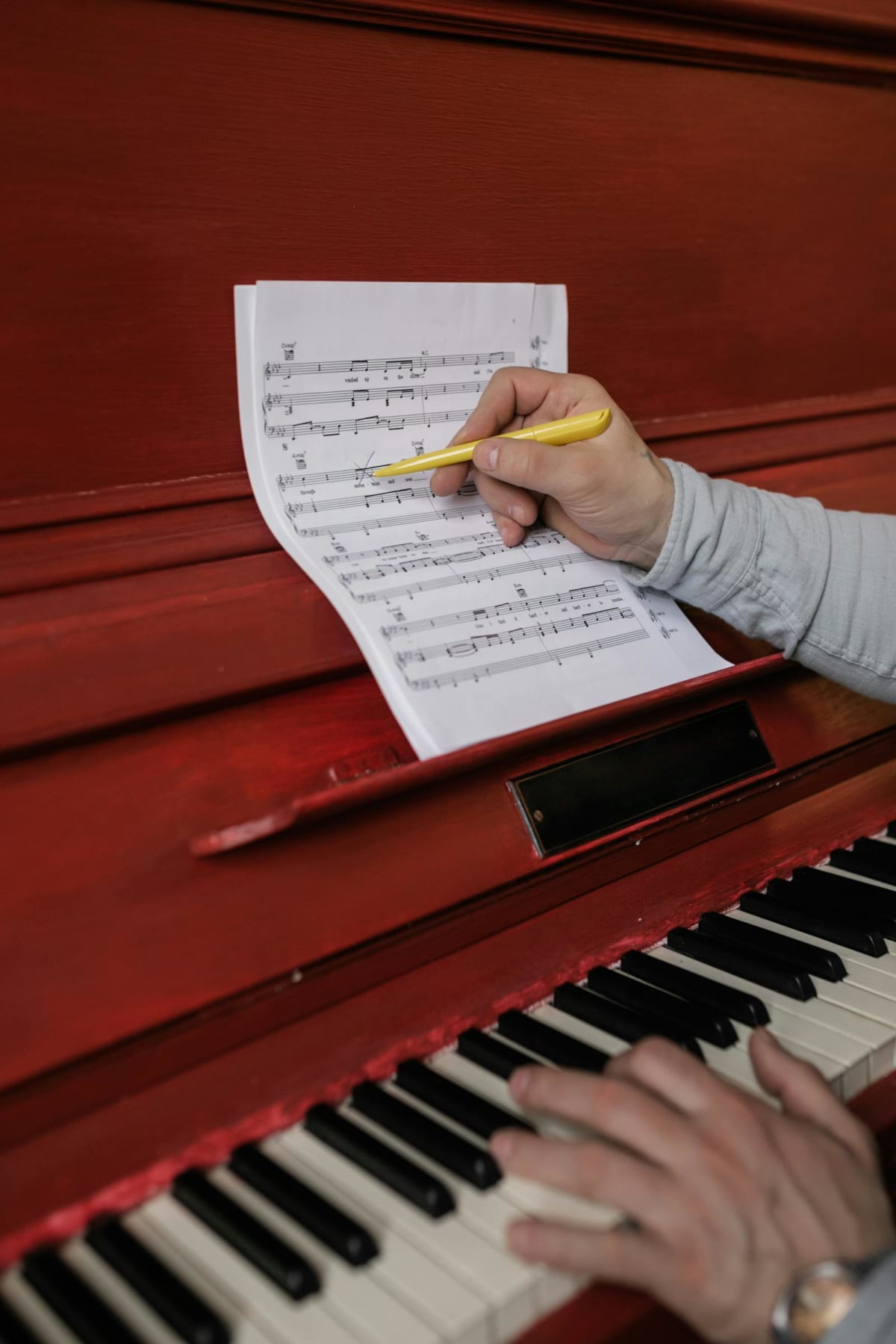
Photo: Alena Darmel via Pexels
This is one reason a tired-day session still pairs naturally with a short practice log. The session may not be the place for major breakthroughs, but it can still leave tomorrow much cleaner than today started.
There is a point where stopping is the most productive choice
Not every tired session deserves rescue. Sometimes the real win is refusing to turn exhaustion into fake discipline. If attention is so poor that you cannot hold the task in mind, if the body starts compensating sloppily, or if irritation is rising faster than useful feedback, the session has probably crossed from low-value into counterproductive. At that point, persistence becomes expensive.
There is some support for taking that boundary seriously. J. Matt McCrary and colleagues’ pilot fatigue-monitoring study in musicians treats sleep, recovery, overplaying, pain, and fit-to-play feelings as meaningful variables rather than background noise. Sleep research on motor sequence learning also points the same way. In The Role of Sleep in Motor Sequence Consolidation, sleep stabilized recently learned motor performance rather than magically replacing practice. That is useful because it reframes the tired-night decision. Sometimes the productive move is not one more sloppy block. It is protecting what was already learned and coming back sharper.
You are repeating the same mistake without noticing it until several reps later.
Technique is changing in ways you would not normally accept just to get through the passage.
You are bargaining with yourself to keep going rather than getting useful information from the task.
Physical discomfort, tension, or clumsy compensations are rising as the session goes on.
On those days, stopping is not laziness. It is load management. That same realism is what makes a sustainable practice routine better than a heroic one in the long run.
A fallback session works best when you decide it before the bad day arrives
The biggest tired-day mistake is improvising the rules in the moment. When people are depleted, they either expect too much from the session or give up without extracting anything useful. A fallback session solves that by pre-deciding what counts as a win on a low-energy day. It should be short, specific, and modest enough that it does not depend on optimism.
A workable fallback session might be fifteen minutes. Two minutes to choose one piece or one section. Five minutes to review or retrieve. Four minutes to do score study, mental rehearsal, or slow map-building. Two minutes to note tomorrow’s opening task. One or two minutes to stop cleanly instead of drifting into more tired repetitions. That kind of session keeps the thread alive without pretending it can replace your best work.
Choose one lane
Review, map, listen, memorize, or plan. Do not ask one tired session to do all five.
Keep the task known
Use familiar material or familiar methods. A tired session is a poor place for adventurous new problem-solving.
Leave a handoff note
Write the first task for tomorrow while you still remember what the session revealed.
Stop before drift
A tired fallback session succeeds by ending on purpose, not by slowly morphing into a bad full session.
The point is not to glorify exhaustion. It is to build a system where bad days still contribute something and truly depleted days still end intelligently. If you already know what the fallback looks like, consistency becomes less dramatic and much more durable.
Bottom line
A tired practice session is most useful when it shifts from solving hard new problems to protecting continuity, gathering information, and setting up tomorrow’s better work.


