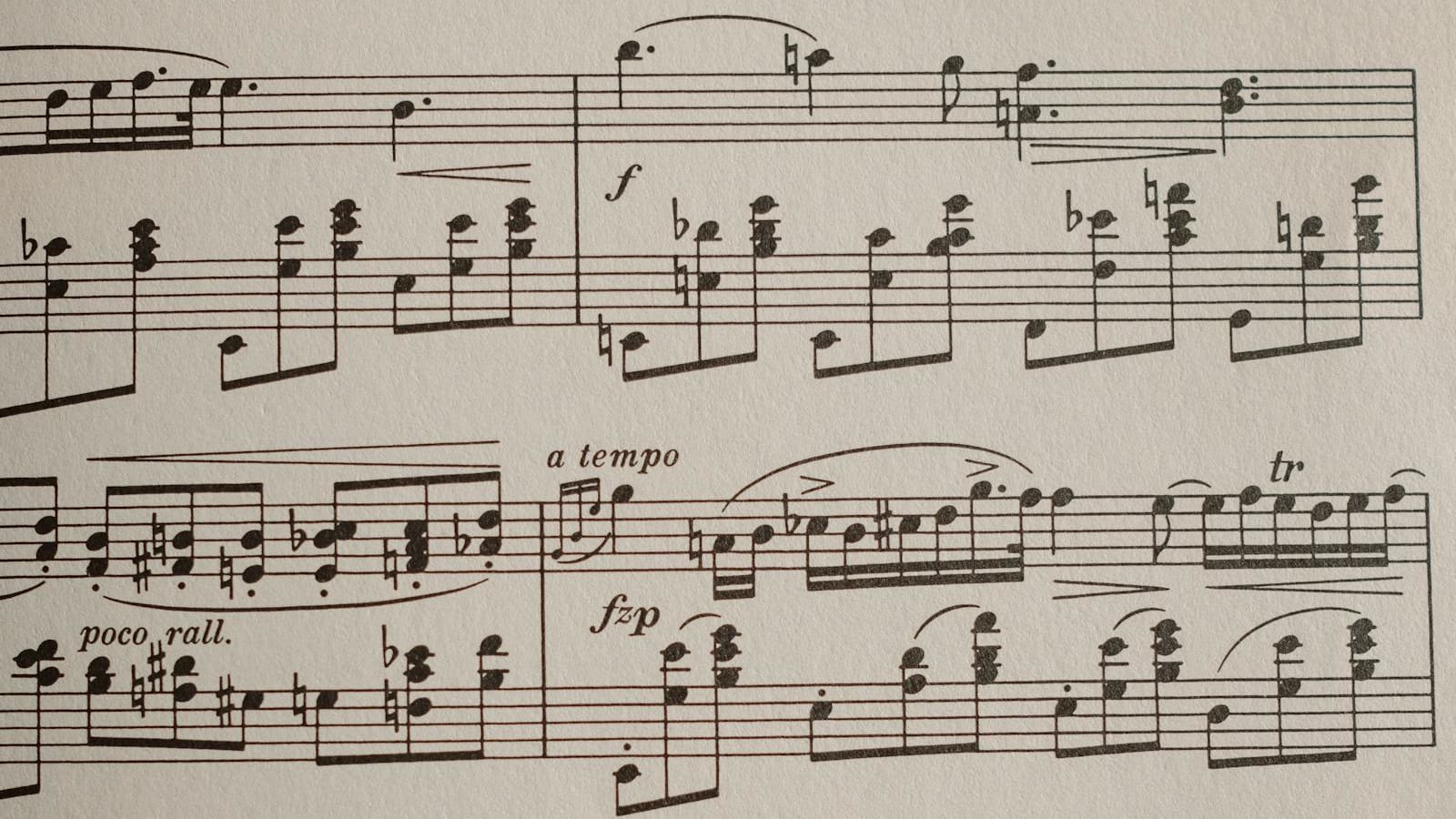
Bar 12 looks like bar 28. They are not exactly the same. The difference is the third note in the right hand, an F♯ in bar 28 instead of an F. You have noticed the difference. You have written the F♯ in over the second one, circled it, drawn an arrow. And you still play F in bar 28, every time, no matter how slowly you take it, no matter how carefully you read the score.
This is one of the most frustrating experiences in piano study, and one of the least addressed in standard advice. The instinct is to try harder — to "really focus" on bar 28, to slow down even more, to read it more carefully. None of that fixes it. The reason is that the cause is not lack of attention. It is a real cognitive phenomenon called memory interference, and it has its own mechanism, its own behaviour, and its own set of fixes that have almost nothing to do with concentration.
The phenomenon has a name
In cognitive psychology, interference refers to memories competing with one another during recall. When two pieces of information are very similar, they interfere — the brain has stored them with overlapping cues and cannot reliably retrieve one without the other being activated. The closer the two memories, the worse the interference. This is among the most replicated findings in the cognitive literature, going back to Hugo Münsterberg in the 1890s and formalised over the next century into the standard frameworks of proactive interference (old memories disrupting new ones) and retroactive interference (new memories disrupting old ones).
What this means for piano practice is concrete. When bar 12 and bar 28 are nearly identical, your brain does not store them as two separate items — it stores them as one schema with a small variation. When you reach bar 28, the brain retrieves the schema, executes it, and the small variation does not survive the retrieval. The hands play the dominant version. The dominant version is usually whichever you learned first or have practised more, although context can shift which wins on any given day.
This is also why slow practice alone often does not fix the problem. Slowing down does not separate the two memories; it just gives the schema more time to execute. The two passages stay linked because nothing has been done to distinguish them in the way your brain stores them. The fix has to introduce distinctiveness — deliberate, multi-channel, more than just reading the score more carefully.
"The cause is not lack of attention. It is that your brain has stored two nearly-identical passages as one schema with a small variation it cannot reliably honour."
Where this shows up in the repertoire
Once you start looking, near-identical passages are everywhere in the piano repertoire. Bach is famous for them — fugue subjects return in different keys with slight modifications, preludes contain repeating patterns with one altered note, the same figuration recurs across a piece with a different chord underneath. Sonata form structurally requires it: the recapitulation restates the exposition material but transposes the second theme and often changes the transition. ABA forms set up the trap by definition — the second A returns, modified, after a contrasting B. Chopin's nocturnes constantly do this through ornamented restatements of a theme.
The reason these moments cause trouble is not that the composer was being cruel. It is that musical form is built on returning material with variation. Composers used the same device the brain finds hardest to encode because it is the same device that makes music feel cohesive and structured. The work for the performer is to learn the variations against the pull of the schema.
The classic interference shape
PASSAGE A — bar 12
C — E — G — C, with the right-hand third note as F.
First encountered. Established as the default version.
PASSAGE B — bar 28
C — E — G — C, with the right-hand third note as F♯.
Looks identical except for one note. Loses to Passage A on retrieval.
When passages are this close, the brain stores them as a single schema. The variation does not survive retrieval until you give the second version its own identity.
Why "concentrate harder" does not work
The reason willpower fails on this problem is that the interference happens below the level of conscious attention. By the time you reach bar 28, the schema has already begun executing — fingers have begun moving toward the F before your conscious mind has finished reading the bar. The conscious instruction "remember the sharp" arrives milliseconds too late, every time. You feel the failure as inattention because the hands are doing something your mind did not order, but the inattention is not the cause; it is the symptom.
This is also why a frustrated player can play bar 28 correctly when they isolate it — they have time for the conscious instruction to arrive — and then play it wrong again the moment they approach it from bar 27 in real time. The isolation does not transfer because the schema only activates in context. The Pract.is essay on how to fix a mistake you have practised hundreds of times covers a related case; the interference version is harder, because the wrong note is not even a habit error — it is the correct execution of a different memory.
Technique 1 — Make the two passages physically different
The first and most effective technique is to give the two passages distinct physical fingerprints. Different fingerings, different hand motions, different dynamics, different pedaling — anything that changes how the passage feels in the body. The brain cannot store two passages as the same schema if the bodies they produce are different. You are deliberately moving them apart in memory by moving them apart in execution.
For the bar 12 / bar 28 example, you might choose to play bar 12 with a relaxed hand motion and bar 28 with a slight lift on the F♯, marking it physically. You might use a slightly different fingering for the right hand on the variant note. You might play bar 12 unpedalled and bar 28 with a touch of pedal. None of these changes need to be audible to a listener — the goal is to give your own body two different things to do. The body remembers the difference even when the conscious mind does not.
This is also where editing the fingering matters. If your edition uses the same fingering for both passages and you keep mixing them up, change one of the fingerings deliberately and write it in. The brain will encode the variant passage along with its variant fingering — two physical patterns instead of one with a footnote.
Technique 2 — Anchor the divergence point
The second technique focuses attention on the exact moment the two passages diverge. In the bar 12 / bar 28 example, that moment is the third note in the right hand. The work is to give that single note a distinctive feeling — a tiny weight shift, a touch of staccato, a millisecond of mental highlight. Some pianists physically lean toward the variant note; others sing the variant note in their head as they play it; others use an explicit verbal cue ("F sharp here") at the exact instant of execution.
The mechanism is that distinctive moments resist interference better than ordinary moments. A note that is psychologically marked — by intention, by attention, by a small physical action — gets encoded as its own event rather than as a small variation of the surrounding pattern. The Pract.is article on memorizing music without making your playing fragile describes how serious memorizers use deliberate landmarks throughout a piece; the interference case is the same principle applied to a specific high-conflict moment.

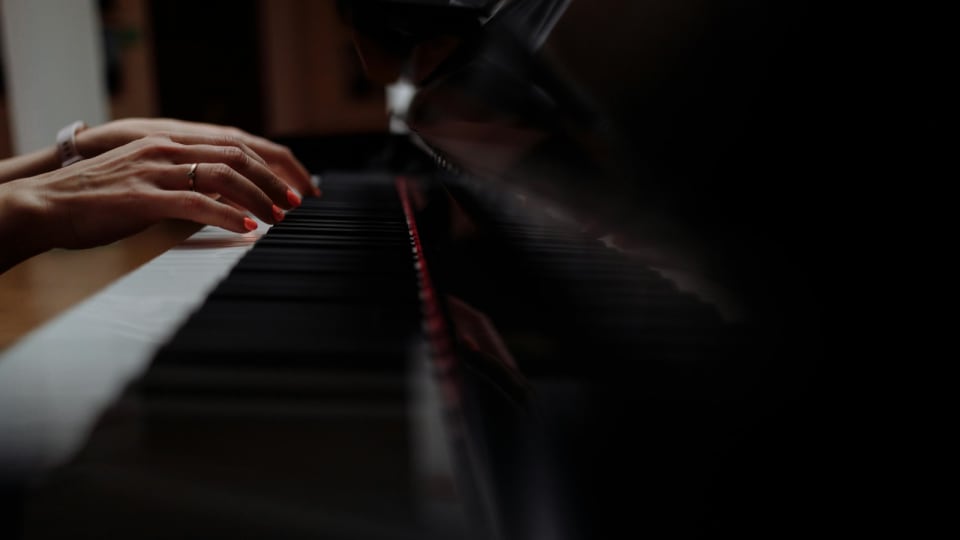
Photo: cottonbro studio via Pexels
Technique 3 — Practise the transitions into each passage
The third technique is the most under-appreciated. The mistake at bar 28 almost always happens because of how you arrive at it, not because of bar 28 itself. The schema activates in context — the bars leading up to bar 28 look enough like the bars leading up to bar 12 that the brain gets cued into the wrong retrieval. The fix is to deliberately practise the transition into each version, not the variant passages themselves.
Take the four bars before bar 12 and play them into bar 12, repeatedly, slowly, with attention to how the entry feels. Then take the four bars before bar 28 and play them into bar 28, repeatedly, with attention to how that entry feels different. Notice the harmonic context. Notice the previous phrase's shape. Notice where you are emotionally in the piece at each moment. The brain encodes the variant passage with its lead-in attached. By the time the hand reaches the variant note, the context has primed the correct version rather than the default.
This is also why the same passage practised in isolation transfers poorly. Bar 28 by itself has no context to differentiate it from bar 12. Bar 28 with its four-bar approach has a unique context the brain can use as a retrieval cue.
"The mistake at bar 28 almost always happens because of how you arrive at it, not because of bar 28 itself."
Technique 4 — Practise the two passages in different sessions
The fourth technique pulls a different lever — temporal distance rather than physical or contextual difference. Cognitive psychology has consistently shown that distributed practice produces more durable memory than massed practice, and the effect is stronger when the items being learned interfere with each other. If you spend a single session drilling bar 12 and bar 28 back to back, the two memories compete in real time and the stronger one usually wins. If you work bar 12 in Monday's session and bar 28 in Tuesday's session, the two passages are encoded in different temporal contexts and interfere less.
This does not mean never play them together — eventually they have to live side by side in the actual piece. It means that in the early differentiation work, separate the two in time. Drill the approach to bar 28 in a session that does not touch bar 12 at all. Drill the approach to bar 12 in a different session. After a week of this kind of separation, the two passages have their own histories and the interference is reduced. The Pract.is article on why slow practice stops working covers related distributed-practice principles in a different context.
The four techniques, side by side
Most cases of passage confusion respond to one of the four techniques most. The diagnostic is to ask which kind of cue your brain is missing.
| Technique | Cue it adds | When it works best |
|---|---|---|
| Physical differentiation | Body-level memory anchor | When the two passages are notationally identical except for one note |
| Anchor the divergence | Conscious-attention spotlight | When the two passages are short and the divergence is a single moment |
| Practise the transitions in | Context-based retrieval cue | When the surrounding bars are very similar — the most common case |
| Distribute in time | Temporal separation | Early in learning, before the two passages have to live next to each other |
Most stubborn cases need a combination — usually transitions-in plus physical differentiation, applied over a week or two of deliberate work. The single most common mistake is to keep practising the passages themselves in isolation, hoping that one more careful read will lock the variant note in. That approach almost never works; it is the wrong tool for the cognitive problem.
What about marking the score?
Most pianists already mark the score — circles, arrows, the variant note in bright pencil. These help, but less than you might expect. The reason is that during real-time playing, the eye does not actually re-read every marking; it tracks the music at a higher level. Markings get glanced past once the piece is somewhat learned, and the schema-driven hands execute regardless of the visual highlight.
Markings work best when they serve as the trigger for one of the four techniques above — a circle that means "lean toward this note physically," an arrow that means "this is where the version differs, attend here." A marking that is just a marking, without a paired physical or attentional action, gets absorbed into the schema like everything else. The Pract.is essay on listening more critically while you practise covers the broader case of using markings as instruction rather than as decoration.
A worked example
Imagine the Bach C-major Prelude. Bars 17 and 19 use the same broken-chord figuration with a tiny harmonic shift between them — the kind of moment that produces interference reliably across thousands of intermediate students. The standard approach is to play through the prelude and stop when bar 19 comes out wrong. After three weeks of that, the mistake is more entrenched, not less.
The differentiation approach looks different. Day one: play the two bars together five times, deliberately marking bar 19 with a slight physical lift on the variant note. Day one continued: practise the two-bar lead-in to bar 17, twenty repetitions, paying attention to how the harmonic context approaches that figuration. Day two: practise the two-bar lead-in to bar 19, twenty repetitions, paying attention to the different harmonic context. Day three: bar 17 with its lead-in only; do not touch bar 19. Day four: bar 19 with its lead-in only; do not touch bar 17. Day five: play the section in full, slowly, with the body-level differentiation maintained.
By the end of a week, the two passages have separate histories — different temporal contexts, different physical fingerprints, different attended-to moments. The interference reduces, often dramatically. The variant note that resisted three months of "concentrate harder" yields to one week of structured differentiation work.
The longer principle
Passages that confuse the hand are not a sign that you are inattentive, undisciplined, or insufficiently musical. They are a sign that two near-identical patterns have been encoded together in a way the brain handles poorly under retrieval. The fix is not motivation; it is structure. Distinctiveness in the body, distinctiveness in attention, distinctiveness in context, distinctiveness in time. The four levers of memory differentiation.
This generalises beyond piano. Anyone who has tried to remember the difference between two near-identical phone numbers, two similar passwords, two routes that branch the same way — the same interference mechanism is at work. The reason it shows up so dramatically at the piano is that musical patterns are designed to recur with variation. The composer set the trap on purpose, and the performer has to do the work of distinguishing what looks similar but is not.
Bar 28 is not lost. It just needs its own identity — a way the body executes it, a moment your attention lands on, a context the brain can use to retrieve it. Once it has those, the schema stops winning. The variant note arrives, every time, where it was always supposed to.