
Best Keyboard Stands in 2026: X-Style vs Z-Style vs Table
The best keyboard stand depends on playing height, floor contact, and knee room. Compare six X, Z, and table models from $33 to $350 for home and stage.
Pract.is Editorial
Research-based practice guidance for musicians from the Pract.is editorial team.
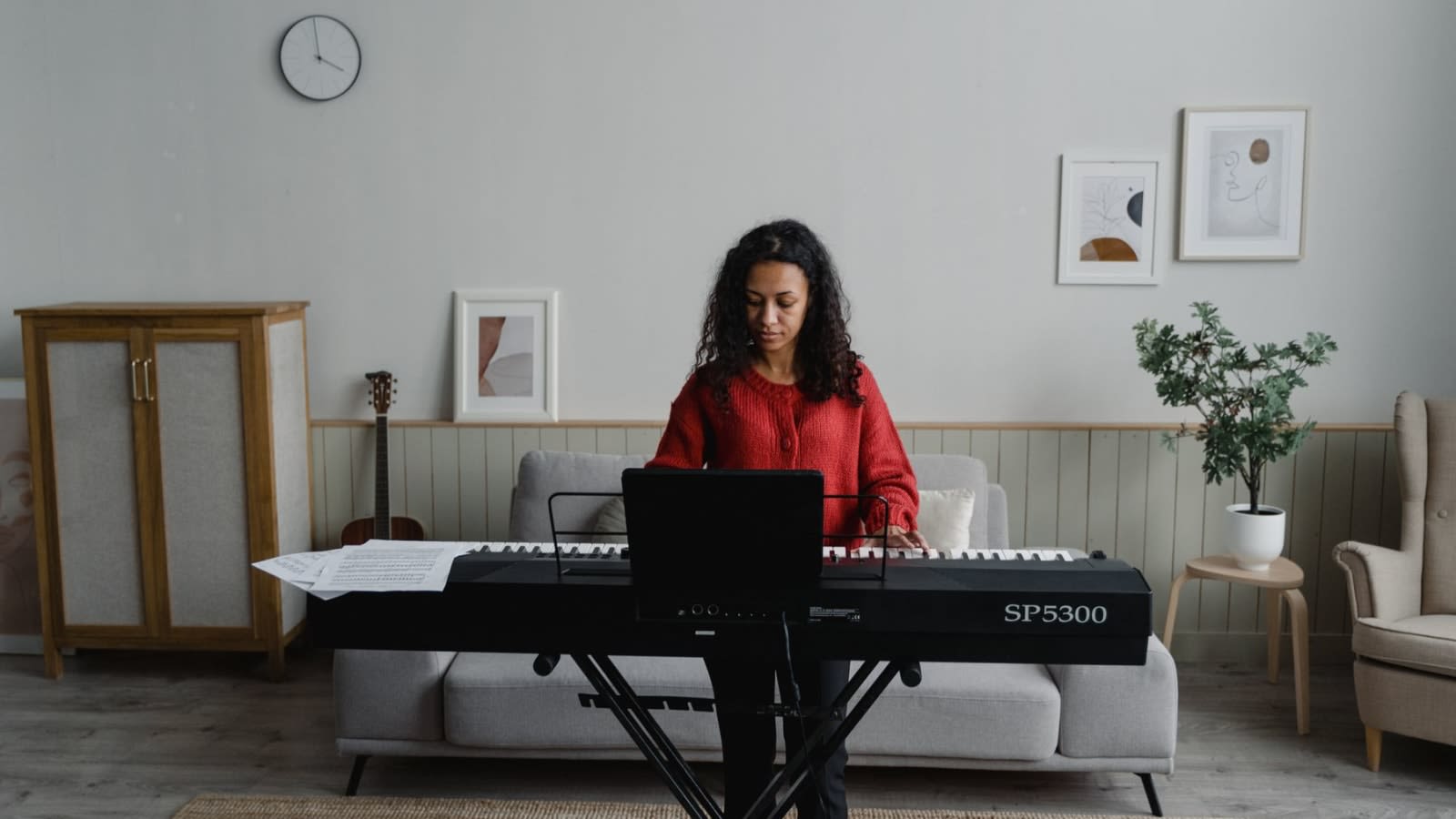
The best keyboard stand for most permanent 88-key slab-piano setups is a well-fitted Z-stand: its height and width adjust independently, and the open center leaves room for knees and pedals. A sound double-X stand is better when the rig must fold flat and travel often, while a table stand suits players who want open legroom and a broad, four-legged footprint.
The cheap X-stand that wobbles may not be failing because the keyboard is too heavy for its headline load rating; movement can begin in the center joint, narrow geometry, flexible tubing, loose sleeves, incomplete contact under the keyboard, or one foot hovering above the floor. Practis did not bench-test these models side by side; we compared current maker specifications, manuals, adjustment systems, dimensions, and US non-Amazon prices checked on August 24, 2026.
A load rating is not a stability rating
A maximum-load figure tells you how much weight that maker says the correctly assembled stand can support. It does not report how far the keybed shifts during repeated chords, how much the frame twists when the left and right hands alternate, or how easily the entire station can tip when pushed. There is no shared wobble score printed beside the 90-, 220-, or 286-pound figures, so those numbers should not be used as a cross-brand stiffness ranking.
Playing adds horizontal force and torsion to the obvious downward weight. That force travels from the hands through the keybed, support pads, frame joints, feet, and floor. A small clearance at any connection can become visible movement at key height, especially when the keyboard sits high above a narrow base. A 25-pound keyboard can therefore feel less settled on a stand advertised for 100 pounds than it does on a lower-rated frame with sound geometry and firmer contact.
“A load rating says how much weight points down. It does not say how much the stand moves sideways.”
This is also why a premium stand cannot rescue a poor fit. If a keyboard's molded feet sit outside the support pads, or a support bar presses against a speaker grille instead of a flat load-bearing surface, the instrument can rock while the frame remains still. Treat the keyboard, stand, bench, pedals, cables, and floor as one playing station rather than judging the stand in isolation.
Where keyboard-stand wobble actually starts
The center clutch is the first place to inspect on a single-X stand. A toothed disk or locking pin sets the angle, but manufacturing clearance and wear can leave a little rotational play after it is locked. Alternating pressure at the keys works that clearance back and forth. Double bracing reduces tube flex and improves load distribution, yet it does not remove the hinge or the fact that an X closes as it rises.
Height changes the geometry. A low X has a broad stance and widely separated support arms. Raise it for standing use and both the feet and top supports move inward, placing the keys higher above a narrower base. That does not make every raised X unsafe, but it can make motion more noticeable and leave less of the keyboard supported near its ends. The five positions on the Hercules KS120B illustrate the coupling clearly: its maker lists a 33.5-inch top width at the lowest setting and 11.3 inches at the highest.
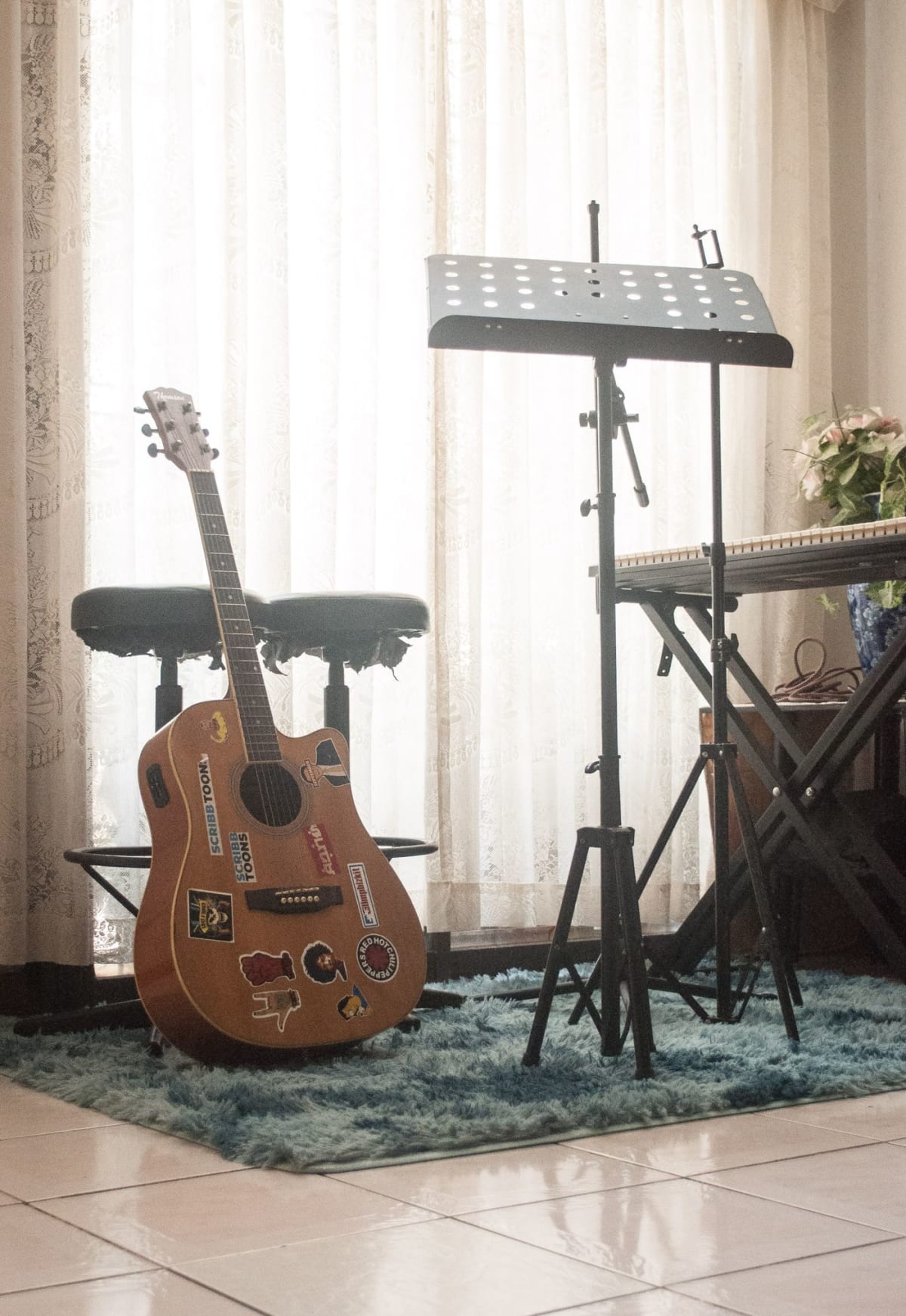
The remaining suspects are less glamorous. Thin tubes can twist. Rubber top sleeves can compress unevenly or creep away from the useful contact area. End caps and floor feet can loosen. A hard tile floor exposes a foot that is even slightly short, while a thick rug can allow the whole base to settle and sway. Before replacing a stand, remove the keyboard, tighten only the fasteners the maker permits, fully seat every pin or lever, and press each bare corner of the stand to find a rocking foot.
The keyboard itself can mislead the diagnosis. Long plastic or composite chassis may flex slightly at their ends, particularly when supported close to the middle. Press one end while watching the stand's feet and center joint. If the board moves but the frame does not, a wider top-support setting or an exact-model furniture base may help more than a larger load number. If a floor foot lifts, the problem is below the keybed.
The $25-to-$35 tier raises the odds of simple materials and broad tolerances, but price alone is not a verdict. The roughly $33 On-Stage KS7190 has a clear role under a light, small-format keyboard on a level, low-traffic floor. A badly adjusted $175 stand can still rock, while a modest X used low and wide can feel perfectly adequate. The useful question is not “Is an X-stand bad?” It is “Does this frame fit this keyboard at this playing height on this floor?”
X, Z, table, and furniture frames solve different jobs
Single-X is the minimum viable portable frame. It is inexpensive, fast to open, and flat enough for a closet or small car. That makes sense for light 61-key boards, occasional lessons, and players who pack down after every session. Its center brace competes with knees and pedals, and the linked height-width adjustment is the main compromise. A double-X adds a second set of tubes, increasing stiffness and usable capacity at the cost of weight, but keeps the same underlying scissor geometry.
Z-style is the best default for a permanent slab piano. Width and height can usually be adjusted separately, so an 88-key board can receive support farther toward its ends without forcing the keytops too high. The center remains open for a three-pedal unit and seated legs. Models vary substantially, though: the Liquid Stands MS1078 breaks into several pieces to pack flat, while the Hercules KS400B folds as a one-piece frame. Neither moves through a doorway as effortlessly as a collapsed X.

Table stands trade a quick fold for four-corner control. Their parallel rails and separate legs create an open center, and better models let the player level an uneven floor without twisting the whole frame. They are especially useful for seated workstations, deep instruments, and mobile rigs that travel by car rather than on foot. Check the minimum height carefully: the On-Stage KS7150 starts at 26 inches, which can put the keys too high once a thick stage-piano chassis is added; the K&M 18950 reaches down to about 23.6 inches.
A manufacturer-matched furniture stand is the fixed-home answer. It bolts to or locates against a specific piano, can accommodate the maker's attached three-pedal unit, and looks intentional in a room. It is not universal, portable, or automatically child-proof. For a young player, pet, or busy walkway, use the exact compatible base, follow its anchoring instructions, and never treat a portable stand as something a child may climb or hang from.
The keyboard choice still comes first. The portable instruments in our beginner keyboards under $400 post and the 88-key slabs in our beginner digital-piano picks do not share one set of dimensions or weights, so one stand brief cannot cover all of them. The complete beginner piano setup also shows why stand, bench, pedals, and headphones have to be budgeted as a system rather than leftovers.
The shortlist, arranged by job rather than price
These six models cover genuinely different jobs. All dimensions and maximum loads below are manufacturer-stated, not results from a shared independent test. The linked prices are US manufacturer or specialist-retailer snapshots checked on August 24, 2026; they are not Amazon prices or promises of future availability.
Affiliate notice: Some links are paid links. As an Amazon Associate, we earn from qualifying purchases.
This is the practical default for an 88-key home station: independent adjustment, four adjustable feet, security straps for compatible keyboards, foam pads, and an open center at $84.99 direct. It packs into multiple pieces rather than folding in one motion, so buy it for value and fit, not the fastest load-out.
AutoLock adjustment, locking pins, moving support arms, and one leveling foot give this 16.5-pound frame a serious stage brief. It folds to about 27.7 × 23.8 × 6.9 inches without becoming a kit of loose pieces. The trade is a higher $174.99 retailer snapshot.
The double-X tubes, automatic EZ-LOK positions, and adjustable rubber foot make this a stronger travel candidate than a basic scissor stand. It weighs 13 pounds and folds to 40.7 × 20.3 × 4.3 inches. At $104.99 from a specialist retailer, it is for players who truly need the X fold, not those seeking maximum seated legroom.
A five-position disk clutch, one-inch tubing, and flat fold make this honest basic gear at a $32.95 retailer snapshot. Use it with a light, small-format keyboard on a level floor, preferably at a lower setting. It is not our first choice for a permanent 88-key piano, a young child's station, or a busy walkway.
The welded and bolted platform folds to only about 3.5 inches thick and leaves the center open. Its $139 retailer snapshot undercuts the premium table below. Measure seated key height before ordering because the 26-inch minimum can be too tall under a thick stage piano.
Each leg adjusts independently without tools and includes a leveling screw, giving this 21.3-pound table the most precise four-leg seated geometry here. It collapses for transport but costs $349.99 from a specialist retailer. Buy that precision only when uneven floors, exact height matching, or a demanding workstation justify it.
The load figures look impressive across the list, but they are not the reason for our ordering. The MS1078 wins on value because its geometry suits the typical home slab-piano job. The KS400B earns its premium through a faster one-piece fold. The KS120B is the sensible X upgrade, the KS7190 is the candid lightweight budget option, and the two tables separate on minimum height, leveling control, and price.
“Buy the stand for the keyboard at playing height, not for the folded shape in the product photo.”
Fit and stress-test the whole playing station
Start with four measurements. Record the keyboard's width and depth, locate the flat load-bearing areas underneath, measure the desired keytop height from the floor, and note the space your knees and pedals need. Stand height alone is incomplete because the chassis adds several inches before the key surface begins. A shorter player may need a lower stand, a properly adjusted piano bench, foot support, and possibly a pedal extender rather than an adult setup with the bench raised and feet dangling.
Adjust any portable stand with the keyboard removed. Fully engage pins, disk teeth, locking levers, and folding braces, then tighten the specified knobs. Put the keyboard down so every top pad contacts a suitable flat surface without blocking speakers, vents, ports, or screw holes. Security straps are useful only when the keyboard has compatible attachment points; they are not universal tie-downs. Route power, audio, USB, and pedal cables away from the frame's feet so a tug cannot turn into a tip.

Then test the station in the room where it will be played. Leveling feet can correct a small floor difference, but they cannot compensate for a badly chosen stance or a deep carpet that keeps settling. Add the real pedal unit, music rest, tablet arm, laptop shelf, microphone boom, and second tier before deciding that the stand is stable. Each accessory adds mass and a longer arm through which a small push can twist the frame.
This test is diagnostic, not a destructive push test. Stop if a pin is not seated, a brace is partly folded, a keyboard overhangs its supports, or a foot will not plant. Never let a child climb, sit, or hang on a portable stand, regardless of its stated load. Where children, pets, or traffic make tipping the main risk, a maker-approved furniture stand installed as directed is the better starting point.
A settled station makes it easier to notice the musical problem instead of compensating for moving hardware. A Practis plan can keep goals, session notes, recordings, and practice history together once the physical setup is ready to disappear into the routine.
For most fixed 88-key setups, start with the Liquid Stands MS1078; choose the Hercules KS400B when a one-piece folding Z is worth paying for. Choose the Hercules KS120B when a true X-style flat fold is non-negotiable, and use the On-Stage KS7190 only for the lighter, simpler job it was built to do. The right stand is not the one with the largest number on the box. It is the one that fits the keyboard, player, and floor so well that the keys stop announcing what is underneath them.
More on setup.
Silent Piano vs Digital: Is a Hybrid Piano Worth It?
Silent piano vs digital piano: compare action, headphone noise, upkeep, prices, and whether a hybrid earns its premium for shared-home practice.
Pract.is Editorial
61 vs 76 vs 88 Keys: Which Keyboard Size Is Right?
61 vs 76 vs 88 keys comes down to range, action, and space. Compare each size by repertoire, portability, and three current keyboard examples.
Pract.is Editorial

Best Keyboard Gig Bags and Cases in 2026: 61- and 88-Key Picks
Compare the best keyboard gig bags and cases for 61- and 88-key boards, with current prices, interior dimensions, case weights, and airline guidance.
Pract.is Editorial