
Best Keyboard Gig Bags and Cases in 2026: 61- and 88-Key Picks
Compare the best keyboard gig bags and cases for 61- and 88-key boards, with current prices, interior dimensions, case weights, and airline guidance.
Pract.is Editorial
Research-based practice guidance for musicians from the Pract.is editorial team.

A keyboard case begins with a tape measure. A 61-key label can describe a shallow controller, a tall arranger, or a stage keyboard with protruding knobs. Eighty-eight-key instruments vary even more. The right bag has enough usable room on all three axes and enough protection for the way the instrument will actually travel.
Start with who handles the keyboard
A careful owner placing a board across an empty back seat creates a different risk from a stagehand stacking it below speaker stands. Stairs add dropped-corner risk. Public transit makes the carry system important. Checked baggage introduces conveyors, inspection, and loads the owner cannot control. The protection level should follow that route.
A soft bag can be entirely sensible when the same person lifts it at both ends of the trip. It has little crush protection, though, even when the padding feels substantial. A semi-rigid case adds sidewalls and spreads minor impacts across a larger surface. Molded hard cases tolerate rougher handling, while their empty weight and exterior bulk can make every doorway, vehicle, and baggage fee more difficult.
The table puts the eight candidates on the same measurement order. Prices were checked with the manufacturer or an authorized US retailer on August 28, 2026 and may change.
| Model | Format | Interior L × D × H | Empty weight | Current price |
|---|---|---|---|---|
| Gator GKBE-61 | Flexible, 10 mm padding | 41.75 × 17.5 × 5 in | 2 lb | $74.99 |
| Roland CB-B61 | Padded, backpack straps | 41.5 × 13 × 5.25 in | 4.85 lb | $164.99 |
| Gator GK-61 | Structured, wheels | 43 × 17.5 × 6.5 in | 22.1 lb | $284.99 |
| SKB 1SKB-4214W | Hard, wheels | 43 × 15.25 × 5.25 in | 18.08 lb | $469.99 |
| Gator GKB-88 SLIM | Padded, internal straps | 53.75 × 14 × 6.75 in | 6 lb | $169.99 |
| Roland CB-B88V2 | Padded, movable insert | 56.69 × 14.9 × 5.78 in | 4 lb 14 oz | $175.99 |
| Roland SC-G88W3 | Semi-rigid, three wheels | 56.5 × 18 × 6.5 in | 21 lb 14 oz | $399.99 |
| Gator GTSA-KEY88 | Molded hard, wheels | 59 × 19 × 6.63 in | 32 lb | $529.99 |
Measure the keyboard, the case, and the route
Remove the music rest, stand, and loose pedal unit unless the case is specifically intended to hold them. Measure the keyboard at its longest, deepest, and tallest fixed points. Include feet, end cheeks, knobs, pitch wheels, and any connector or power switch that projects beyond the main shell. Manufacturers do not always present dimensions in the same order, so rewrite both sets as length × depth × height before comparing them.
- 1Confirm the exact model. Similar names, regional revisions, and plus-sign updates can have different cabinets.
- 2Measure the physical board. Use the widest fixed points rather than estimating from the keybed.
- 3Use interior case dimensions. Every keyboard dimension must sit below the corresponding usable interior dimension, with room for padding and loading.
- 4Account for restraint. A roomy case needs blocks or straps that prevent movement without pressing keys, knobs, or jacks.
- 5Test the loaded route. Add board, case, and accessory weights, then check doors, stairs, car openings, and lift height.
A little clearance makes loading practical. A case whose published height exactly equals the keyboard's published height leaves no allowance for rounded specifications, foam, protrusions, or manufacturing tolerance. SKB's keyboard-case sizing guidance suggests adding half an inch to required length, width, and depth. That is a useful screen rather than a universal guarantee, since shaped interiors and compressible padding behave differently. A maker's fit tool or explicit compatibility list should settle a close call.
The variation among current 88-key instruments shows why the label cannot do this work. These external dimensions come from the makers; the last column is simple arithmetic against the four 88-key cases below, before allowing for padding or tolerances.
| 88-key instrument | External L × D × H | Instrument weight | What the first screen shows |
|---|---|---|---|
| Casio PX-S1100 | 52.06 × 9.13 × 4 in | 24.7 lb | Below all four published interiors on every axis |
| Yamaha P-225 | 52.19 × 10.69 × 5.06 in | 25 lb 6 oz | Below all four published interiors, with less height room in the CB-B88V2 |
| Roland FP-30X | 51.19 × 11.19 × 6 in | 32 lb 11 oz | Published height exceeds the CB-B88V2 interior by 0.22 in |
| Yamaha DGX-670 | 55 × 17.5 × 5.94 in | 47 lb 3 oz | Too deep for both soft bags; below the two larger case interiors on paper |
The first two pianos are both slim and light enough to look straightforward, yet their case-plus-instrument totals still differ by several pounds. The DGX-670 is another 88-key board, but its 17.5-inch depth rules out cases with 14- and 14.9-inch interiors immediately. Our digital pianos under $1,000 comparison covers more of the instrument-side differences. Anyone still deciding between key counts can start with the separate 61, 76, and 88-key guide.
Affiliate notice: Some links are paid links. As an Amazon Associate, we earn from qualifying purchases.
Soft bags for owner-controlled trips
Soft bags are lighter, easier to store, and less awkward in a small car. Their padding can reduce ordinary bumps, while the fabric carries little meaningful load when something heavy presses into the keyboard. The four options here solve different fit and carrying problems.
Gator GKBE-61 keeps cost and weight low
The GKBE-61 is the lightest and least expensive case in this guide. Its published interior is 41.75 × 17.5 × 5 inches, with 10 mm padding inside a nylon shell. At two pounds, it adds very little to a beginner keyboard. The 17.5-inch depth gives it considerably more room than a slim 61-key bag, though length and height still need to be checked. There are no internal restraints, wheels, or rigid sidewalls. A compact controller may slide inside the generous cavity, and a sustain pedal in the main compartment can move against the keys. The GKBE works for storage, lessons, and a keyboard that one careful person places in an uncluttered vehicle. The soft walls remain exposed to whatever sits beside or above the bag in a cargo area.
Roland CB-B61 adds backpack carry
Roland's CB-B61 has a 41.5 × 13 × 5.25-inch interior, thick foam, a fleece lining, and an exterior that combines 600D polyester with ripstop nylon. Shoulder and backpack straps are the practical difference for a player who also carries a stand, bench, or cable bag. The empty bag weighs 4.85 pounds, and Sweetwater listed it at $164.99 when checked.
The narrow 13-inch depth deserves attention. It suits many slim performance boards, including instruments shaped like the Yamaha CK61, while some 61-key arrangers are considerably deeper. Backpack straps also place the keyboard's full length behind the wearer. Check ceiling height, door frames, and other people before using them on stairs or transit.
Gator GKB-88 SLIM: padded hand carry without a huge shell
The GKB-88 SLIM is a six-pound padded bag with a 53.75 × 14 × 6.75-inch interior. Adjustable padded straps hold the instrument down, which is valuable when a slim piano leaves unused space above or around its ends. Reinforced riveted handles and an exterior accessory pocket complete a simple hand-carried design. The current Sweetwater price was $169.99. No shoulder straps or wheels are specified. A 25-pound slim piano brings the loaded weight above 30 pounds before the pocket receives a pedal and power supply. The bag remains manageable for a short walk from house to car, and less appealing across a large campus or venue. Deep 88-key instruments fail the 14-inch interior dimension regardless of their weight.
The Roland CB-B88V2 adds length and a movable end insert
At 56.69 × 14.9 × 5.78 inches inside, the CB-B88V2 accepts a longer and slightly deeper group of boards than the Gator soft bag. A movable padded insert shortens the cavity around a smaller keyboard. The polyester case has thick padding, a fleece interior, a reinforced hand grip, and a large front pocket. It weighs 4 pounds 14 ounces and was $175.99 at B&H.
The insert controls end-to-end movement; it cannot create height. A Roland FP-30X is listed at 6 inches high with its music rest detached, already above the case's 5.78-inch interior on published numbers. The bag also lacks wheels. For a board that clears the depth and height limits, the bag adds less than five pounds and the end insert can take up spare length.

Structured rolling cases for repeated load-ins
A rolling case becomes attractive once the same instrument crosses parking lots, school corridors, and stages every week. The wheel system helps on smooth ground; somebody still has to lift the loaded case over curbs and stairs. Side structure also reduces flex when the case brushes a doorway or another piece of equipment.
Gator GK-61 rolls on a reinforced frame
Gator builds the GK-61 around a polyethylene-reinforced interior frame, then lines it with soft foam and tricot. The 43 × 17.5 × 6.5-inch cavity provides substantially more depth and height than slim 61-key cases; fit still depends on all three keyboard dimensions. Adjustable padded straps control a smaller instrument. Wheels, a tow handle, skid bars, and large accessory compartments suit regular car and van use.
The case weighs 22.1 pounds empty and measures almost 49 inches outside. A 12-pound stage keyboard produces a reasonable loaded package; a much heavier workstation plus pedals can become a two-person lift on stairs. The $284.99 GK-61 offers more shape and handling protection than a normal gig bag, though its zippered nylon exterior is not a molded flight shell.
Roland SC-G88W3: sidewalls, three wheels, and room for deeper boards
The SC-G88W3 has rigid side-impact panels, thick foam, a fleece lining, and adjustable internal straps. Its 56.5 × 18 × 6.5-inch interior is the first 88-key option here deep enough for the published 17.5-inch body of a Yamaha DGX-670, although that close fit should still be confirmed for the exact instrument. Three wheels, skid rails, reinforced handles, and a large front pocket support venue work.
Roland's semi-rigid case is 60.25 × 20.5 × 8.31 inches outside and weighs 21 pounds 14 ounces. Add the DGX-670 and the package reaches roughly 69 pounds before accessories. It may be fine to roll and unpleasant to lift. A small hatchback, tight stairwell, or solo load-in can determine whether its $399.99 protection is practical.

Hard cases for shared loads and checked transport
Hard shells make sense when the keyboard leaves the owner's hands or travels among other heavy cases. They provide a load-bearing outer structure, yet the interior still has to immobilize the instrument. An oversized shell with badly placed blocks lets the keyboard gather speed before an impact.
SKB's 1SKB-4214W is a comparatively light hard case
SKB's 1SKB-4214W uses a hard shell, a corner-cleat restraint system, lid foam, exterior bumpers, built-in wheels, and Travel Sentry locking latches that TSA authorities can open with the appropriate tool. SKB says it meets ATA Category 1 specifications as an airline shipping container. The published interior is 43 × 15.25 × 5.25 inches. At 18.08 pounds, it is lighter than Gator's structured GK-61 despite moving to a hard exterior. It matches the GK-61's 43-inch interior length while providing 2.25 inches less depth and 1.25 inches less height. Its exterior measures 45.5 × 18.75 × 8.25 inches. The current official price was $469.99.
Gator GTSA-KEY88: a large configurable molded shell
The GTSA-KEY88 is the broadest case in this comparison. Its molded polyethylene shell surrounds a 59 × 19 × 6.63-inch interior with movable wedges and blocks. Two TSA-accepted locking latches, recessed wheels, a top handle, and two tow handles address the mechanics of moving a long, heavy case. Gator listed a 200-pound wheel capacity and 130-pound tow-handle capacity.
Empty weight is 32 pounds. The exterior is 64.5 × 22.25 × 10.25 inches, or 97 linear inches, before any airline-specific interpretation. With a 47-pound DGX-670 inside, the base total is about 79 pounds. The $529.99 case is a credible solution for uncontrolled handling, and it can trigger weight or oversize charges that a slimmer instrument and case may avoid.
Air travel changes the calculation
For flights operated by carriers covered by U.S. 14 CFR Part 251, small musical instruments receive cabin treatment when they fit approved baggage stowage and space is available at boarding. A full-length 61- or 88-key case usually exceeds normal cabin baggage dimensions. The same rule addresses ticketed-seat carriage for certain large instruments and checked musical instruments, subject to size, weight, safety, and carrier conditions. It does not turn a keyboard case into guaranteed cabin baggage.
The operating carrier and aircraft matter, especially on a codeshare. The Department of Transportation's musical-instrument FAQ explains that a carrier does not have to modify its FAA-approved carry-on baggage program when that program does not already permit an instrument as cargo at a passenger seat. Current rules, fees, embargoes, and the combined exterior dimensions and weight should be confirmed for every leg before the ticket becomes difficult to change.
“ATA” and “TSA” describe narrower things than many product listings imply. ATA Spec 300 contains packaging and testing guidance for air-transport containers. A maker's ATA claim can be useful evidence about construction. Travel Sentry or TSA-accepted latches let authorized screeners open and relock compatible locks; they do not approve the case for a flight, set baggage fees, or promise protection from damage.
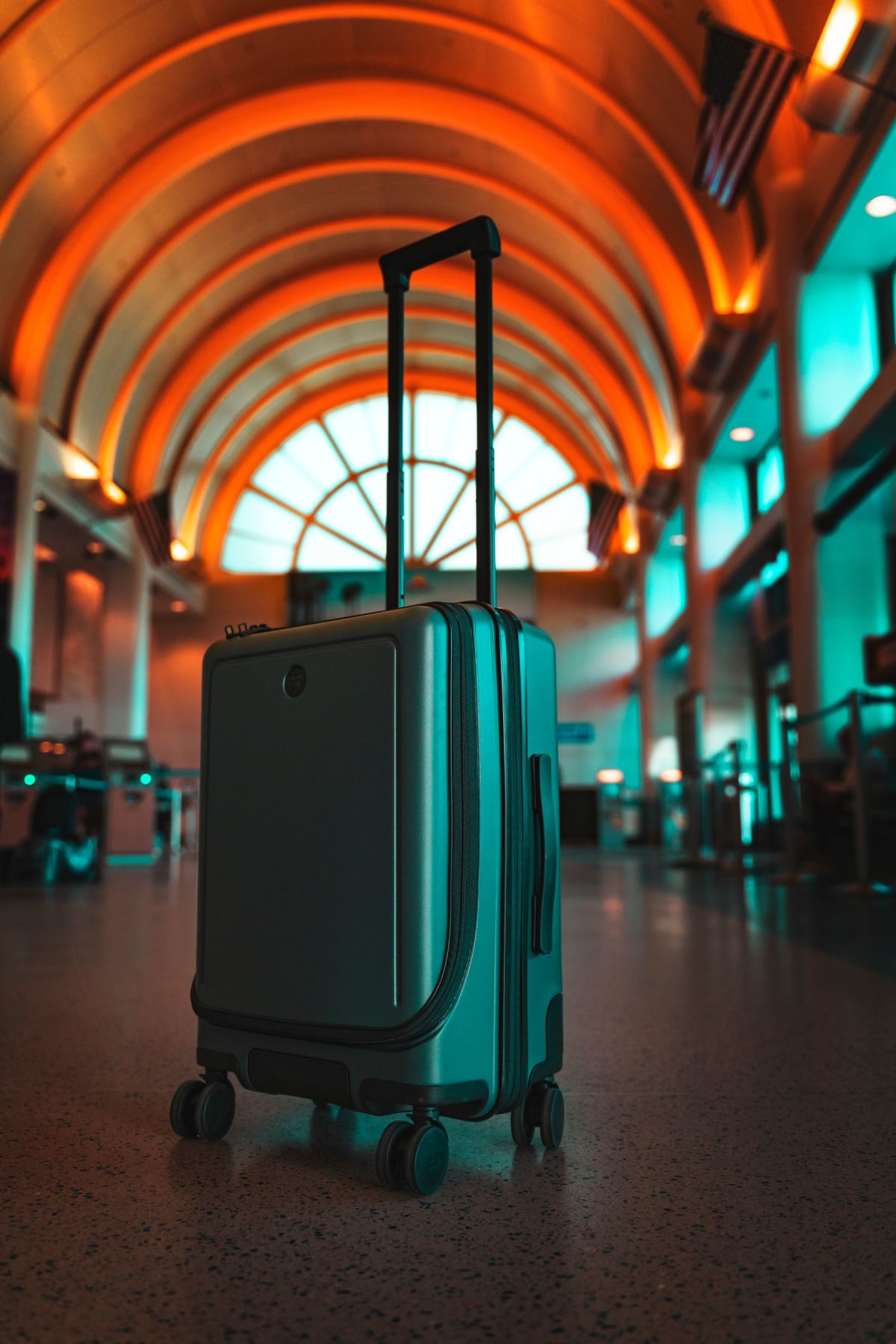
TSA says musical instruments must undergo screening in carry-on or checked baggage, and asks travelers to tell an officer when an instrument needs special care. Security screening is separate from the airline's acceptance and baggage rules. Photograph the instrument, serial number, case, and packed interior before check-in, and retain the baggage receipt. The DOT's damaged-baggage guidance also warns that improper packing can affect a claim and that domestic contracts may exclude some fragile or electronic items.
Pack the controls so they carry no load
Put the keyboard in the case with the music rest removed and the keys facing the intended direction. The bottom support should contact the cabinet's structural underside rather than individual keys, knobs, or connectors. Adjust end blocks and straps so the board cannot build momentum inside the case. Close the zipper or lid without leaning on it. Any resistance above a tall knob or display means the fit needs attention.
Power supplies, pedals, and cables belong in a divided exterior pocket or a separate accessory bag. A heavy sustain pedal loose above the keys can cause more damage than the ordinary bump the padding was meant to absorb. Avoid overfilling the front pocket until it rounds into the control surface. For the other large object that has to leave the house, our keyboard stand guide compares folded length, stability, and transport weight.
Lift the packed case once before the return window closes. Carry it through the narrowest door, place it in the actual vehicle, roll it over a threshold, and raise it to trunk height. Check that the handles balance the load and that wheels do not let the case tip when it stands. Then reopen it and look for impressions in the foam around knobs, end cheeks, and cable jacks.
A case that passes those checks is doing useful work before the first gig begins. Keep the model dimensions and loaded weight with the rest of the equipment list; they will matter again when the vehicle, venue, or itinerary changes.
More on setup.

Silent Piano vs Digital: Is a Hybrid Piano Worth It?
Silent piano vs digital piano: compare action, headphone noise, upkeep, prices, and whether a hybrid earns its premium for shared-home practice.
Pract.is Editorial
61 vs 76 vs 88 Keys: Which Keyboard Size Is Right?
61 vs 76 vs 88 keys comes down to range, action, and space. Compare each size by repertoire, portability, and three current keyboard examples.
Pract.is Editorial

Gifts for Piano Students in 2026: 20 Useful Picks Under $100
Compare 20 useful gifts for piano students under $100, including practice tools, headphones, score accessories, digital gear, and piano-care upgrades.
Pract.is Editorial