

Search "best online piano lessons" and the page fills with apps and pre-recorded courses. Actual teachers — real people who watch you play and fix what is going wrong in the moment — are harder to surface, even though that one-to-one feedback is exactly what most stuck pianists are missing. This guide is the other list: the best online piano teachers for 2026, the ones who give real private piano lessons (or the closest structured equivalent), sorted by who they actually suit.
There are picks here for adults, serious self-taught players, blues and jazz, complete beginners, and kids — with honest notes on format and price, because a live 55-minute lesson and a self-paced video library are very different products at very different costs.
Teacher, course, or app — know which you're buying
The three are easy to confuse because they all market themselves as "online piano lessons." A private teacher watches you in real time over Zoom and corrects your hands, timing, and interpretation as you play — irreplaceable for technique and for anything you keep getting subtly wrong. A structured course gives you a proven path and exercises, but no one is watching. An app gamifies note-reading and song-learning, which is great for momentum and weak for technique — we went deep on that gap in our look at whether AI can actually teach you piano.
Most of the names below lean toward one of those modes. Only a couple offer genuine live one-to-one instruction, which is why the niche of real "private piano lessons online" is smaller — and more valuable — than the flood of course and app results suggests.
| Teacher | Best for | Format | From |
|---|---|---|---|
| PianoTechSupport | Adults, intermediate & serious self-taught; exam/audition prep | Live 1-on-1 (Zoom) | ~$40 / 55-min lesson |
| BachScholar (Cory Hall) | Classical, sight-reading, Bach | Live 1-on-1 (remote) | On request |
| Bill Hilton | Blues, jazz, improvisation, play-by-ear | Courses, workshops, ad-hoc coaching | Free–low-cost |
| PianoTV (Allysia) | Adult beginners who want structure | Self-paced + group courses | ~$97 / course |
| Hoffman Academy | Kids & young beginners | Self-paced video + app | Free; Premium ~$18–20/mo |
1. PianoTechSupport — best for serious 1-on-1 guidance
If you want a real teacher rather than a playlist, PianoTechSupport is the pick. It is run by a Vienna conservatory-trained concert pianist (M.A., Music University of Vienna) who has been teaching online for about five years and runs a YouTube channel of roughly 23,000 subscribers built entirely on practical, no-fluff playing advice. The lessons are the opposite of generic "online piano tips": they target the things that actually hold pianists back — technique, repertoire choices, sight-reading, interpretation, the common mistakes that quietly cap your progress, and how to practice more intelligently between sessions.
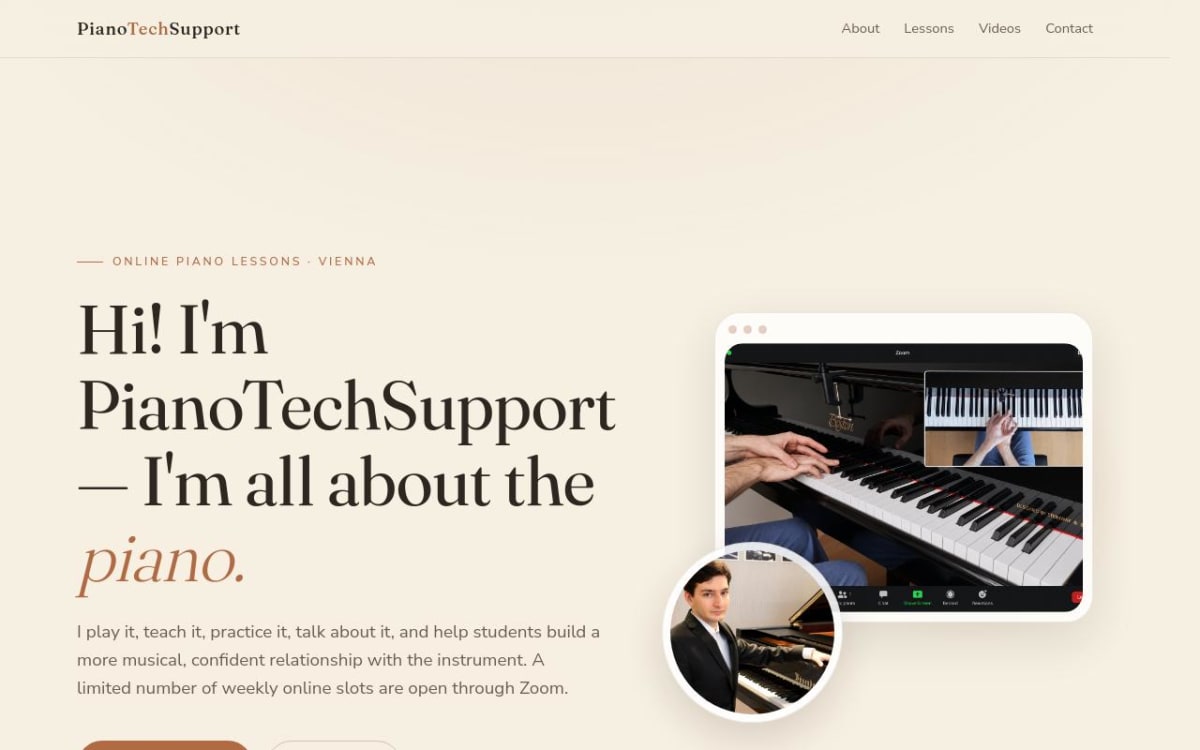
Lessons are one-to-one on Zoom, 55 minutes, from around $40 each — the site lists €40, with multi-lesson packs bringing it down to about €34 a lesson, and trial lessons are available. For a teacher with a serious classical pedigree that is genuinely low: independent teachers with a master's or doctorate commonly charge $70–90 an hour, so this lands at the friendly end of the market for the credentials behind it. There is also exam-track support — ABRSM and Trinity grades, plus conservatory entrance and audition preparation.
To see the teaching style before booking anything, this two-hour technique masterclass is a fair sample of the depth on offer — 100 techniques worked through for every level:
Best overall · private lessons
Who it's for: adult learners, intermediate pianists, and ambitious self-taught players who want structured, honest, classically-grounded guidance from a real teacher — not another video library. Transparent pricing and a trial lesson make it easy to test. Sites: pianotechsupport.com · YouTube.
"An app can show you the notes. Only a teacher watching you play can tell you why the passage keeps falling apart."
2. BachScholar (Cory Hall) — best for classical and sight-reading
Dr. Cory Hall has run BachScholar since 2008 and has published over 50 volumes of editions and teaching material, so the bias is unapologetically classical and scholarly. He and his wife Marilyn teach remote private lessons to students of all ages and levels worldwide, and the channel is best known for a methodical approach to sight-reading and to playing Bach with conviction. If your goal is reading fluency and a serious classical foundation, this is a teacher who has thought about it more than most.

Pricing for remote lessons is not posted publicly — you arrange it on request — and a big part of the offering is the BachScholar Editions catalogue of books and sheet music. Best for classically-minded players, sight-reading projects, and anyone who wants a teacher with a publishing-grade command of the repertoire. More at bachscholar.com.
3. Bill Hilton — best for blues, jazz, and playing by ear
Bill Hilton has been making piano tutorials since 2009 and is the UK's most recognizable face for the side of piano that classical training often ignores: blues, jazz, improvisation, and general musicianship. His site leans into community and projects rather than traditional lessons — a free beginner's course, cohort workshops with live seminars, a Patreon community, and one-to-one coaching available on an as-needed basis rather than weekly.

There is no fixed hourly rate; the free tutorials and low-cost Patreon are the entry point, with paid workshops and coaching layered on top. Best for adults who want to improvise, play blues and pop by ear, and understand how music works — not just read what's on the page. See billspianopages.com.
4. PianoTV (Allysia) — best for structured adult beginners
Allysia Van Betuw's PianoTV is one of the friendliest on-ramps for adult beginners. Alongside a large free YouTube library, she runs PianoTV School: structured, semester-based courses that take a complete beginner up through roughly Grade 3, with weekly pieces, lesson plans, technique and sight-reading exercises, and forum feedback. It is calm, methodical, and refreshingly free of hype.

This is course-based rather than live one-to-one — individual courses run around $97 (with bundles available) — so you trade real-time correction for structure and a much lower price. Best for self-motivated adult beginners who want a clear path and don't yet need a teacher watching every note. Details at pianotv.net.
5. Hoffman Academy — best for kids
For young beginners, Joseph Hoffman's Hoffman Academy is the standard-bearer. It is a self-paced video curriculum built specifically for children, wrapped in an app with games, practice tools, and downloadable materials that keep kids coming back. The full video lessons are free; a Premium membership (around $18–20 a month, with discounted slots for additional children) unlocks the games, sheet music, and practice features that make it stick.
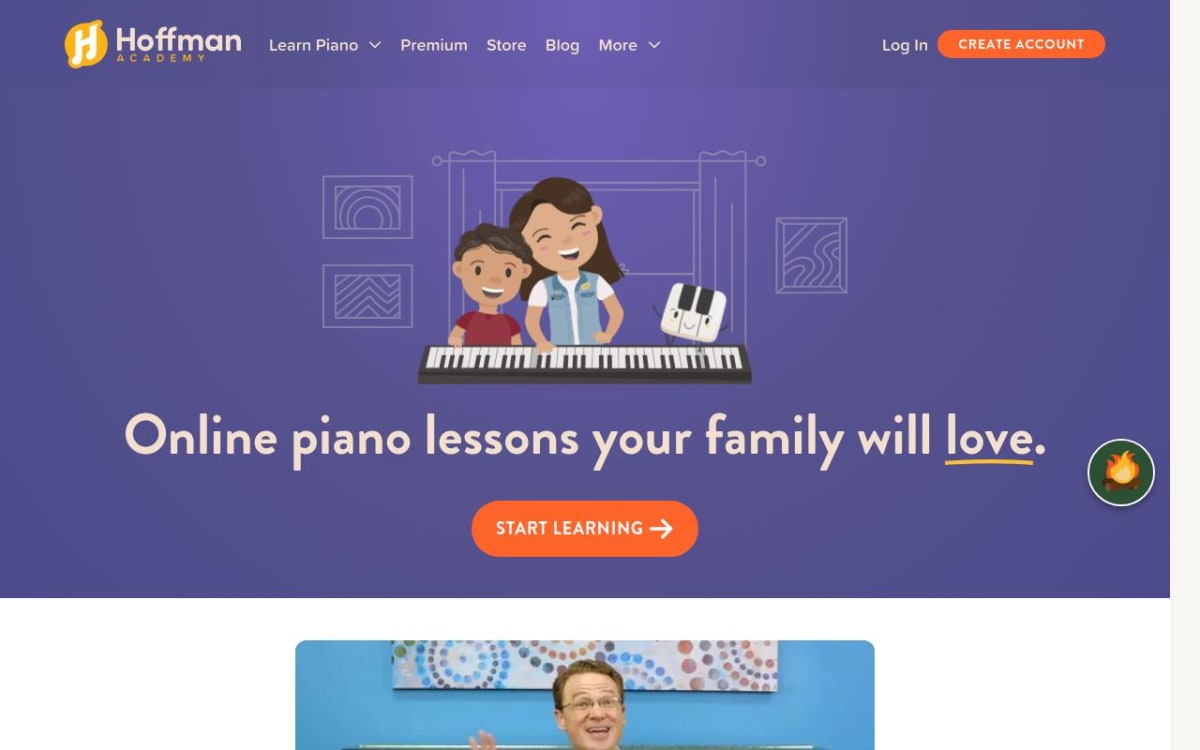
It is not live one-to-one teaching, so for an older or fast-moving child you may eventually want a real teacher too. But as an affordable, genuinely kid-friendly start — especially for families with more than one young learner — nothing else matches it. See hoffmanacademy.com.
How to pick the right one for you
The honest sorting question is what you actually need watched. If your problems are physical or subtle — technique, evenness, tone, a passage that won't settle — you need a live teacher's eyes, which points to PianoTechSupport or BachScholar. If you mainly need a path and motivation, a course (PianoTV) or a kid-friendly program (Hoffman) does the job for far less. If you want to improvise and play by ear, Bill Hilton is the specialist.
Which online piano teacher fits you?
Two more things worth deciding before you book. First, read our guide to choosing a piano teacher — the red and green flags apply just as much over Zoom as in person. Second, if you are an adult worried you have left it too late, you almost certainly haven't; we made that case in is it too late to learn piano as an adult.
Whichever you choose, the lesson is only as good as the week that follows it. Lessons happen once; practice happens daily, and the players who improve fastest are the ones who actually track what changed between sessions — a habit a free tool like Practis makes easy, so you walk into each lesson knowing exactly where you left off.
Common questions
How much do online piano lessons cost in 2026?
Live one-to-one online lessons typically run $35–70 an hour, rising to $70–90 for teachers with advanced degrees. Self-paced courses and kids' programs cost far less — often $15–25 a month or about $100 per course — because no one is teaching you in real time.
Are online piano lessons as good as in person?
For most learners, a good Zoom lesson is close to the in-person experience and lets you study with a teacher you could never reach locally — a Vienna-trained pianist from your living room, for instance. The main trade-off is that a teacher can't physically reposition your hand, so camera angle and a decent mic matter.
What's best for an adult beginner versus a serious student?
Adult beginners who want a low-pressure path do well with a structured course like PianoTV. Serious or intermediate players who keep hitting the same walls get more from live 1-on-1 lessons with a teacher like PianoTechSupport, where the feedback is specific to your playing.
Which is best for kids?
For young children, Hoffman Academy's gamified, self-paced curriculum is the easiest and most affordable start. As a child advances or needs accountability, adding occasional live lessons with a real teacher is the natural next step.
If you only do one thing: book a single trial lesson with a real teacher before committing to any course or app. One honest 55 minutes with someone watching you play will tell you more about what to work on than a month of guessing — and it's the fastest way to find out whether online lessons are right for you.


