Short answer: yes, AI can help you learn piano in some specific ways. No, it cannot replace a good teacher. And if you use it naively, it can give advice that sounds plausible while being incomplete, badly prioritized, or physically risky.
That is the real issue with questions like “Can ChatGPT teach piano?” The answer is not a simple yes or no. It depends on what kind of teaching you mean.
The most useful frame: AI works best as a practice assistant, not as a full piano teacher.
OpenAI's own documentation already makes the broad caution clear: ChatGPT can make mistakes, and users should check important information. That matters even more in music training than people first realize, because technique, pain, and repertoire choice are not harmless trivia categories. OpenAI FAQ.

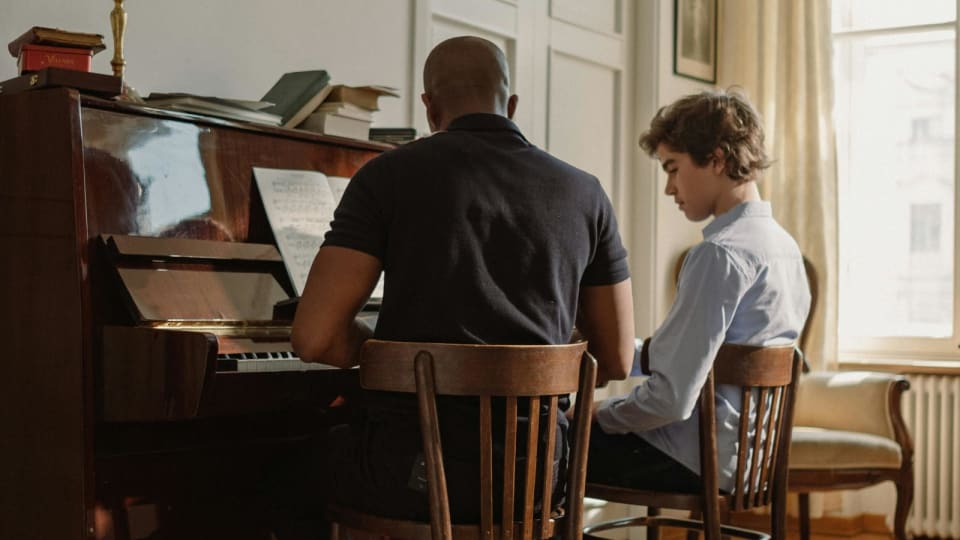
Photo: Tima Miroshnichenko via Pexels
Where AI Actually Helps
| Useful role | Why AI can help |
|---|---|
| Explaining concepts in simple language | It can rephrase theory, rhythm, or practice ideas at different levels |
| Generating practice structure | It is good at creating checklists, routines, and practice templates |
| Giving repertoire comparisons | It can help compare pieces, composers, or styles if the prompt is specific enough |
| Brainstorming solutions | It can offer multiple approaches when you feel stuck |
| Summarizing information | It can condense articles, teacher notes, or practice reflections into something usable |
1. AI Is Good at Explanations, Examples, and Organization
If you ask ChatGPT to explain the difference between staccato and portato, the structure of a sonata form movement, or how to organize a 30-minute practice session, it can often be genuinely useful. It is especially helpful when you need:
- a concept explained more simply
- multiple examples of the same idea
- a practice routine or checklist
- help translating teacher feedback into a concrete plan
This is where AI is strongest in piano learning: language support and planning support. It can often help you understand, structure, and review information more efficiently.
2. AI Can Help You Practice Better Questions
One underrated use is that AI can help learners ask better questions. For example, instead of vaguely wondering “Why is this piece hard?”, it can help break the problem into:
- is the rhythm unstable?
- is the fingering inefficient?
- is the leap not visually prepared?
- is the tempo too ambitious for the current coordination?
That shift matters because better diagnosis usually leads to better practice.
3. AI Is Weak When the Problem Is Physical or Highly Individual
This is where many people overestimate it. AI does not see your shoulders, wrists, hand shape, breathing pattern, tension level, or the exact way you are moving through a passage. It can only guess from your description.
That matters because many serious piano problems are physical and highly individual:
- tension in octaves
- pain in forearm or wrist
- awkward thumb crossings
- rotation issues
- pedaling that depends on your exact instrument and room
If the description is slightly wrong, the advice can sound coherent and still miss the real issue completely.
4. Technique Advice Is the Highest-Risk Category
This is where AI can fail in a way that is not just unhelpful, but potentially harmful. Confident text can make weak technique advice sound more reliable than it is.
Research on musicians shows that musculoskeletal pain is common in instrumental training, including among piano students and professional musicians. That means sloppy advice around posture, movement, tension, or pain should not be treated casually. Baadjou et al., Kok et al..
Examples of risky AI-style advice include:
- “keep your fingers curved at all times” without context
- “never move the wrist”
- “push through the discomfort until the muscles strengthen”
- “this pain is normal adjustment”
Those statements can be too rigid, misleading, or just wrong for the actual situation.
5. Repertoire Selection Is Another Major Weak Spot
AI can suggest pieces. That part is easy. What it often does less well is judge fit accurately for a specific player. A piece that is technically “intermediate” on paper may be a terrible next step for a student whose reading is weak, or whose hands are small, or whose rhythm is unstable.
This is one reason generic AI repertoire lists can be misleading. They often sort by reputation or rough difficulty instead of by what the student actually needs next.
If you want repertoire help from AI, the prompts have to be much more specific than “give me intermediate piano pieces.” You need to include things like:
- current pieces you can already play
- reading level
- technical bottlenecks
- practice time available
- stylistic interests
Even then, a good teacher often judges fit better because they can hear and see your actual playing.
6. AI Cannot Replace Feedback on Sound
One of the deepest parts of piano teaching is teaching the ear: voicing, tone balance, phrase direction, timing, style, character, and how one sound differs from another in the room. Text-only AI is weak here by definition.
It can tell you what legato means. It can describe what a singing tone is. But it cannot reliably tell you whether your melodic line is actually projecting over the accompaniment at the keyboard in front of you.
This is one of the biggest reasons AI is not a substitute for a strong human teacher. The teacher is not just supplying information. The teacher is hearing what you are actually doing.
So What Should You Use AI For?
| Use AI for... | Do not rely on AI alone for... |
|---|---|
| practice planning | pain, injury, or discomfort decisions |
| concept explanations | fine technique diagnosis |
| rewriting teacher notes into action steps | high-stakes repertoire matching |
| brainstorming interpretations and strategies | judging your actual sound quality in real time |
| reflection prompts after practice | replacing a teacher completely |
A Safe Way to Use ChatGPT for Piano
If you want to use AI well, a safer workflow looks like this:
- Use it to clarify or organize a problem.
- Ask for multiple possible explanations, not one confident answer.
- Avoid taking rigid technique advice at face value.
- If pain, tension, or injury risk is involved, stop treating AI as authoritative.
- Use a teacher, video feedback, or careful self-recording to reality-check important claims.
In other words, let AI help you think better, but do not let it pretend it can always see better.
What AI Still Cannot Replace
- a teacher hearing your actual sound
- real-time correction of movement and tension
- subtle repertoire judgment
- motivational authority built on personal relationship
- the human ability to notice what you are not saying but still physically doing
If you want structure and reflection support between lessons, that is where tools can help most. For example, tracking what you actually practiced in Pract.is gives AI-style planning and reflection a much better base than vague memory alone.
FAQ
Can ChatGPT teach me piano from scratch?
It can explain basic concepts and suggest routines, but it cannot replace live feedback on movement, sound, and repertoire fit. It is better as an assistant than as a full teacher.
Is it safe to use AI for piano technique advice?
Only cautiously. General explanations can be useful, but specific technique or pain-related advice can be misleading without seeing your actual playing.
What is the best use of AI for piano students?
Practice planning, concept clarification, summarizing feedback, generating reflection prompts, and helping structure questions more clearly.
What should I never ask AI to decide alone?
Whether pain is normal, whether a movement pattern is healthy, or whether a difficult piece is a safe technical fit for you without additional real-world feedback.
The Bottom Line
AI can help piano students, but mostly in the way a smart assistant helps: by organizing information, clarifying ideas, and improving practice structure.
It still fails in the areas where teaching becomes physical, audible, and individual. That is why ChatGPT can support piano learning, but it cannot replace a good teacher.