ROLI's AI Music Coach is the most interesting piano-AI launch of 2026 so far. That part is easy.
As of March 7, 2026, ROLI says AI Music Coach entered closed beta on February 5, 2026 and that a public beta is planned for the end of March 2026. The system combines the ROLI Learn app with the Airwave camera hardware, which tracks all 27 joints in each hand at 90 frames per second and feeds that into a conversational coaching layer.
That is not just another “learn piano fast” app with prettier copy. It is a real attempt to push software feedback past note detection and into movement, posture, timing, and guidance.
So this is not a dismissal piece. ROLI deserves credit for aiming higher than most piano-tech companies do. But it is also exactly the kind of product that needs sharper scrutiny, because once you strip away the marketing glow, you run into the same old question: what can AI actually diagnose, and what does it still not understand well enough to replace a teacher?
Important note: this is commentary, not a hands-on review. The analysis below is based on ROLI’s official AI Music Coach and Airwave pages checked on March 7, 2026, including its beta FAQ, feature descriptions, and compatibility details.
The Fair Version of ROLI's Claim
To be fair to ROLI, the company does not literally say “teachers are obsolete now.” In fact, its AI Music Coach page says the goal is a human-first use of AI and explicitly argues that music learning from other people should remain central.
But the product is still clearly aiming at the same emotional territory as private teaching:
- an intelligent coach by your side every time you practice
- feedback in real time
- guidance tailored to your strengths and weaknesses
- help with posture, fingering, timing, and technique
That is why the comparison matters. If a system is asking to be understood as a coach, then it should be judged partly by coaching standards, not only software standards.
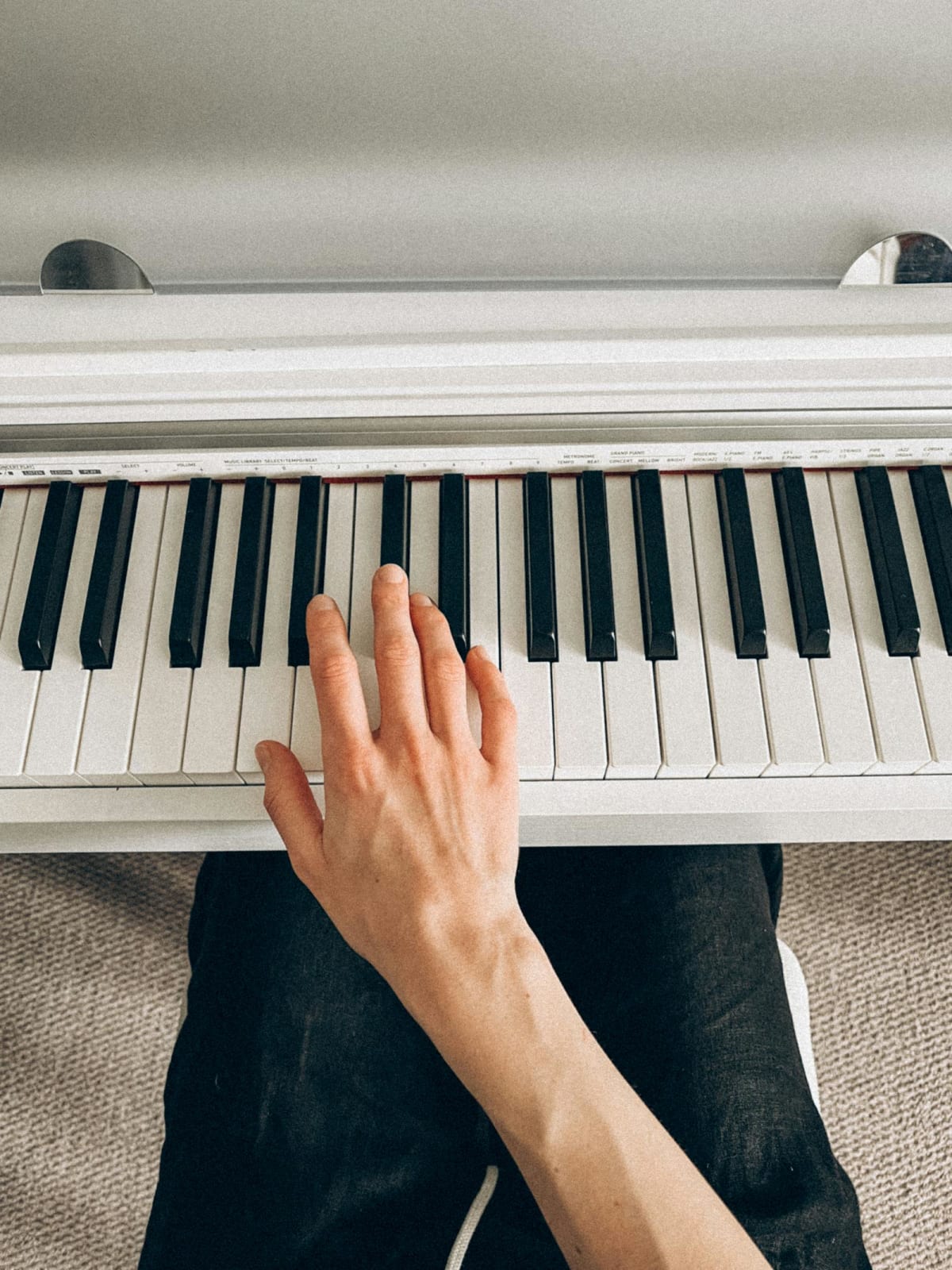
Photo: Lina Kivaka via Pexels
What ROLI Gets Right
Before the criticism, the strongest point first: ROLI is solving a more serious problem than most piano apps solve.
| What ROLI is trying to do | Why it matters |
|---|---|
| Track how you move, not only which notes you hit | That is much closer to how real technical diagnosis works |
| Give live spoken feedback during practice | It reduces the lag between mistake and correction |
| Adapt difficulty and pacing | Beginners often need guidance that is neither too fast nor too vague |
| Combine content, hardware, and coaching in one system | That can reduce setup friction and keep practice moving |
| Address posture, positional, rhythmic, harmonic, and dynamic feedback | This is already broader than the note-only logic of many older apps |
This is exactly why the product is worth taking seriously. Most piano software is still trapped at the level of note compliance. ROLI is at least trying to build a system that sees more of the actual act of playing.
What It Gets Wrong
The short answer is: it confuses measurable signals with full diagnosis.
That is a common AI problem. If a system can track more inputs than older apps, it starts to look like it understands the whole musical situation. But “more inputs” is not the same thing as “complete pedagogical understanding.”
1. Technique Is Not Just Geometry
ROLI is strongest when it talks about things a camera can see reasonably well: finger position, hand placement, gross posture, timing relationships, and movement patterns. That is useful.
But piano technique is not just visible shape. It also involves:
- how force is transferred through the arm
- how much effort is unnecessary
- whether a movement is sustainable over time
- what tone quality that movement produces
- whether the body is compensating in a hidden way
A wrist can look fine and still be too rigid. Fingers can appear correctly curved while the sound stays tight and dead. A student can pass a technical checkpoint while still misunderstanding the sensation that makes the movement healthy and repeatable.
2. “Real-Time Feedback” Still Does Not Equal Real Understanding
ROLI says AI Music Coach can respond in real time with spoken guidance, adjust pace and difficulty, and give feedback as you play. That is impressive. It is also exactly where the overreach starts.
Real teaching is not only about spotting the immediate error. It is also about understanding why this student is making this error in this repertoire at this stage of development.
A good teacher can connect one mistake to:
- repertoire choice that is too hard
- an old fingering habit from easier music
- insecure pulse
- lack of harmonic understanding
- fatigue or pain
- fear, rushing, or attention drift
That kind of causal diagnosis is the real gap. AI can increasingly identify surface patterns. It still struggles much more with pedagogical judgment.
3. The System Is Better at Correction Than Interpretation
ROLI can reasonably claim it helps users play more accurately and with better habits than older learning apps. What it cannot honestly claim yet is to understand the deeper interpretive side of piano playing at teacher level.
For example, it is one thing to say:
- your timing drifted here
- your hand shape changed here
- your dynamics were uneven here
It is another thing entirely to guide a student through:
- voicing a hidden inner line
- balancing harmonic tension across a phrase
- choosing fingering for color, not just convenience
- using pedal as structure instead of blur
- shaping rubato without collapsing pulse
Those are not edge cases. They are central to real musicianship.
4. Hardware Precision Does Not Solve Repertoire Judgment
One of the most underrated jobs of a teacher is deciding what you should even be working on right now.
That includes:
- when to change pieces
- when to stay longer with fundamentals
- when to stop forcing progress on material that is currently too advanced
- when a technical weakness needs separate work away from the piece
ROLI's system may adapt lesson pace, but that is not the same as strong long-term repertoire sequencing. This is the same weakness that shows up in many piano-learning apps, even advanced ones. They are often better at keeping users moving than at deciding when stopping, simplifying, or redirecting would be smarter.
5. Injury and Pain Are Still High-Stakes Blind Spots
ROLI explicitly ties Airwave to better habits and reduced strain. That is understandable, but it is also where caution matters most.
If a student is dealing with:
- pain in the forearm
- thumb collapse under pressure
- locked shoulders
- hidden over-practice tension
- stress-related gripping
the problem may not be safely fixable through generalized automated prompts. In high-stakes technique questions, “better than note-only apps” is not the same as “safe enough to trust without human oversight.”
This is one reason I would still point readers back to Can AI Actually Teach You Piano? and The Problem with Piano Learning Apps. Better sensing does not magically erase the core limits of automated teaching.
6. It Is a Closed System, Not a General Teacher
As of March 7, 2026, ROLI says AI Music Coach beta requires Airwave, a ROLI Piano or Piano M, and specific modern tablets. For the beta, the AI Music Coach FAQ says compatibility is limited to newer iPad Air and iPad Pro models. Airwave’s broader compatibility page also lists recent Samsung Galaxy Tab models for the underlying learning setup.
That does not make the product bad. It just means this is not some universal piano intelligence floating freely above the instrument. It is a tightly controlled hardware-software environment designed to make a narrow set of judgments under favorable conditions.
That distinction matters. A teacher can work with your acoustic piano, your digital piano, your body, your repertoire, your schedule, your psychology, and your changing goals. ROLI works inside ROLI's system.
Where AI Music Coach Will Probably Be Very Good
If I had to predict the strongest use cases, they would be these:
| Likely strong use case | Why |
|---|---|
| Complete beginners who need constant guidance | The system reduces friction and can keep practice interactive |
| Users who respond well to immediate correction | Fast feedback is powerful when the issue is simple and repeatable |
| Basic habit formation | Posture, fingering, and rhythmic consistency are more teachable by system than deeper artistry is |
| Users who would otherwise practice alone with no feedback at all | Even partial feedback can be much better than complete silence |
Where It Still Won't Replace a Teacher
- technical problems with hidden tension or pain
- repertoire sequencing and long-term curriculum decisions
- sound, color, voicing, pedaling, and phrasing at a serious level
- motivation issues rooted in psychology, not task design
- situations where the student needs nuanced judgment, not just feedback frequency
The Bottom Line
ROLI's AI Music Coach is impressive because it pushes piano software closer to real pedagogy than most competitors do.
It gets a lot right: richer sensing, tighter feedback loops, better beginner support, and a more serious technical ambition than most music apps have shown.
What it gets wrong is the oldest AI mistake in the book: assuming that because a system can measure more, it therefore understands enough to replace expert human judgment.
It does not. Not yet.
The most sensible way to see AI Music Coach is as a potentially strong practice assistant, not a full replacement for a piano teacher. If ROLI keeps talking about it that way, the product has a real chance to be useful. If people start treating it as a substitute for deep musical teaching, they will be asking it to do a job it still cannot do.
And if you do use a system like this, track what happens outside the product too. A separate log like Pract.is is useful because it helps you measure actual practice behavior, not only what the app says you completed.
FAQ
What is ROLI AI Music Coach?
It is ROLI's new AI-guided piano-learning system built into the ROLI Learn app and unlocked by Airwave hardware. It combines conversational guidance with hand tracking and real-time feedback.
Can ROLI AI Music Coach replace a piano teacher?
No. It may become a strong practice assistant, especially for beginners, but it still cannot match a good teacher's judgment about technique, repertoire, interpretation, pain, and long-term development.
When is ROLI AI Music Coach available?
ROLI says the closed beta began on February 5, 2026 and that a public beta is planned for the end of March 2026.
What does Airwave actually track?
ROLI says Airwave tracks all 27 joints in each hand at 90 frames per second and feeds that into feedback about posture, position, rhythm, harmony, and dynamics.