
How Ensemble Playing Should Change the Way You Practice Alone
Ensemble playing is not solo practice plus other people later. This guide shows musicians how to change their individual work so pulse, cues, counting, balance, and recovery actually transfer into rehearsals.
Pract.is Editorial
Research-based practice guidance for musicians from the Pract.is editorial team.

Ensemble problems usually start in solo practice. Not because you practiced too little, but because you practiced for a different job. Solo work often rewards control, certainty, and repetition under stable conditions. Ensemble playing asks for something harder: stable pulse, shared timing, cue awareness, role flexibility, and the ability to keep going when the room does something you did not expect.
If your individual practice is built only around getting your own part comfortable, rehearsal can feel weirdly unfair. You know the notes. You can play the passage. But the entrance is late, the tempo breathes in the wrong place, the dynamic covers somebody else, or you lose the line the moment another player phrases differently than you imagined. That is not bad luck. It is a transfer problem.
Research on musical joint action makes this pretty clear. Peter Keller and colleagues describe ensemble coordination as requiring simultaneous precision and flexibility, supported by three real-time skills: anticipation, attention, and adaptation. Laura Bishop’s work on string quartet performance makes the same point from another angle: ensemble players must divide attention between their own part and their co-performers, not just execute isolated technique. So if you want rehearsal to go better, your solo practice has to start behaving like shared music-making before anyone else enters the room.
Before getting practical, it helps to name what usually goes wrong. Most musicians do not need a mystery fix. They need to stop training the wrong behaviors in private.
| Solo-room habit | Why it fails in ensemble | Better private version |
|---|---|---|
| Following only your own rubato | You arrive in rehearsal with tempo choices no one else can stand on | Practice clear pulse first, then controlled flexibility around a felt beat |
| Always starting from your own first note | Entrances fall apart when someone else gives the cue | Rehearse breathing, counting, and silent lead-ins before you play |
| Playing your line at full expressive weight all the time | You cover other voices and stop hearing balance changes | Practice role shifts: lead, blend, support, and get out of the way |
| Stopping whenever the texture gets messy | You never train recovery after someone else misses or phrases differently | Run short sections with planned disturbances and keep the pulse alive |
| Judging success only by your own accuracy | You miss whether your part is actually usable with others | Ask whether the part is predictable, countable, and easy for others to join |
Start treating pulse as shared infrastructure, not private expression
One of the biggest ensemble mistakes is assuming pulse becomes important only once other people show up. It is already the structure they will be forced to trust. Keller’s review of rhythmic joint action is blunt on this point: interpersonal coordination needs precision in the tens of milliseconds, but also enough flexibility to adjust to expressive goals and changing circumstances. That means your pulse cannot be random, and it cannot be rigid in a dead way either. It has to be readable.
Readable pulse is different from metronomic stiffness. A good chamber player or section player does not flatten everything into clicks. They make the beat legible. Other musicians can tell where the center is, where the phrase leans, and how much room there is to breathe without the floor disappearing. If your private playing blurs all of that, rehearsal has to spend time decoding your timing before it can make music.
A 2024 study in Frontiers in Human Neuroscience tested 50 trained musicians and found that individual synchronization practice improved subsequent joint synchronization. That matters because it gives a practical answer to a common complaint: “How am I supposed to practice ensemble skills alone?” One answer is to practice alignment itself. Not just your notes, but your ability to lock to an external event, feel subdivision, and keep your timing predictable enough that another player could hook onto it.
For most musicians, this means doing more than one kind of pulse work. Use a click, yes, but also count subdivisions out loud, feel larger phrase lengths, and test whether your tempo still holds when you stop hearing every beat. If the line only stays together while an external click is doing all the organizing, you have not really built internal pulse. You have rented one.
Count
Say the subdivision or at least the large beats during unstable passages. If you cannot count it, ensemble timing will stay fragile.
Release
Practice cutoffs and rests as deliberately as attacks. Ensemble clarity often falls apart after notes, not before them.
Breathe
Even instrumentalists who are not wind players need breath-shaped timing. If the phrase never inhales, your timing becomes private instead of shareable.
Transfer
Check the passage once without the click. If the pulse vanishes immediately, you were following, not owning.
This is one place where good practice across different instruments still points to the same conclusion. The feedback channel changes, but the repetition has to make your timing more usable, not just more familiar.
Entrances, cues, and counting need their own repetitions
Many musicians practice ensemble repertoire as if the piece starts when they begin making sound. That is too late. In ensemble playing, the real beginning is usually before the note: a breath, a glance, a head cue, a counted rest, a lift, or a felt tempo set by someone else. If you ignore that in private, you are skipping the part of the skill most likely to crack in rehearsal.
A 2018 study of piano duos in Vienna examined how musicians coordinate beginnings and found that at piece onset, when there is no prior audio to indicate the first beat or starting tempo, synchronization depends heavily on the clarity of the visual cue. The study also notes that followers tend to align with the leader’s cue timing rather than merely guessing the start. In plain terms: clear starts are not magic. They are a skill.
That means your private repetitions should sometimes include the cue, not just the phrase after it. Count the bars before your entrance. Breathe in tempo before the attack. If your part enters after someone else, listen to or imagine their line and join from that world instead of from silence. If you lead the entrance in rehearsal, practice a consistent preparatory gesture that matches the tempo you actually intend to give, not a vague theatrical nod that means nothing to anyone else.
The teacher-perspectives study in Frontiers in Psychology is useful here too. In their sample, 13 of 19 expert teachers named listening as the key ensemble skill, and one teacher pointed out that duets and canons help students learn where the music fits in and make a student count. That is exactly the point. Counting is not remedial. It is how you avoid making every entrance depend on instinct.
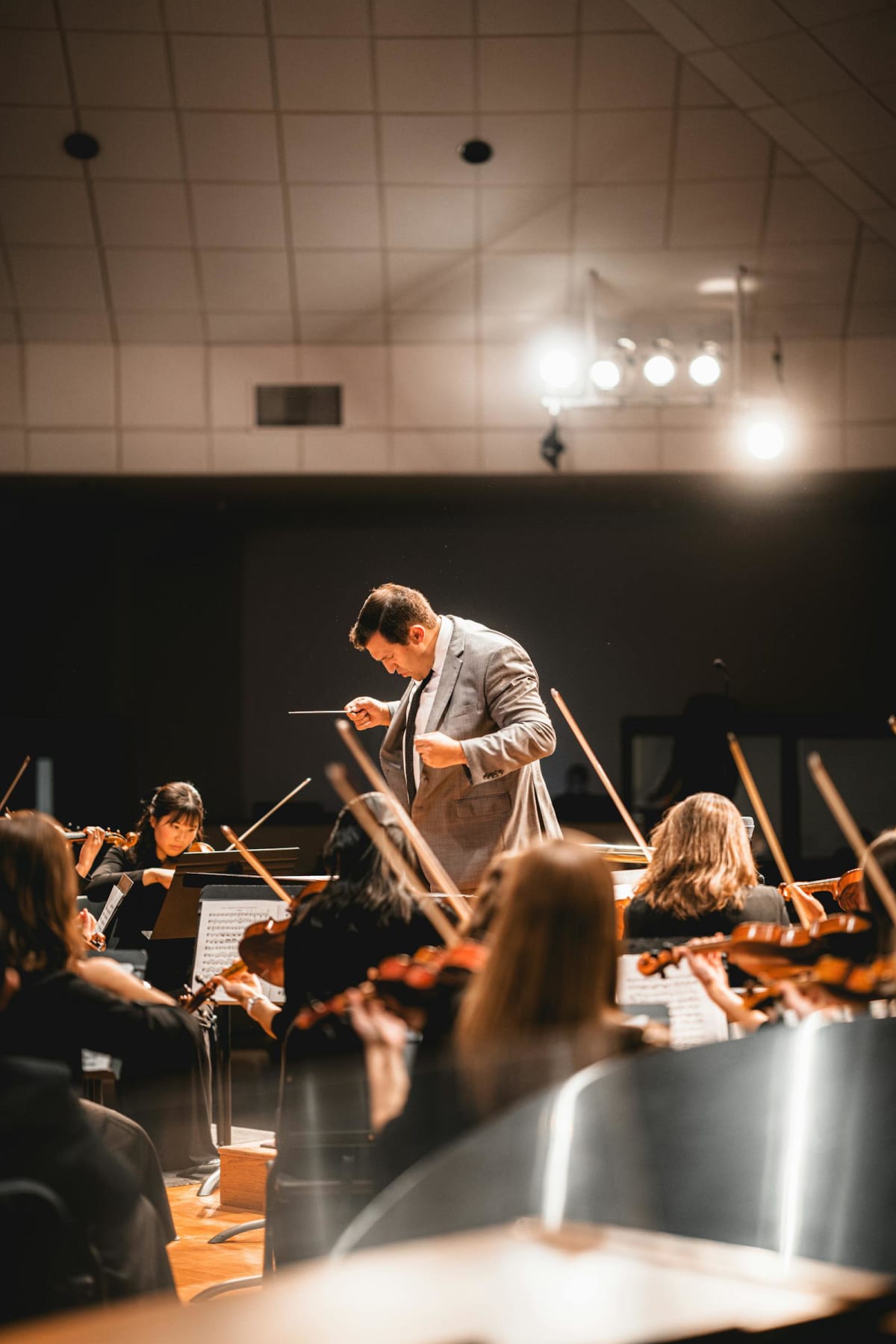
Photo: Zacchaeus Rains via Pexels
If the first note is late in rehearsal, the problem often started two beats earlier. Practice the lead-in, not only the entrance itself.
Listening outward means changing your role, not just hearing more sound
People say “listen” in rehearsal all the time. The advice is correct, but it is incomplete. Listening in ensemble playing is not passive hearing. The 2020 teacher-perspectives paper describes the ability to “listen and respond to others” as the most important ensemble skill, and the respondents treated listening as an active process tied to attention, awareness, and action. That is the useful version of the word.
Active listening means noticing when your role changes. Sometimes you lead. Sometimes you support. Sometimes you carry rhythmic definition. Sometimes your job is to disappear into someone else’s line so the texture works. One respondent in that study described followership as “subverting your own musical expectations” so the ensemble can work musically. That is a better description of chamber skill than most technical advice musicians receive.
In private practice, you can train this by assigning roles on purpose. Play the line once as if you are the structural leader. Then play it again as if someone else has the real melody and your part only exists to support timing or harmony. Practice crescendos that stop early because another part needs the ceiling. Practice releases that leave room after your note instead of emotionally clinging to the phrase. If you always shape your line for maximum personal satisfaction, you arrive at rehearsal overcommitted.
This is also where the difference between solo confidence and ensemble usefulness becomes obvious. A player can sound convincing alone and still be hard to play with. If your part is dynamically inflexible, rhythmically possessive, or emotionally unwilling to bend, the other musicians have to work around you instead of with you. That is not artistry. It is poor coordination wearing expressive clothes.
| If rehearsal keeps showing this... | Your private practice probably needs this... |
|---|---|
| You cover the actual melody or important inner detail | Role-switch reps at two or three dynamic levels, including “support only” volume |
| You miss other people’s phrasing changes | Runs where you sing or imagine the other part before playing your own |
| The group feels like it drags when you enter | Lead-ins with counted rests, breath prep, and lighter attacks into shared pulse |
| You lose the texture after one mistake in another part | Recovery reps where you keep counting through disturbances and rejoin cleanly |
Practice recovery and adaptation, not just ideal conditions
Rehearsals are rarely clean enough to reward perfect-condition practice. Someone rushes. Someone phrases differently. The conductor gives a broader beat than you expected. A wind player needs more breath time. The violas bring out an inner line you had been ignoring. If all your private work assumes a fixed environment, you are training a version of the piece that only exists alone.
Keller’s review frames ensemble coordination around anticipation, attention, and adaptation. Bishop’s quartet paper adds that weaker performers often distribute attention badly, staying locked on their own output when they should be reallocating toward the group. This is why ensemble-ready practice must include controlled instability. Not chaos, just enough disruption that you have to preserve pulse and orientation instead of relying on autopilot.
That can be simple. Deliberately enter a beat later in a practice run and recover without stopping. Drop one note and keep the measure alive. Practice resuming after the barline rather than always from the top. Play a phrase while imagining that another section has slightly more time than you expected, then decide how you would stay connected without collapsing. That kind of work feels less polished than full uninterrupted runs, but it transfers far better.
This is also why practicing for performance instead of just the practice room matters so much. Ensemble playing exposes whether your preparation survives contact with reality. The same general pattern also shows up in why some adult beginners improve faster than others: faster progress usually comes from better problem selection and better transfer, not simply from grinding longer.
A 12-minute ensemble add-on you can attach to almost any practice session
If you already have a repertoire routine, you do not need to rebuild your entire life around ensemble prep. You need a consistent add-on that teaches your part to behave well with other people. This short block works for chamber music, section playing, pits, worship teams, bands, and most collaborative settings.
3 minutes: pulse map
Count, subdivide, and clap or tap the most dangerous bars before playing them. Your goal is to make the timing legible without your instrument hiding the problem.
2 minutes: cue reps
Practice the breath, lift, glance, or counted rest before each exposed entrance. Rehearse joining from silence and from someone else’s imaginary part.
2 minutes: role shift
Run the passage once as leader, once as support. Change dynamics, attack weight, and phrase shape so you can feel the difference in the body.
3 minutes: disturbance training
Miss one note on purpose, delay an entrance, or interrupt the phrase and rejoin at the next landmark. Keep the meter alive and do not panic-stop.
2 minutes: written note
Write one sentence about what tends to fail in rehearsal: late cue, balance issue, weak rest count, or drift after a release. This is where a practice log or Pract.is can actually help, because the note gives tomorrow’s session a real target instead of a vague memory.
That block is short on purpose. If ensemble readiness only happens in long ideal sessions, it will not happen often enough. A smaller routine you can repeat is more valuable than a perfect plan you run once every two weeks. It fits the same logic as building a sustainable practice routine: consistency beats ambition when the work is specific.
Private practice should make you easier to play with. If it only makes you more comfortable alone, it is solving the wrong problem.
More on practice methods.
A Practice Diary for Pianists: Turning Hours at the Keys Into Results
A piano practice diary can expose plateaus, strengthen memory, and protect sight-reading time. Learn what to record so each session changes the next.
Pract.is Editorial

Reading Your Practice Data: What the Numbers Actually Tell You
Practice statistics reveal coverage, spacing, effort, and trends. Learn to track practice progress without mistaking activity for musical improvement.
Pract.is Editorial

How to Build a Practice Routine You Actually Keep
A practice routine is easier to keep when its order stays fixed and its length can change. Build a schedule for sessions of 10, 25, or 45 minutes.
Pract.is Editorial