forScore vs. Practis Score is not a contest between an old PDF reader and a new practice app. forScore is a mature Apple score workspace built for library and performance work; Practis Score is a newer cross-platform workspace built to carry the details of a practice session into the next one. We built Practis, so this comparison puts its limits beside its advantages instead of pretending to be neutral.
If the score should remember the session. It links the page to time, session notes, recordings, trouble spots, and a page heatmap across web, iPhone, and Android.
If the score should run your library and performance. Its metadata, setlists, annotation depth, pedal and MIDI controls, backups, and stage workflow are substantially more mature.
The practical answer for some musicians: keep forScore as the performance library and use Practis for selected scores that need focused practice history.
The same PDF arrives at two different destinations
Both apps can put an owned PDF on a screen, let you mark it, and keep it close at hand. The meaningful difference appears after that common starting point. forScore keeps moving toward a clean, reliable performance environment. Practis keeps moving toward evidence that helps the next practice session start with context.
That is why feature-count comparisons can be misleading. A setlist folder and a page heatmap are not rival versions of the same feature. One prepares the music for a gig; the other exposes where a practice session actually spent its attention.
One PDF, two working paths
forScore prepares the page for performance; Practis carries the work on the page into the next session.
The distinction here is intentionally narrower than our broader comparison of sheet music apps, which also covers Newzik, MobileSheets, Piascore, and nkoda. This head-to-head is for a musician who already owns PDFs and wants to know which of these two working paths fits.
Where forScore is clearly ahead
forScore has spent years solving the unglamorous details of a serious digital music library. Scores can be organized with metadata, labels, bookmarks, menus, and setlists; pages can be cropped, rearranged, or grouped; and the library can be searched without turning every rehearsal into file management. A musician carrying hundreds or thousands of charts will feel that maturity quickly.
Its performance workflow is the larger advantage. forScore supports Bluetooth page-turn devices, MIDI commands, synchronized page turns, saved page-turn timing, setlist navigation, linked audio, recording, and a configurable metronome. Those tools matter when a score app becomes part of the instrument setup rather than something consulted between repetitions. Practis Score is not a substitute for this stage infrastructure.
Annotation is also deeper in forScore. Its current tools include drawing presets, stamps, shapes, text, rulers, selections, layers, and a polished Apple Pencil workflow. Practis has pen, highlighter, eraser, and annotation layers, which are enough for ordinary fingering and phrasing notes, but a player who marks scores extensively will find more control in forScore.

forScore also offers unusually clear ownership and backup choices. Its backup and archive tools can preserve the database, PDFs, metadata, and settings, while CSV export makes the catalog less opaque. Its optional practice Dashboard stores tracking data locally unless the user chooses to share it. That local-first design is a real privacy strength, not a minor technical footnote.
As checked on July 17, 2026, the US App Store lists forScore at $24.99, with an optional forScore Pro subscription at $14.99 per year. It supports current Apple platforms, including iPhone, iPad, Mac, and Vision Pro, but not Android or a general web workflow. The price is easy to justify for a working Apple-based musician; the platform boundary is decisive for everyone else.
"forScore is the better instrument stand. Practis is trying to remember what happened while the music was on it."
Where Practis Score changes the practice session
Practis Score starts with a different object: the repertoire piece rather than the PDF file. A musician attaches an owned PDF to a piece, opens it for practice, and the session timer begins. At the end, the time and session note return to the same practice history as work done away from the score.
The page itself contributes evidence. Bookmarks can label structural places; trouble spots can mark unstable passages; and a viewport heatmap records where attention collected across the score. A page that received forty careful minutes no longer looks identical in the record to one that was flipped past twice. The built-in metronome and recorder can stay close to the passage instead of requiring a trip through other apps.
The screenshot below shows the current browser score workspace in its normal reading theme. The important controls are intentionally close to the page: annotation tools on the left, the score in the center, bookmarks and trouble markers on the right, and a small movable metronome rather than a separate full-screen mode.
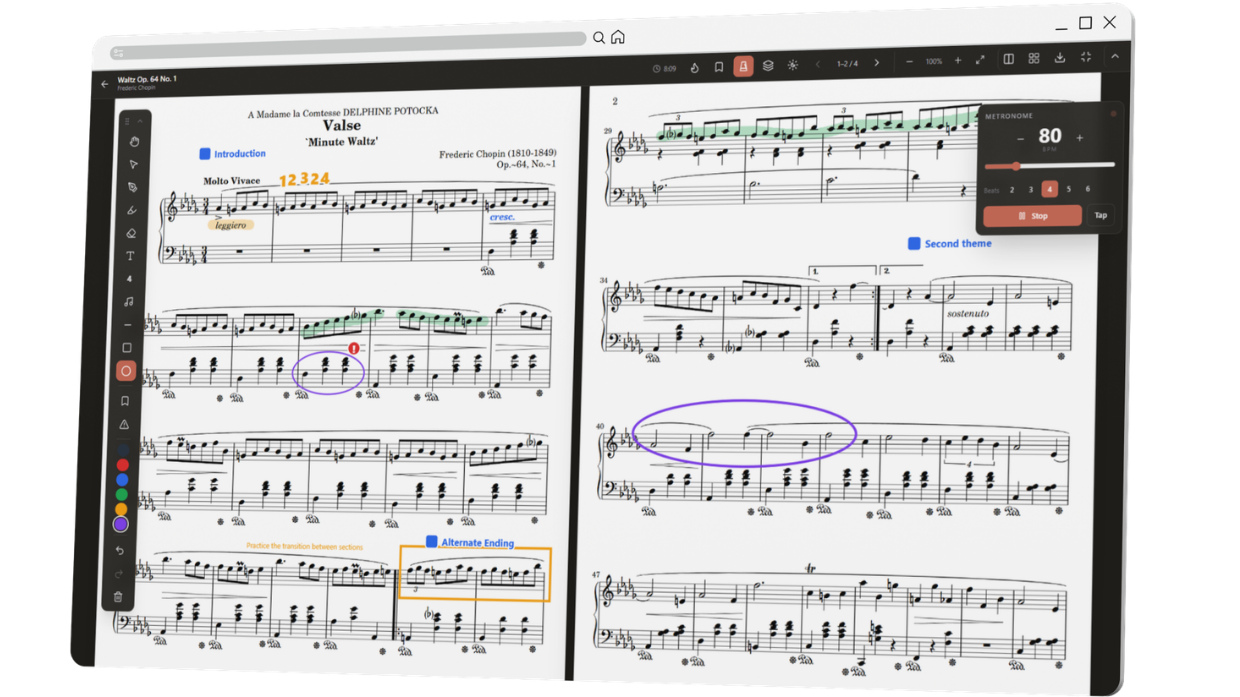
Practis works on the web and has iPhone and Android apps. A free account currently includes up to ten scores and 200 MB of score storage. That makes it simple to test with active repertoire instead of moving an entire archive.
The limits matter. Practis does not scan printed music, recognize notation, transpose a score, or supply a licensed catalog. Uploads must be PDFs the musician is entitled to use, with a current 25 MB file limit and one attached score per repertoire piece. Its library metadata, setlists, external page-turn controls, MIDI behavior, annotation precision, and performance tooling are not as developed as forScore's. It is a focused practice layer, not a mature replacement for every score job.
Both track time, but they remember different things
It would be unfair to describe forScore as a reader that forgets practice. Its opt-in Dashboard tracks which scores, bookmarks, and setlists were viewed and for how long. It provides up to 90 days of analytics, time- or view-based goals, daily through all-time summaries, and PDF reports. For a musician whose practice already revolves around opening the right score, that is useful and pleasantly unobtrusive.
This official Dashboard view makes the model clear: the tracked unit is a viewed score, bookmark, or setlist, arranged as time and activity.

Practis uses the session as its tracked unit. It can preserve duration, a written note, the piece, recordings, metronome use, page activity, viewport heat, and marked trouble spots. That gives it a stronger answer to a narrower question: not merely how long was this score open?, but where did the work collect, what did the musician notice, and what should happen next? For musicians who need a broader record beyond PDFs, our guide to practice log apps and templates compares digital and paper approaches without assuming the score must be at the center.
This distinction has a sensible learning basis, but it should not be inflated into a clinical claim. A 2026 study of 290 musicians by Suzuki, Wolf, and Ginsborg describes self-regulated music practice as a cycle of planning, execution, and reflection; higher self-regulation scores were associated with self-efficacy and deliberate practice. The study did not test either app. It simply helps explain why what happens after a session can be as relevant as what is visible during it.
"Tracking is only useful when the record changes what you do the next time the score opens."
The feature comparison, without pretending every feature is equal
The table below separates availability from maturity. A check in both columns does not mean the two implementations are equally deep; the final column names the practical consequence.
| Working need | Practis Score | forScore | What changes |
|---|---|---|---|
| Devices | Web, iPhone, Android | Apple ecosystem | Android rules out forScore immediately. |
| Large PDF library | Basic repertoire-led library | Deep metadata, labels, bookmarks, menus | forScore scales better for a professional archive. |
| Annotation | Pen, highlighter, layers | Advanced drawing, stamps, shapes, text, layers | Heavy score markers get more precision in forScore. |
| Live performance | Basic reading and setlist support | Mature setlists, pedals, MIDI, synchronized turns | forScore is the safer stage choice. |
| Practice time | Automatic session timer and diary | Opt-in views and duration Dashboard | Both track time from different starting points. |
| Page evidence | Page and viewport heatmap, trouble spots | Viewed score or bookmark history | Practis is more specific about where attention went. |
| Reflection | Session notes and recordings in practice history | Reports plus score-linked audio and recordings | Practis keeps reflection closer to the next session. |
| Tracking privacy | Account-based sync; encrypted in transit | Dashboard stored locally by default | forScore has the stronger local-only model. |
| Getting scores | Upload owned PDFs | Import owned PDFs | Neither is a licensed score subscription. |
The most important rows are usually devices, live performance, and page evidence. The rest become relevant only after those three fit. A musician should not sacrifice reliable stage control for a more detailed heatmap, or buy an iPad-only library tool when practice actually moves between an Android phone and a browser.
Choose around the workday, not the brand
Choose forScore if the app needs to hold a large Apple-based library, build dependable setlists, respond to pedals or MIDI, and disappear during a performance. Its Dashboard may already provide all the practice visibility needed, especially if score-level time is enough.
Choose Practis Score if the recurring problem is continuity: forgetting where yesterday's work stopped, spending too much time on comfortable pages, or losing notes and recordings across separate tools. It is also the practical option of the pair for Android users. If the score is only one part of a wider routine, our explanation of what a music practice app should actually track can help clarify whether page-level data is even the missing piece.
Use both if forScore already runs performances well but two or three active pieces need a closer practice record. There is little reason to migrate a carefully organized archive merely to test another philosophy. Put one legally owned PDF into each workflow and let an ordinary two-day rehearsal expose the useful friction.
The 48-hour score test
The winner is the app that reduces friction at the moment your work usually breaks. forScore wins when the break is library or stage logistics. Practis wins when the break is remembering the shape of yesterday's practice. Neither answer needs a universal ranking, and neither product becomes better by being asked to do the other's central job.