The most dangerous hand pain is often the pain you explain away in under ten seconds. “Probably just tension.” “Probably because I practiced a lot today.” “Probably nothing.” Sometimes that instinct is right. Sometimes it is the exact habit that turns a manageable overload signal into a bigger problem.
For musicians, the hard part is not just pain itself. It is interpretation. Hands get tired. Forearms get loaded. A new technique problem can make one motion feel expensive for a few days. None of that automatically means you are injured. But normalizing every symptom is just as unhelpful as panicking over every ache. The useful move is to sort the pattern quickly and honestly.
That matters because playing-related pain is common. A 2023 systematic review found musculoskeletal pain is highly prevalent in musicians, with risk shaped by instrument demands, posture, technique, workload, and psychosocial strain. A newer systematic review on therapeutic exercise in instrumental musicians describes playing-related musculoskeletal disorders as a spectrum that can include pain, weakness, numbness, tingling, and loss of function. In other words, hand pain after practice is common enough to deserve clear thinking, not superstition.
Start with the pattern, not the panic
No article can diagnose your hand through a screen. But symptom pattern is still useful. If both hands feel generally tired after a longer-than-usual session, and the sensation fades with rest, that points in a different direction from a sharp pain at one exact tendon, or numbness that lingers after you leave the instrument. The point is not to label yourself. It is to stop treating every symptom as the same category of problem.
NHS guidance on repetitive strain injury is useful here because it is plain and specific. It notes that symptoms often start gradually and can include pain, weakness, tingling, numbness, cramps, and swelling. That gradual onset is one reason musicians get fooled. A problem can build quietly enough to feel normal right until it is not.
The fastest first filter is simple: does this feel like diffuse load, one repeatable trigger, or a change in nerve-type sensation and function? That is the decision point below.
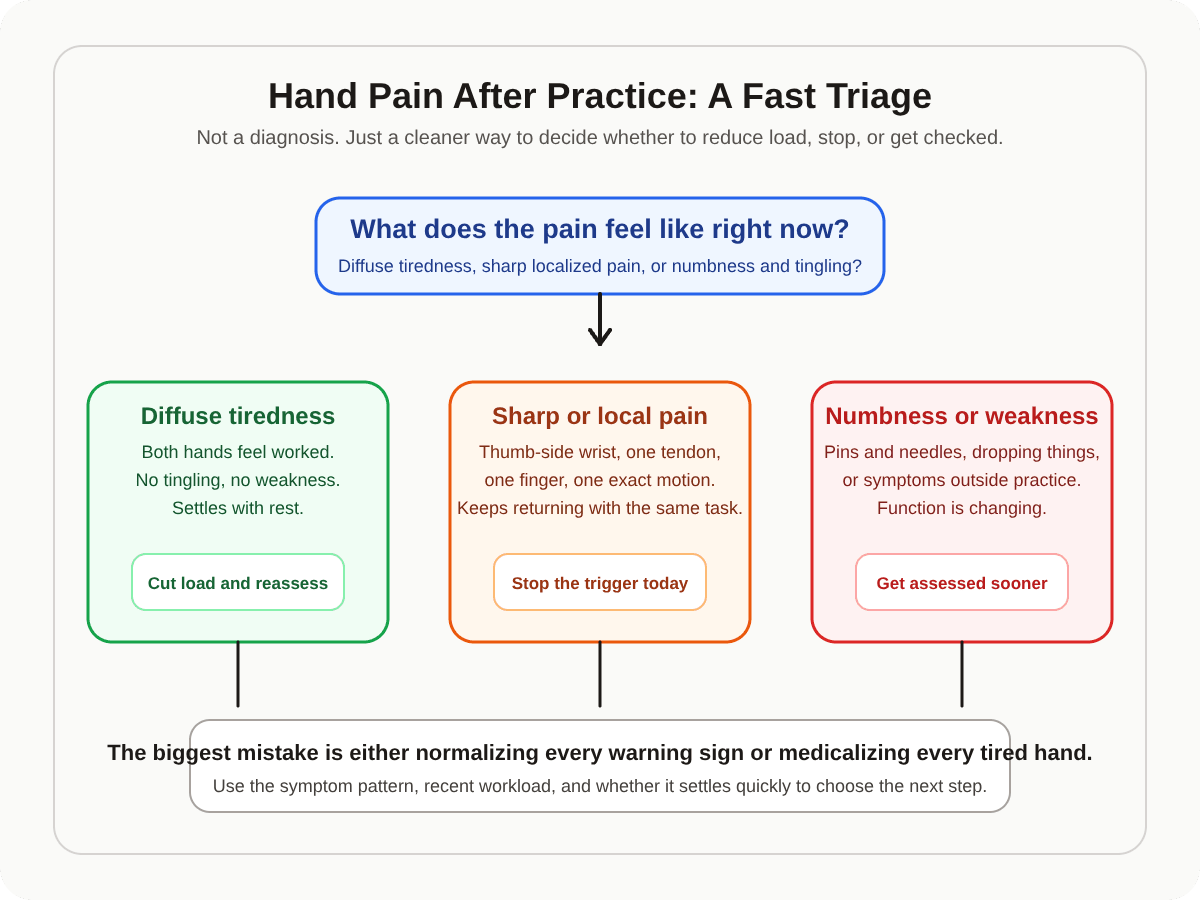
More like overload
Both hands or forearms feel generally worked, symptoms calm down after stopping, and nothing is tingling or giving way.
More like a trigger problem
One motion, one passage, one hand position, or one specific area hurts every time you repeat it.
More like a warning sign
Tingling, numbness, weakness, swelling, or symptoms that keep showing up in daily life as well as practice.
What is usually just fatigue, and what should make you more cautious?
Musicians need a better definition of “normal.” A hand can feel used without being unsafe. If you practiced more than usual, spent a long block on octaves, barre chords, repeated bow strokes, or fast passagework, some diffuse muscular tiredness is not shocking. HSS notes that many minor aches settle after a short rest or a few days, especially when the response is calm and sensible rather than panicked.
That said, fatigue and warning signs are not the same thing. Fatigue is usually broad, dull, and proportionate to what you just did. It tends to ease when you stop, and it does not usually come with tingling, numbness, dropping objects, or clear loss of motion. Warning signs are usually more specific. They are sharper, stranger, or more persistent. They interrupt function instead of just making you feel worked.
| If it feels like this | It is more likely | Best next move |
|---|---|---|
| General tiredness across the hands or forearms after an unusually heavy session | Load and muscular fatigue | Stop for the day, reduce the next session, and see whether it settles quickly |
| One exact movement or passage causes the same local pain every time | A movement or tissue-overload problem worth interrupting | Stop repeating the trigger and review setup, technique, and recent workload |
| Pins and needles, numbness, weakness, or symptoms that spill into daily tasks | A stronger warning sign that should not be normalized | Reduce load immediately and consider prompt medical assessment |
| Visible swelling, severe pain, or inability to move normally | Something beyond routine post-practice fatigue | Stop self-testing and get assessed |
This is where the broader prevention logic from piano injuries are more common than you think matters. Most musician problems do not arrive as dramatic one-time events. They arrive as a repeated mismatch between what the tissue can currently tolerate and what the practice setup keeps asking it to do.
Location matters, but only as a clue
Symptom location can help you sort what not to ignore, but it is not a self-diagnosis kit. Still, some patterns are common enough to be worth recognizing. Mayo Clinic’s description of de Quervain’s tenosynovitis centers on pain and tenderness on the thumb side of the wrist, often made worse by gripping and repeated wrist bending. Its carpal tunnel guidance describes numbness and tingling most often affecting the thumb, index, middle, and part of the ring finger, not the little finger. Those are not labels you should assign casually, but they are patterns worth taking seriously.
| Pattern you notice | What it can point toward | Why it matters |
|---|---|---|
| Thumb-side wrist pain with gripping, lifting, or repeated wrist movement | A common tendon-loading pattern clinicians often compare with de Quervain’s | Repeatedly “playing through it” is usually a bad experiment |
| Tingling or numbness in thumb, index, middle, and part of ring finger | A pattern consistent with median-nerve irritation seen in carpal tunnel cases | Nerve-type symptoms deserve earlier attention than ordinary tiredness |
| Diffuse soreness only after a much heavier session than usual | Short-term overload rather than one clear diagnostic pattern | Load reduction and recovery may solve it if it settles quickly |
The practical point is modest but important. If the symptom is local, consistent, and reproducible, do not keep probing it with the exact same motion for another thirty reps. That is the same logic behind knowing whether you need more repetition or a better strategy. Once the body is clearly objecting to one exact pattern, more repetitions are often not more learning. They are just more irritation.
What to do in the first 24 to 72 hours
The first mistake musicians make is pretending nothing happened. The second is shutting everything down for too long without any plan. NHS advice on RSI splits the difference well: keep active overall, but limit the aggravating activity at first and then increase gradually. It also warns against resting the area for more than a few days because prolonged rest can make the body part weaker and less flexible. HSS and BAPAM add another piece musicians need to hear clearly: if you feel pain, stop, and take the break seriously.
1. Stop the exact trigger
Do not spend the evening “checking” whether the same passage still hurts. You already have the data.
2. Reduce load, not all movement
Back off the aggravating task first. Gentle normal use is different from hammering the same pattern again.
3. Use simple symptom care
NHS suggests wrapped hot or cold packs for short intervals. Choose the option that calms the area, not the one that feels more heroic.
4. Audit the week
Was it longer sessions, harder repertoire, more force, worse sleep, a different setup, or a new technical demand?
5. Escalate if the pattern is wrong
If it is getting worse, spreading, tingling, or affecting normal life, stop self-managing earlier.

Photo: Kindel Media via Pexels
One more correction is worth making here. Stretching is not always the answer people think it is. BAPAM’s warm-up guidance explicitly says a warm-up does not involve stretching, and that gentle stretches are better saved for after playing once muscles are warm. That matters because injured or irritated musicians often default to aggressive stretching the area that already hurts. Usually the smarter first move is load reduction, calm symptom management, and better diagnosis of the trigger.
When to stop self-managing and get checked
This is the part musicians are worst at. If symptoms are not going away, are getting worse, or are starting to affect ordinary life, the goal should shift from self-experimentation to actual assessment. NHS says to see a GP if RSI-type symptoms are not going away or are getting worse. Cleveland Clinic’s hand and wrist guidance is similarly clear about seeking care for pain that does not improve with at-home care, severe swelling, difficulty moving normally, or symptoms that are interfering with usual tasks.
If tingling, numbness, or weakness are in the picture, do not file them under ordinary practice fatigue. If the same local pain returns every session for a week even after you cut load, do not keep negotiating with it. If your practice routine has become a constant cycle of “it calmed down, so I tested it again, and now it is back,” that is already your answer.
Stop guessing sooner if
The pain is sharp and repeatable, the hand is swelling, motion is limited, you are getting numbness or pins and needles, or everyday tasks like opening jars, typing, lifting, or gripping feel different than usual.
For musicians, the best clinicians are often those with hand, upper-extremity, sports, or performing-arts experience. The right question is not just “what is this called?” It is “what is being irritated, what load can I tolerate right now, and how do I return without recreating the same problem?” That is also why building a practice routine you can sustain long-term matters so much. Pain is often the point where unsustainable structure finally becomes visible.
FAQ: the questions people usually ask after the panic search
Is it normal for my hands to feel sore after one unusually long practice session?
It can be. Diffuse tiredness after a bigger-than-usual session is different from a sharp, local, repeatable pain or nerve-type symptoms. If it settles promptly with rest and reduced load, that is reassuring. If it keeps returning or changes function, treat it more seriously.
Should I stretch the painful area right away?
Not aggressively. BAPAM’s guidance is that warm-up is not the same thing as stretching, and gentle stretching is better once muscles are already warm. If an area is actively irritated, forcing range immediately is often a poor first response.
Can I keep practicing if the pain is mild?
You can often keep moving in a reduced way, but you should usually stop the exact task that clearly triggers the pain. Continuing to play through one reproducing motion just to prove toughness is how mild problems become persistent ones.
Who should I see if it is not improving?
A GP, sports-medicine clinician, hand specialist, physiotherapist, or performing-arts medicine clinician can all be appropriate starting points depending on where you are. The key is to find someone who takes function, load, and return-to-playing seriously rather than giving you only a generic “rest more” answer.
Hand pain after practice is not always a crisis. But it is always information. The useful habit is not fear. It is faster recognition, cleaner decisions, and less ego when the hand is clearly asking for a different plan.