Your first instrument should fit Tuesday night, not your fantasy self. That is the cleanest way to avoid a bad choice.
A lot of adults pick an instrument for the wrong reason. It looks impressive. It matches a self-image. It feels like the kind of person they want to become. Then real life arrives: apartment walls, maintenance, finger discomfort, storage, money, tired evenings, irregular schedules. The right first instrument is usually the one whose sound you genuinely want and whose daily friction you can actually live with.
Start with sound, but do not stop there
The strongest reason to choose an instrument is still the oldest one: you love the sound enough to come back to it. Daniel Mateos-Moreno and Anders Hoglert's 2024 study on instrument choice is helpful here because it strips away a lot of lazy assumptions. In their sample, instrument timbre was the most common stated motive, while genre preference mattered surprisingly little. They also found that trying instruments in a testing session had a meaningful influence on choice.
That is a useful corrective. Adults often overthink genre identity. "I like jazz, so maybe saxophone." "I like singer-songwriters, so maybe guitar." But what keeps people returning is usually more basic: do I actually want to hear this sound coming from my own hands every day?
At the same time, sound is not enough by itself. The same Cambridge paper also notes that people do not always end up on the instrument they would have preferred most, because practical barriers interfere. Availability, family context, age, and access all shape the decision. For adults, the equivalent barriers are usually cost, noise, space, portability, maintenance, and lesson access.
Bad reason: "This instrument makes me look like a serious musician." Better reason: "I want this sound badly enough to live with its daily inconvenience."
Five filters matter more than image
Once the sound pulls you in, run the choice through five more practical filters. These are what stop a promising instrument from becoming expensive furniture.
| Filter | Question to ask | Why it matters |
|---|---|---|
| Sound preference | Would I still want this instrument if nobody saw me play it? | Timbre is what keeps you returning when progress is slow |
| Practice volume | Can I make this much sound where I live, at the time I can actually practice? | An instrument you cannot realistically play becomes a weekend fantasy |
| Maintenance | Will I really tune, wipe, swab, oil, replace strings, or buy reeds as needed? | Maintenance friction matters more than people admit |
| Session shape | Does this instrument reward short daily contact, or does it punish long gaps more harshly? | Your actual week matters more than your ideal week |
| Cost and setup | Can I afford the full starter setup, not just the instrument body? | Bench, stand, case, reeds, rosin, sticks, mute, and lessons all count |
The session-shape point is the one adults often miss. Laura Ritchie and Phil Kearney's pilot study on adult beginner instrumentalists is useful because it frames early progress around self-regulation, not inspiration. That matters when choosing an instrument. You are not only choosing a sound. You are choosing a daily practice relationship.
If your life realistically gives you 15 to 25 minutes on most days, the best first instrument is the one that can still produce satisfying, directed work in that window. If you know your schedule is chaotic, an instrument with high setup friction, high maintenance, and high volume constraints is usually a harder first bet.
A quick comparison of common first instruments for adults
This is not a ranking. It is a friction map. Use it to narrow the field before you fall in love with the wrong idea.
| Instrument | Portability | Practice volume | Maintenance | Short daily practice fit |
|---|---|---|---|---|
| Digital piano | Low to medium | Excellent with headphones | Low | Strong |
| Acoustic guitar | High | Moderate | Low to medium | Strong |
| Ukulele | Very high | Low to moderate | Low | Very strong |
| Violin | Very high | Acoustically exposed | Medium to high | Medium, but daily contact helps a lot |
| Flute or clarinet | Very high | Apartment-dependent | Medium to high | Medium, regularity matters |
| Electronic drums | Low to medium | Very good with headphones, but pad noise remains | Low to medium | Strong |

Photo: Tima Miroshnichenko via Pexels
What those options really mean in adult life
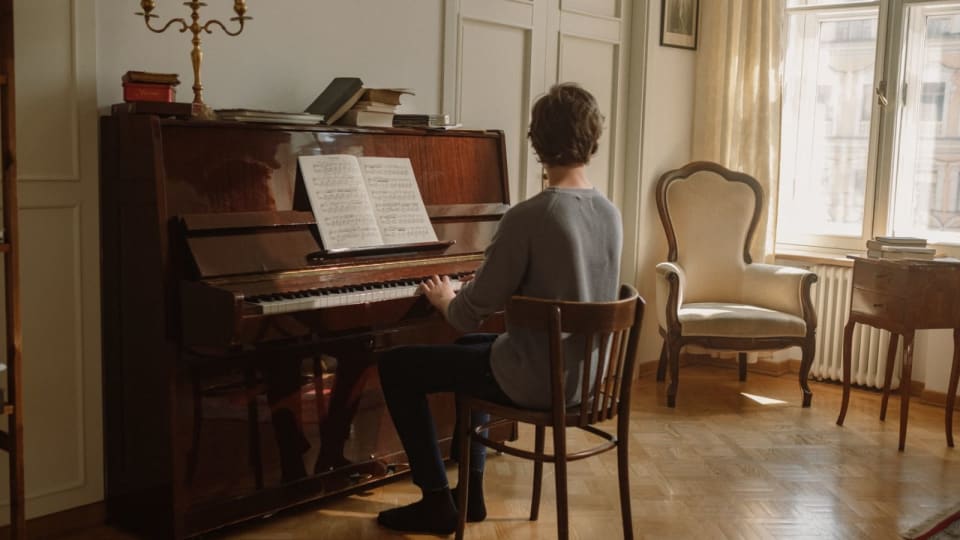
Digital piano is one of the safest adult-entry choices if you are genuinely drawn to piano. The reasons are practical: visual layout, direct pitch feedback, low maintenance, and silent practice through headphones. Yamaha's beginner piano guide emphasizes the obvious but important advantages of digital pianos being more compact, more affordable, and maintenance-free than acoustics, while its weighted-keys guide explains why weighted keys matter when the actual goal is piano. If piano is the sound you want, this is often the lowest-friction serious route. If that is your lane, the natural next reads are how to start piano as an adult and whether you really need 88 keys.
Acoustic guitar is portable, musically flexible, and socially useful. You can accompany songs quickly, carry it easily, and get a lot of reward from short sessions once basic chord transitions settle in. The tradeoff is that acoustic guitars are less forgiving of neglect than many beginners think. Yamaha's maintenance guidance stresses humidity and temperature stability, and beginners also run into tuning, string changes, and fingertip discomfort early. So guitar is a good first choice if you want songs, portability, and broad stylistic range, but not if you want zero upkeep.
Ukulele is often the best choice for adults who want the shortest path from "I own an instrument" to "I can actually make music on it." Fender's beginner material is blunt on why: soft nylon strings, small size, low cost, and simple chord entry make it easier on the hands than steel-string guitar. That does not make it a toy. It makes it a low-friction instrument. If your real constraint is energy, not enthusiasm, ukulele is often a smarter first choice than guitar.
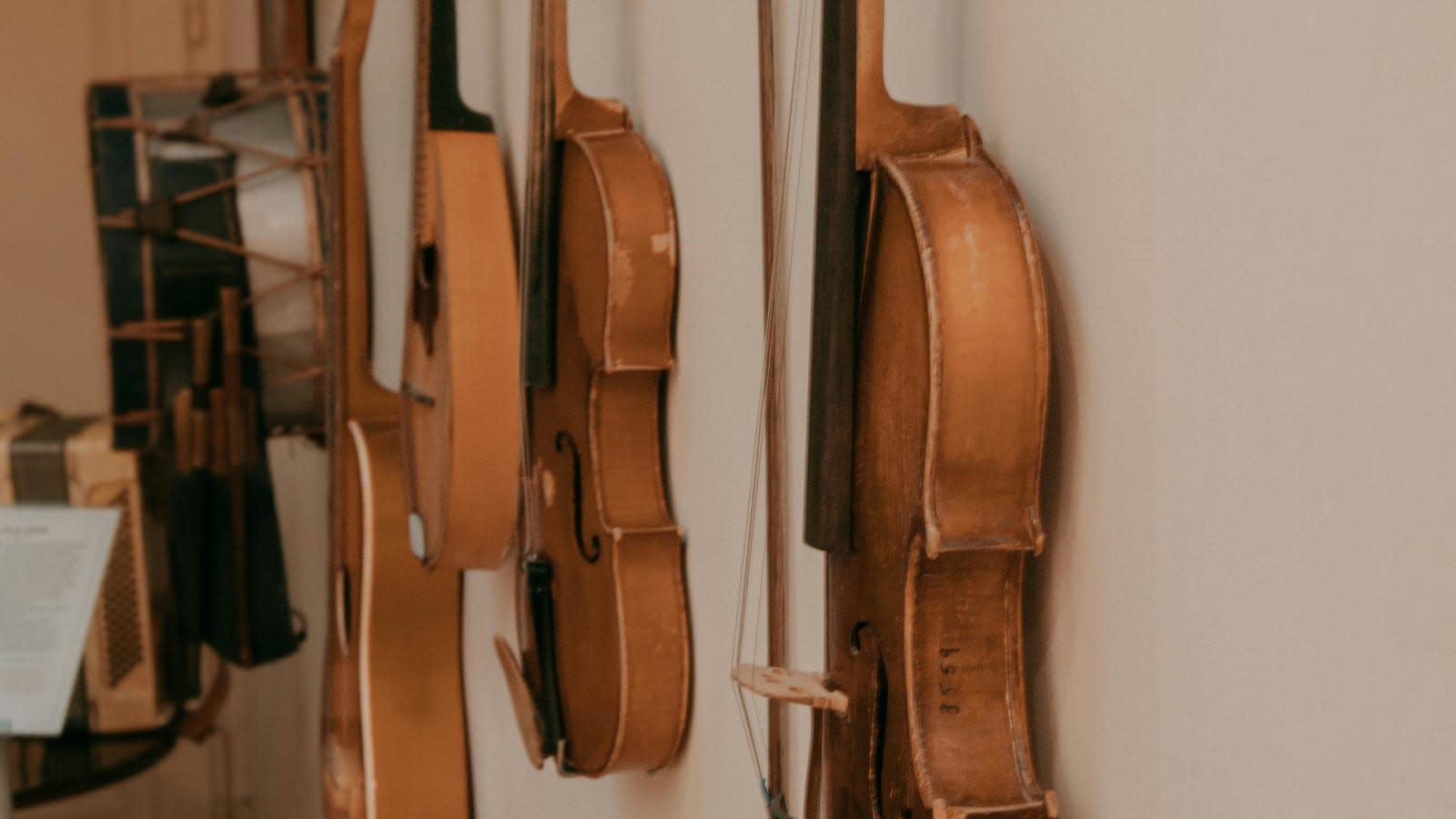
Violin is the opposite kind of choice. Tiny to carry, hard to hide. It travels well, but the early learning curve is steeper because pitch is fully exposed, tone depends on the bow, and even a small amount of tension shows up in the sound. Violin also asks more ongoing care than people expect. Yamaha's care pages emphasize wiping rosin after playing and regular string replacement. So violin is a good first instrument only if the sound is strong enough in your imagination that you can tolerate a slower, scratchier opening phase.
Flute and clarinet are highly portable and musically satisfying, but they are not maintenance-free commuter instruments. Flute needs moisture removed after playing and regular pad care, as Yamaha's flute maintenance guide spells out in detail. Clarinet adds reed management and, in wooden models, humidity caution; Yamaha's clarinet guide warns that rapid temperature and humidity changes can affect the body. These instruments suit adults who love wind sound enough to accept a little ritual after every session. They also reward regular daily contact because embouchure and response degrade faster across gaps than many beginners expect.
Electronic drums are the most practical adult route into drumming for many homes. Roland's V-Drums materials make the case clearly: headphone monitoring and quieter pad technology make home drumming much easier than an acoustic kit, and the company now openly markets quiet-design electronic kits around exactly that problem. The remaining catch is that electronic drums are not silent. Pad impact, pedal vibration, and floor transfer still matter. So e-drums are an excellent first choice if rhythm is your center and you can control room noise, but a poor one if you live over somebody with no tolerance for foot noise.
If you are torn between two instruments, choose the one with the lower weekly friction unless the other sound is overwhelmingly stronger for you.
Run the seven-day reality test before you buy
Adults do not need a spiritual revelation to choose an instrument. They need a cleaner test.
- Name your real sound. Pick the one or two instruments whose sound you would still want if nobody ever complimented you for choosing them.
- Check the room, not the dream. Think about neighbors, family, walls, storage, humidity, and whether the instrument can stay set up or must be unpacked every time.
- Price the full setup. Include stand, bench, case, rosin, reeds, sticks, mute, tuner, headphones, or first lesson. The body alone is rarely the real price.
- Match it to your actual session length. If your life gives you twenty real minutes, choose the instrument that still rewards twenty real minutes.
- Try before committing if possible. Mateos-Moreno and Hoglert's study is useful again here because trying instruments was itself influential. One test session can save months of mismatch.
- Ignore fantasy identity. "I feel like a violin person" is not worthless, but it is weaker than "I can see myself practicing this on a tired Wednesday."
- Choose the instrument you are likeliest to touch tomorrow. Not the most prestigious one. Not the most cinematic one. The one you will actually pick up.
If consistency is your real challenge, that last step matters more than everything else. The right first instrument is not the one with the highest ceiling. It is the one that fits a sustainable routine. That is the same logic behind building a practice routine you can sustain long-term.
The wrong first instrument usually fails for a boring reason. Not because you lacked talent. Because the sound, setup, maintenance, or daily-life fit was wrong. Get that fit right, and the beginning becomes much easier to trust.