
Sloppy rhythm is not one problem. That is why “practice slower” only gets you part of the way.
A passage can be rhythmically messy for at least four different reasons: the subdivision is vague, the two hands are not landing together, the weak spot sits at a chunk boundary, or the whole thing only works while an external click is spoon-feeding every beat. If you treat all four with the exact same fix, progress gets slow fast.
Research note: this article was written on March 16, 2026 from primary sources, including Drake and Palmer in Cognition (child and adult pianists ages 9-26 learning a new piece across 11 practice trials, 2000), Pfordresher and Palmer in Psychological Research (three experiments on delayed auditory feedback and subdivision, 2002), Goebl and Palmer in Experimental Brain Research (12 pianists, 2008), Furuya and Soechting in Experimental Brain Research (6 pianists, 2010), van Vugt et al. in Frontiers in Psychology (conservatory pianists, 2012), Furuya and Yokota in Journal of Neurophysiology (27 pianists, 2018), Hestermann et al. in Psychological Research (16 novices and 16 amateur musicians, 2019), and Nusseck et al. in Frontiers in Psychology (25 advanced piano students, 2025).
First, identify what kind of rhythmic mess you are hearing
Most players call everything “bad rhythm,” which is too vague to fix. Start here instead.
| What you hear | What is probably happening | Best first fix |
|---|---|---|
| Fast notes bunch up or stretch out unevenly | The subdivision is not actually clear | Count aloud, clap or tap the rhythm, then play it on one note |
| Hands are individually fine but land together badly | The coordination plan is unstable | Block the vertical arrivals, practice the entry points hands separate, then reconnect |
| The bar is fine until a crossing, leap, or barline | The weak point sits at a chunk boundary | Loop one beat before and after the seam, not the whole bar |
| It sounds secure only while the metronome clicks every beat | You are following the click, not owning the pulse | Move to larger beats, off-beat clicks, or gap-click tests |
That diagnostic step matters. Drake and Palmer found that as pianists improved across practice, their timing skill and their planning skill improved together. In plain English: cleaner rhythm is not just a matter of moving slower. It is a matter of organizing the sequence better.
Why slower practice helps, but does not solve the whole thing
Slow practice is still good advice. It gives you time to hear the spacing, notice the coordination, and prevent the passage from turning into blur. The problem is that it only works if you use the extra time for something specific.
If you slow down and keep the rhythm vague, you are just repeating vague rhythm at a lower speed. If you slow down but always restart from the beginning, you may never attack the actual leak. And if the passage is unstable because of grouping or movement, lowering the tempo alone will not reorganize either one.
Two studies are especially useful here. van Vugt and colleagues found that pianists' timing became less consistent at octave boundaries in scale playing, which points to chunk boundaries as vulnerable spots. Hestermann and colleagues found something similar in rhythm production more broadly: transitions at predicted chunk boundaries showed more sequence errors and more variability.
A useful rule: slow practice is a microscope, not a cure. Use it to reveal the exact failure point, then fix that point directly.
1. Separate the rhythm from the notes for five minutes
If the rhythm is messy, remove as much extra information as possible. A lot of pianists keep trying to fix timing while also dealing with notes, fingering, leaps, articulation, and pedal. That is too much traffic at once.
The quickest reset is often this:
- clap or tap the rhythm away from the keyboard
- count the subdivision aloud, especially through rests and tied notes
- play the rhythm on one pitch only
- put the real notes back in once the spacing is stable
This is not childish. It is efficient. In the 2002 delayed-auditory-feedback study by Pfordresher and Palmer, instructions to mentally subdivide reduced timing variability under difficult feedback conditions. That lines up with everyday teaching experience: when the inner grid becomes clearer, the surface rhythm stops wobbling so much.
If a passage only falls apart when both hands play the notes, try a stripped-down coordination version first. Tap the left-hand rhythm on the fallboard. Tap the right hand on your leg. Then swap. Then put both on a single key. Only then return to the real passage.
If you only have a short window to work on this, use the same triage logic as our 20-minute piano practice routine: choose one transition, one bar group, one exact job.
2. Use rhythmic variation instead of mindless repetition
This is where “practice slower” often needs an upgrade. For fast even-note passages, slow repetitions help, but rhythmic variation often cleans them faster.
Furuya and Yokota recorded the intrinsic hand-muscle activity of 27 pianists and found that practicing a target movement sequence with various rhythms reduced muscular activity and changed coordination patterns, whereas practicing with only a single rhythm did not produce the same neuromuscular effect. That is a strong argument for rhythmic variation as more than a teacher cliché.
| If the problem is... | Try this variation | What it tends to expose |
|---|---|---|
| Even sixteenth-notes blur together | Long-short, then short-long | Weak finger changes and hidden hesitations |
| Repeated-note or scalar runs rush | Accent every third or fourth note | Where the hand stops feeling the larger beat |
| Thumb crossings distort the flow | Dotted rhythm hands separate first | Late preparation at the crossing point |
| One hand consistently lags | Blocked vertical landings before restoring the real rhythm | Insecure arrival timing between the hands |
The key point is this: rhythmic variation is temporary training, not the final rhythm. You distort the passage on purpose so the control problem becomes easier to feel and easier to fix.
3. Fix the joins between chunks, not just the notes inside them
A lot of sloppy rhythm lives in the joins. The notes inside the group may be fine. The handoff into the next group is not.
That is exactly what the chunking literature suggests. van Vugt's piano-scale study found greater inconsistency at octave boundaries, and Hestermann's rhythm-production study found more errors and more variability around predicted chunk switches. Musicians do not execute long streams as one giant unbroken chain. We organize them into smaller units, and the joins between those units are vulnerable.
So stop practicing only the inside of the bar. Practice the seam.
- start one note before the problem, not on the problem
- loop the final note of one group into the first two notes of the next
- practice the entrance after rests on its own
- start from random internal points instead of always from bar 1
- if a leap causes the delay, pre-land the hand shape silently before playing the rhythm
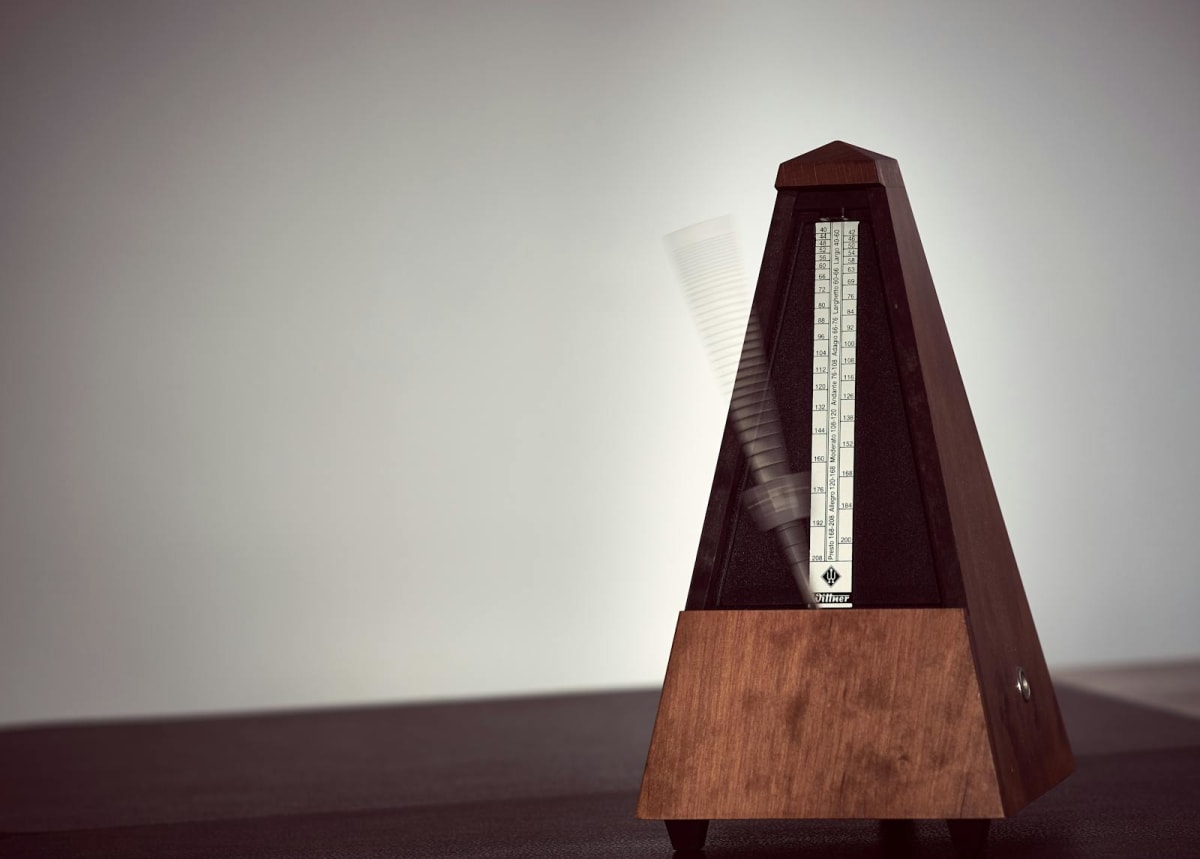
Photo: Florian G via Pexels
4. Change what the metronome is doing
Dense metronome work is useful at the start. It is not the end game.
If the click tells you where every single note goes, you may be getting cleaner alignment without building much internal pulse. That is why a passage can look “fixed” with a metronome and then immediately wobble when the click disappears.
| Metronome setup | What it is good for | When to leave it behind |
|---|---|---|
| Every subdivision | Initial diagnosis of where notes belong | As soon as the spacing is clear |
| Main beat only | Stabilizing basic coordination | When the beat is solid enough to widen |
| Once per bar or phrase group | Testing larger pulse | When you can hold it without clinging |
| Off-beat or gap-click work | Testing whether the time is actually yours | Keep this as a regular check, not permanent support |
If you want a fuller breakdown, read our guide to practicing piano with a metronome. For this specific rhythm problem, the important shift is simple: use the click first as a map, then as a test.
This is also the kind of situation where a training metronome like Takt becomes more useful than a plain click. Gap-style and drift-style checks force you to keep the beat alive when the support gets thinner or less predictable.
5. Treat rhythm as a movement problem when it actually is one
Sometimes the rhythm is sloppy because the movement is sloppy.
Goebl and Palmer found in 12 pianists that tactile information at finger-key contact enhanced the timing accuracy of the upcoming keystroke. Furuya and Soechting found in 6 pianists that when one tone's timing was perturbed, the next inter-keystroke interval changed as a compensatory response. Put differently: each keystroke is helping organize the next one.
That matters in practice. If one finger lifts much higher than the others, if the wrist overreacts at each accent, or if the hand only prepares the leap at the last second, the rhythm will wobble even if you are “counting.”
Three practical checks help here:
- Stay closer to the keys. Big unnecessary motion often shows up as late arrivals.
- Pre-shape the destination. For chords, leaps, and broken patterns, get the hand ready earlier.
- Watch for one-finger sabotage. If the same finger always arrives late or harshly, the rhythm issue may be local, not global.
This is one reason teachers often say “the rhythm problem is actually a fingering problem” or “actually a movement problem.” Sometimes that is exactly right.
6. End the session with playback, not a guess
Rhythm feels different from how it sounds. That gap fools people constantly.
Nusseck and colleagues studied 25 advanced piano students using short playback interventions and found significant differences in the students' self-ratings after listening back, including for rhythm. External ratings did not show the same clear effect, so this is not proof that every recording immediately improves your rhythm. It is still a strong argument for not trusting your in-the-moment impression too much.
At the end of a rhythm session, record one take on your phone and listen for specific things:
- do long notes secretly shorten under tension?
- do rests collapse?
- does the left hand anticipate barlines or cadences?
- does the tempo jump after a dynamic accent?
- does the problem reappear exactly at the same seam?
If you already use phone playback regularly, pair this with recording your practice sessions more deliberately. That turns “my rhythm feels off” into something much more useful: “I rush the second half of beat three whenever the left hand leaps.”
FAQ
Should I still practice slowly if my rhythm is sloppy?
Yes. Slow practice is still essential. The point is that slow practice should reveal the exact problem and then feed into a more targeted fix. Slow playing by itself is not always enough.
Are dotted-rhythm variations actually useful?
Yes, especially for even-note passagework that stays blurry. They are useful because they expose weak finger changes, late crossings, and uneven preparation. They are a training tool, not the final musical rhythm.
Why does my rhythm fall apart when I put the hands together?
Usually because the vertical arrivals and chunk transitions have not been planned clearly enough. Each hand may be stable alone while the combined coordination is still vague.
Do I need a metronome for every rhythm problem?
No. Some rhythm problems are really subdivision problems, some are movement problems, and some are chunk-boundary problems. The metronome is useful, but it is only one tool in the chain.
When rhythm improves, it stops feeling “counted” and starts feeling inevitable. That only happens when you fix the specific leak, not just the speed.


