

Simply Piano is better for adults who need momentum; Skoove is better for adults who want a calmer lesson path with more emphasis on understanding. Both apps can help a beginner start, and both can become limiting if treated as a complete piano education. The right choice depends less on which app has more features and more on which weakness the adult learner needs help with first.
Choose Simply Piano if the main danger is never starting, losing the routine, or needing the app to make the next step obvious. Choose Skoove if the main danger is rushing through app tasks without understanding what the hands, ears, and notation are doing. That framing is more useful than asking which app is "best" in the abstract.
Quick split
Simply Piano
Best when the adult needs fast onboarding, short lessons, visible progress, and a strong habit-forming push.
Skoove
Best when the adult wants a more lesson-like route through reading, theory, technique videos, and support.
The real difference is pace
Simply Piano is built to keep the learner moving. Its current Google Play listing emphasizes real-time feedback, any piano or keyboard, reading sheet music, playing with both hands, personalized 5-Min Workouts, and a song library with more than 5,000 songs. That tells the story clearly. The app wants the first session to feel possible, then wants the learner to return often enough that piano becomes a habit.
Skoove is slower in feel. Its official product page describes a teacher-crafted method, bite-sized lessons, real-time feedback, music theory, note reading, technique, more than 500 online lessons and courses, video tutorials, a moving score, and backing tracks. The Google Play listing also highlights tempo control, looping, AI listening, USB MIDI, Bluetooth MIDI, microphone input, and instructor support. Skoove is still an app, but it behaves more like a compact course than a pure streak engine.
For adults, pace is not a small design choice. A beginner with a full-time job may need Simply Piano's directness because there is no spare energy left for curriculum decisions. Another adult may find that same speed makes the learning feel shallow. That learner may prefer Skoove because it gives more space to connect notes, theory, and musical context. Neither preference is morally better. It is a match problem.
Readers who want broader app context can compare both against other options in our guide to piano learning apps for adults. This post stays focused on the two-app decision because the search intent is usually high: the reader has already narrowed the field and wants a clear answer.
| Decision point | Simply Piano | Skoove | Better fit |
|---|---|---|---|
| Absolute beginner onboarding | Very direct and motivating | Clear, but less urgent | Simply Piano |
| Lesson-like structure | Strong, app-led | Strong, calmer and more explanatory | Skoove |
| Song motivation | Large song-library pitch | Mix of songs, lessons, and courses | Simply Piano |
| Adult-friendly tone | Can feel more gamified | Can feel more instructional | Skoove |
| Human support | Mainly app ecosystem and help center | Premium includes instructor support | Skoove |
Simply Piano is stronger when consistency is the problem
Many adults do not need a philosophical piano method in week one. They need the keyboard to stop feeling intimidating. Simply Piano is good at that. The app breaks early learning into short, obvious actions and rewards completion. That can be exactly right for someone who has wanted to learn piano for years but keeps losing the habit after three sessions.
The 5-Min Workouts are part of Simply Piano's adult appeal. A five-minute session is not enough for serious long-term progress, but it is enough to keep the instrument in the day. That matters because adults often fail through absence, not laziness. Once a learner skips a week, the restart cost rises. A short app prompt can keep the thread alive.
Simply Piano also has a strong household use case. Simply's help center says the Family Plan supports up to 5 profiles on the same account, stores individual progress for each person, and includes full access to all Simply apps under one subscription. The iOS support material also describes a Duo Plan for one extra family member with Simply Piano only. If an adult and a child both want to learn, or if someone in the house may use Simply Guitar or Simply Sing, the wider subscription can make more sense than a piano-only calculation.
The risk is that Simply Piano can reward forward motion before musical control is secure. A learner may complete lessons while still playing with tension, weak counting, collapsed hand shape, or very little listening. The app can hear notes, but it cannot fully judge how those notes are produced. Adults who choose Simply Piano should treat completion as a prompt to test the skill away from the app, not proof that the skill is stable.
Skoove is stronger when understanding is the problem
Skoove is a better fit for adults who dislike feeling pushed through a beginner conveyor belt. Its course language is less about instant excitement and more about learning a path: reading, theory, technique, songs, video support, and feedback. That does not automatically make it deeper than every competitor, but it does make the app feel more adult in tone. Some learners will simply trust it more.
The instructor-support feature also matters. Skoove's help material says Premium includes access to courses with hundreds of lessons and 1-on-1 support from piano instructors. That should not be confused with weekly private lessons. It is not the same as a teacher watching the body play. But for an adult beginner stuck on setup, fingering, a lesson misunderstanding, or a basic practice question, human support can reduce the feeling of being alone with the app.
Skoove's connection options are practical too. Google Play lists support for USB MIDI, Bluetooth MIDI, and microphone input, and Skoove's help center covers device and connection requirements in detail. This matters because app feedback can fail for boring technical reasons. A beginner may think they are playing badly when the problem is microphone placement, room noise, Bluetooth latency, or an unsupported browser setup. A learning app that documents connection paths well is less likely to lose the learner during setup.
The risk is that Skoove may feel less immediately exciting than Simply Piano. Adults who need a strong first-week dopamine loop may bounce before the method has time to work. Skoove asks for a little more patience. That is an advantage for the right learner and a disadvantage for the wrong one.
Official app context
Simply Piano
Best checked through the app stores and in-app pricing prompt because plan prices vary by region and offer.
Official app context
Skoove
Best checked through Skoove's product page, help center, and store listings for current course and support details.
The pricing comparison is less obvious than it looks
Simply Piano and Skoove both use subscription pricing, but public pricing can vary by platform, country, plan, and promotional offer. Simply's help center tells users to open the app to see the current subscription cost because prices vary. Skoove's official page presents monthly, three-month, and twelve-month plan examples in some regions, and store listings show their own in-app purchase ranges. The safe rule is to check the price inside the exact device and country where the learner will subscribe.
Adults should also compare what the subscription is buying. With Simply Piano, the strongest value is the guided beginner path plus the larger Simply ecosystem, especially for families. With Skoove, the strongest value is the lesson-path feel, instructor support, and a calmer blend of note reading, theory, technique, and songs. If two prices are close, the better deal is not the cheaper one. It is the one that will create more actual practice across a normal month.
Trial periods should be treated as tests, not entertainment. A useful trial asks three questions. Did the app make practice happen on a tired day? Did the feedback feel trustworthy with the learner's instrument setup? Did the learner retain anything when the app was closed? If the answer to the third question is no, the app may still be useful, but it should be paired with off-screen practice.
This is also where adults should be honest about attention. Simply Piano may be worth more for someone who needs a strong prompt. Skoove may be worth more for someone who will sit with a calmer lesson and repeat a passage carefully. A subscription that matches personality is cheaper than a subscription that looks rational and goes unused.
Both apps still need an off-screen practice plan
The biggest shared weakness is that both apps can make progress feel more complete than it is. A learner can score well while still playing with poor hand shape, uneven rhythm, harsh tone, or very little awareness of phrase direction. This is not because the apps are dishonest. It is because software feedback sees a narrow slice of piano playing. Correct notes are not the same as controlled playing.
Simply Piano users should add off-screen tests early. After a lesson, close the app and play the same pattern from memory or from a simple written note. If the pattern disappears without the scrolling interface, it is not secure yet. Skoove users should do the same with short lesson segments, especially when the moving score or backing track is doing too much of the organizing. The goal is transfer, not app fluency.
A simple weekly practice note helps here. Write down the current lesson, one technical problem, one rhythm problem, and one thing to retry next time. It should take less than a minute. The point is not to become a spreadsheet musician. It is to notice whether the app is solving the real problem or only moving the learner to the next screen. For a low-friction version, see the guide to using a practice log without turning it into homework.
If the learner feels physical discomfort, the app should not be the only source of truth. Stop and check the setup. Bench height, keyboard height, shoulder tension, wrist angle, and session length matter. Adult beginners often blame themselves for stiffness when the practice setup is creating it. The guide to what to do when your hands hurt after practicing is a better resource for that specific problem.
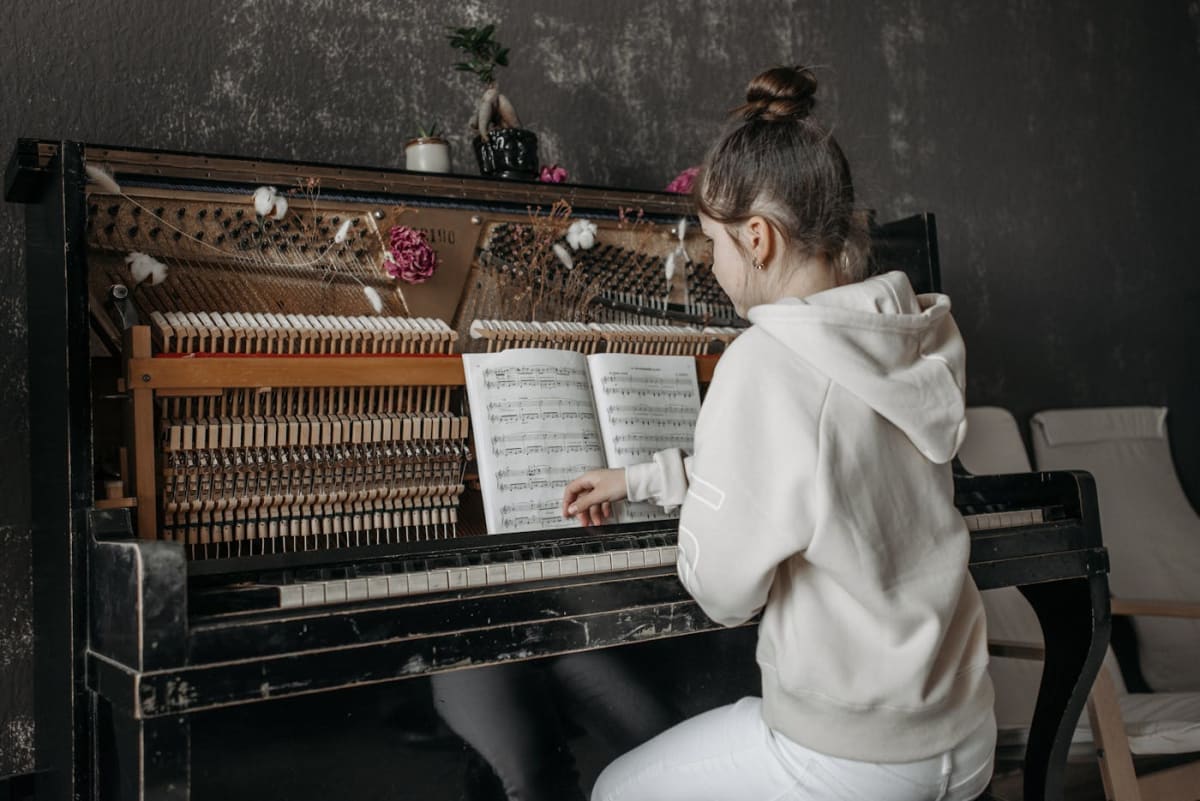
Photo: Pavel Danilyuk via Pexels
The better app by learner type
For a complete beginner who has never read music, Simply Piano is usually the easier first recommendation. Its strength is momentum. It makes the early decision tree smaller and turns the first month into a sequence of manageable tasks. That is valuable for adults who are already fighting schedule friction.
For a thoughtful adult beginner who dislikes being rushed, Skoove is often the better first recommendation. Its tone and course structure can feel more like learning piano and less like completing an app. The instructor-support option also gives it an edge for learners who know they will ask questions. That does not make Skoove more advanced in every way, but it does make it more comfortable for certain adults.
For families, Simply Piano has the broader ecosystem argument because the Family Plan includes all Simply apps under one subscription. For piano-only learners who want a calmer course and support, Skoove may be the cleaner fit. For adults who mainly want to learn specific songs from a more score-like interface, neither is the obvious first pick; Simply Piano vs Flowkey is the more relevant comparison.
Decision flow
Simply Piano or Skoove?
Need momentum?
Start with Simply Piano.
Need explanation?
Start with Skoove.
Family account?
Check Simply first.
Want support?
Check Skoove Premium.
The practical verdict is simple. Simply Piano is the better starter app for adults who need energy, routine, and a clear next step. Skoove is the better starter app for adults who want a more measured learning path and access to instructor support. Either way, the app should start the practice habit, not replace listening, recording, reading, and occasional human feedback.


