

Slow practice stops helping the moment it becomes a safer version of the task instead of a cleaner version of the task. A passage can feel beautifully controlled at half tempo and still be nowhere near ready. That is not because slow practice is bad. It is because slow practice and real-time execution stop being the same job after a certain point.
The useful question is not “should I practice slowly?” The answer to that is still yes, often. The useful question is “what is the slow practice still fixing, and what has to be tested under more realistic timing now?” Once you see that distinction, the plateau makes a lot more sense.
256 players
Emma Allingham and Clemens Wöllner surveyed 256 adult instrumentalists about tempo-management strategies in classical practice.
99.45%
Almost every classical musician in that survey reported using slow practice when managing tempo.
Not enough alone
The same survey also showed heavy use of chunking, rhythm variation, and gradual tempo work because slow practice is not the whole system.
Slow practice is for building a stable version, not hiding from tempo
Slow practice still earns its place because it makes hidden problems visible. It gives you time to hear harmonic direction, choose fingering intelligently, feel where the movement is wasteful, and notice when rhythm is only “roughly right.” Without that stage, faster work often just magnifies confusion. That part of the usual advice is still solid.
There is direct evidence for that. In a study of piano training at submaximal speed, Shinichi Furuya and colleagues found that practice below maximum speed increased the maximum speed of trained finger movements over days. That matters because it shows slow and moderate work can raise the ceiling when the movement is being organized accurately. Slow practice is not a beginner crutch. It is a legitimate motor-learning tool.
But the same finding is easy to overread. It does not mean slower is always better, or that more time below tempo will automatically solve a passage that still falls apart once the clock starts mattering. Slow work is best at clarifying the route. It is much worse at proving whether the route survives when anticipation windows shrink and the motion has to stay efficient under pressure.
| Slow practice is still helping when… | Slow practice has started stalling when… | What to do next |
|---|---|---|
| Notes, fingering, and rhythm keep getting cleaner | The same passage is always clean only below one narrow tempo | Start building a tempo bridge instead of staying parked there |
| You are reducing tension and wasted motion | The motion changes completely as soon as speed rises | Use smaller tempo jumps and test whether the same movement survives |
| You can describe what improved from one rep to the next | You are just repeating accurate slow runs without new information | Change the demand: click placement, entry point, grouping, or tempo |
| You are hearing the real phrasing and pulse | The passage becomes rhythmically limp and over-separated | Restore pulse and grouping before you call the work useful |
How to tell it has stopped helping
The giveaway is not simply that the passage is still hard. Hard can be fine. The real warning sign is that the passage only works in the slowed-down environment you created for it. It is accurate there, but the success does not travel. Raise the metronome a little and the grouping changes. Start from the middle and the fingers hesitate. Remove the click and the rhythm goes soft. That is not stable learning yet. It is local fluency.
There are good reasons for that gap. In Rate Effects on Timing, Key Velocity, and Finger Kinematics in Piano Performance, faster rates changed timing relationships and movement organization rather than merely compressing the same action. In other words, tempo does not only ask for speed. It also changes what counts as a workable movement solution.
If the same rep keeps sounding fine only in slow motion, you are usually past the point where more identical repetitions help. At that stage the question starts sounding a lot like whether you need more repetition or a better strategy, because the problem is no longer “do more.” It is “change the demand.”
Stall signal
Pulse disappears
You are placing notes carefully, but not actually sustaining a living beat.
Stall signal
Tempo cliff
The passage is fine at one speed, then immediately unstable five clicks higher.
Stall signal
Movement rewrite
The hand, bow, breath, or embouchure behaves differently once the tempo rises.
Stall signal
Transfer failure
The passage works only from one start point or only right after a lot of setup reps.
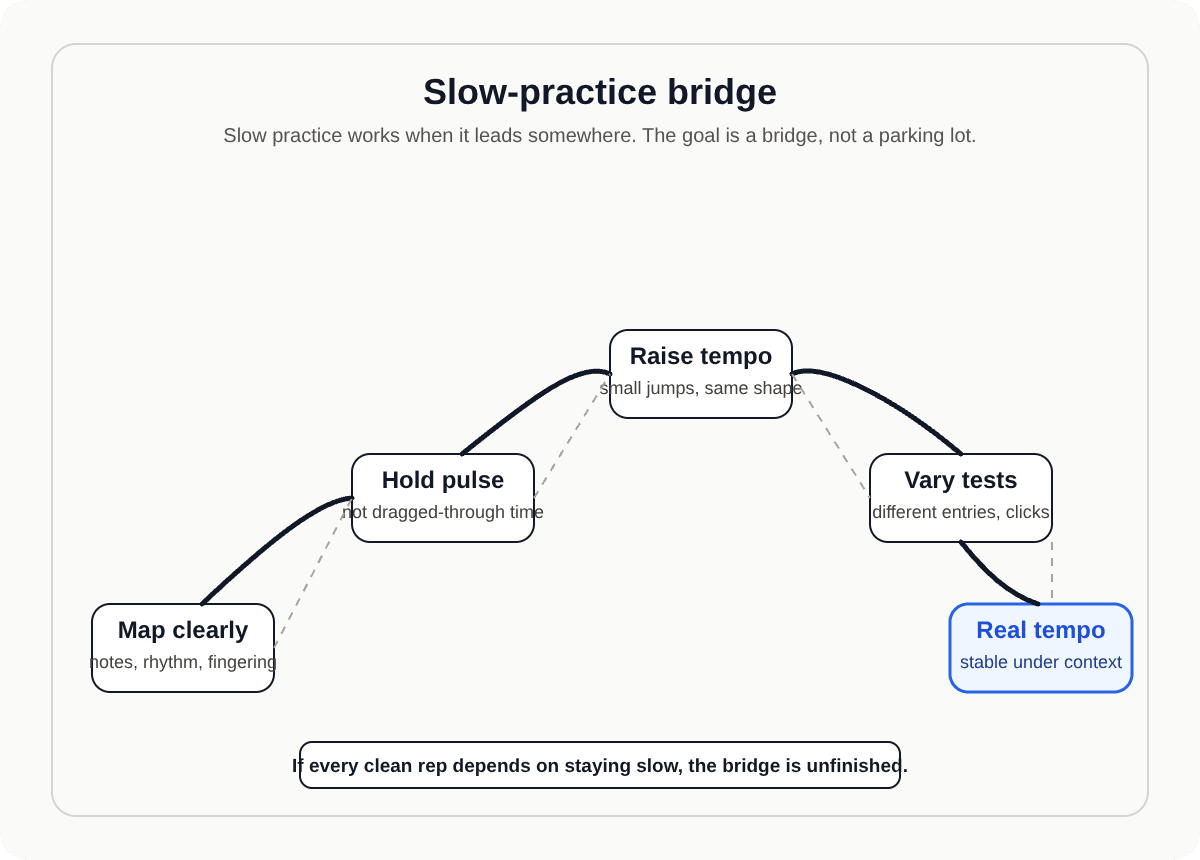
That is usually the point where the problem is no longer “learn the passage.” It is “bridge the passage.” If the work still looks mechanically correct but stops traveling to the real task, you are no longer fixing clarity. You are fixing transfer. That is exactly where difficult passages start falling apart at full speed.
Build a tempo bridge, not a tempo cliff
The next step is not to jump straight from comfort to target tempo and hope adrenaline solves the rest. Build a bridge. That means keeping the same fingering, rhythmic identity, and movement shape while asking for slightly more real-time pressure on each pass. Small jumps work better than giant leaps because they expose where the new demand breaks the pattern.
This is one reason tempo management deserves more than a metronome number. In Allingham and Wöllner’s 2022 survey, musicians did not rely on slow practice alone. They also used chunking and rhythm variation to manage how tempo was learned. That makes sense. If you only run the passage slowly and then test it suddenly at speed, you create a cliff. If you keep building intermediate versions, you create a bridge.
Find the slowest honest version
Pick the tempo where rhythm, fingering, and sound still resemble the real passage instead of a slowed-down dissection.
Increase in modest jumps
Move in small increments or percentage jumps, not in dramatic tests that only tell you the passage is not ready yet.
Stay on each rung briefly
Two or three clean reps are enough if the result is changing. Do not turn every rung into a new parking spot.
Drop back only with a reason
If a higher rung fails, decide what broke. Then return to the lowest tempo that actually changes that problem.
Retest from fresh
Come back after a short break or from a different entry point so you learn whether the new tempo version is actually retrievable.
Keep pulse and movement organized as speed rises
One reason slow practice breaks down is that musicians often slow the passage so much that pulse, grouping, and physical economy all disappear. The notes are technically correct, but the passage is no longer behaving like music. It becomes a sequence of careful placements. That can be useful for mapping, but it is not enough for transfer.
Tempo practice works better when certain things stay intact while speed changes. The pulse should still feel alive. The grouping should still reflect the real phrase. The movement should stay close to the version you want later. If the rhythm gets too stretched or the gesture becomes too segmented, the practice may be accurate without being relevant.
This is where tempo variability research becomes useful. In Dissociable Effects of Practice Variability on Learning Motor and Timing Skills, Baptiste Caramiaux and colleagues found that different tempo-variation strategies affected movement variability and transfer in piano sequence learning. Their results do not support the lazy rule that “more tempo variety is always better,” but they do reinforce the point that tempo work changes both timing skill and movement skill. You are not just moving the metronome. You are teaching the body how to stay organized across conditions.
That is why the bridge often needs supporting tools. Rhythm variation can reveal whether the passage only works in one timing shape. Sparse metronome clicks can show whether your pulse is real or borrowed. Different entry points can expose whether your control is local or portable. If your slow work has also been producing repeated errors, the repair process for stubborn mistakes usually needs to happen before more tempo work becomes useful.
Photo: Arbiansyah Sulud via Pexels
Test transfer before you trust the passage
A passage is not ready just because it survives one smooth climb with the metronome. It has to survive a few different kinds of pressure. Start from the middle. Remove the click. Put it back in context. Raise the tempo and then lower it again without losing the rhythmic shape. Leave it alone for a few minutes and see whether it comes back in the same state. If the result only holds when the runway is perfect, you still have a local solution rather than a dependable one.
This is where practice turns from repetition into diagnosis. Guadalupe López-Íñiguez and Gary McPherson’s music microanalysis work is helpful again because it centers the loop of planning, doing, monitoring, and evaluating. Tempo building fails when the musician only notices whether the rep felt good. It improves when the musician notices what survived the faster condition and what changed shape.
For many players, this is also the point where metronome use needs to mature. A click can help reveal whether pulse is being preserved during tempo growth, but it cannot replace pulse for you. If you want the practical version of that, our metronome guide goes into click placement, sparse beats, and ways to stop outsourcing your timing to the machine.
Bottom line
Slow practice stops working when it no longer improves the real task. Keep it for clarity, then build a bridge back to pulse, coordination, and actual tempo before calling the passage learned.
Slow work is still one of the best tools musicians have. It just becomes far more useful when you treat it as the beginning of the climb instead of the whole mountain.


