

Being able to play through a piece is not the same as being ready to perform it in public. A private run can hide all kinds of weaknesses: shaky memory that only works from the top, tempo that rushes under stress, a fragile opening, an ending that has never been tested cold, and no real plan for recovering after a mistake.
Public readiness is a harder standard. The piece has to hold together when the conditions stop being friendly. That means continuity, recovery, memory security, stable openings and endings, and enough tempo control that nerves do not turn the whole performance into a different piece.
If you want a simple rule, use this one: a piece is ready for public performance when it still works after something goes slightly wrong. If one slip, one wobble, or one rush can still take the whole thing down, it may be learned, but it is not ready.
Public-ready sign
You can keep going, restart intelligently, and land the ending even after a disturbance.
False positive
It sounds good in one comfortable run from the beginning, but the structure collapses as soon as the flow breaks.
What to test
Continuity, recovery, memory anchors, opening stability, ending control, and tempo under mild pressure.
Public-ready means it survives pressure, not just repetition
Musicians often mistake familiarity for readiness. The piece feels comfortable in the practice room, so they assume it is performance-ready. But pressure changes the task. In the 2021 paper Back to feedback: aberrant sensorimotor control in music performance under pressure, Shinichi Furuya and colleagues showed that local tempo became abnormally disrupted under pressure when pianists received delayed auditory feedback. In other words, stress did not merely make performers feel worse. It changed the stability of their timing control.
The companion 2021 PLOS One study on choking under pressure in musicians found related factors in survey data from 258 pianists: failure of memory recall, feeling rushed and out of body control, and erroneous motor actions all surfaced as distinct parts of the pressure problem. That makes the readiness question much clearer. You are not only asking whether the notes are learned. You are asking whether the piece can survive the exact kinds of distortion that public performance tends to create.
This is why our earlier guide to practicing for performance instead of just for the practice room matters. Practice-room success and public reliability overlap, but they are not identical. Public readiness is a more adversarial test.
| “I can play it” test | Public-readiness test | Why the second one matters more |
|---|---|---|
| One decent run from the top | Several clean cold starts and no-stop mock runs | Cold starts and no-stop runs reveal fragility faster |
| Works after a warm-up | Works when you have to begin within seconds | Performance openings rarely get a repair loop |
| Feels memorized in sequence | Can re-enter from multiple landmarks | Memory needs backup routes, not only one chain |
| Mostly accurate when comfortable | Still coherent when you feel slightly rushed | Pressure changes timing, attention, and body control |
Continuity and recovery matter more than spotless accuracy
What destroys a public performance is not always the original mistake. Often it is the collapse that follows. A missed note by itself is survivable. A loss of continuity, panic stop, or blank section is what makes the performance feel unstable to both player and listener.
Roger Chaffin, Jane Ginsborg, James Dixon, and Alexander Demos show why in their 2023 study Recovery from Memory Failure when Recalling a Memorized Performance. Looking at an experienced singer’s recall after public performance, they found that recovery points clustered where structural beats and performance cues were available. The implication is practical: reliable performers do not just avoid memory failure better. They recover from it better because the piece contains usable landmarks.
That is why one of the clearest readiness tests is interruption tolerance. If a small slip or distraction causes a total derailment, the piece is not yet secure enough for public use. If you can absorb the disturbance and arrive on the next anchor, that is much closer to stage-ready playing.
In practice, this means testing recovery deliberately. Can you skip ahead a bar and keep going? Can you miss a note and still land the next phrase shape? Can you continue through a moment of doubt without exposing panic in the tempo or sound? The goal is not to normalize mistakes. It is to make sure one mistake does not become five.
If every slip still causes an automatic stop, the piece is probably not ready. Public performance needs recovery skill, not only ideal-path accuracy.
Memory security means you can re-enter from more than one place
A piece that only works from the beginning is not securely memorized for performance. That kind of memory is sequence-dependent. It feels fine until the sequence breaks, and then there is nothing underneath it.
Roger Chaffin and Gabriela Imreh's classic study Practicing Perfection: Piano Performance as Expert Memory showed how performance cues act as mental landmarks in a memorized performance. Tania Lisboa, Chaffin, and Demos later described in Recording Thoughts While Memorizing Music how a student’s recorded thoughts became retrieval cues that later supported recall under performance conditions. The message is the same in both cases: performance memory is not just one long automatic chain. It is a mapped system.
That mapped system is what lets you restart. Can you begin at the transition, the second page, the recap, the bridge, the return of the main theme, the exposed modulation, the bar before the ending? If the answer is no, the piece may feel memorized but it is still too dependent on uninterrupted flow.
This is where memory security becomes a hard readiness criterion rather than a vague feeling. A public-ready piece should let you enter from several landmarks without a full lead-in run. If you want a wider method for building that kind of memory, it connects naturally to getting more out of each music lesson, because strong teachers can help you identify and test those anchors long before the performance date.
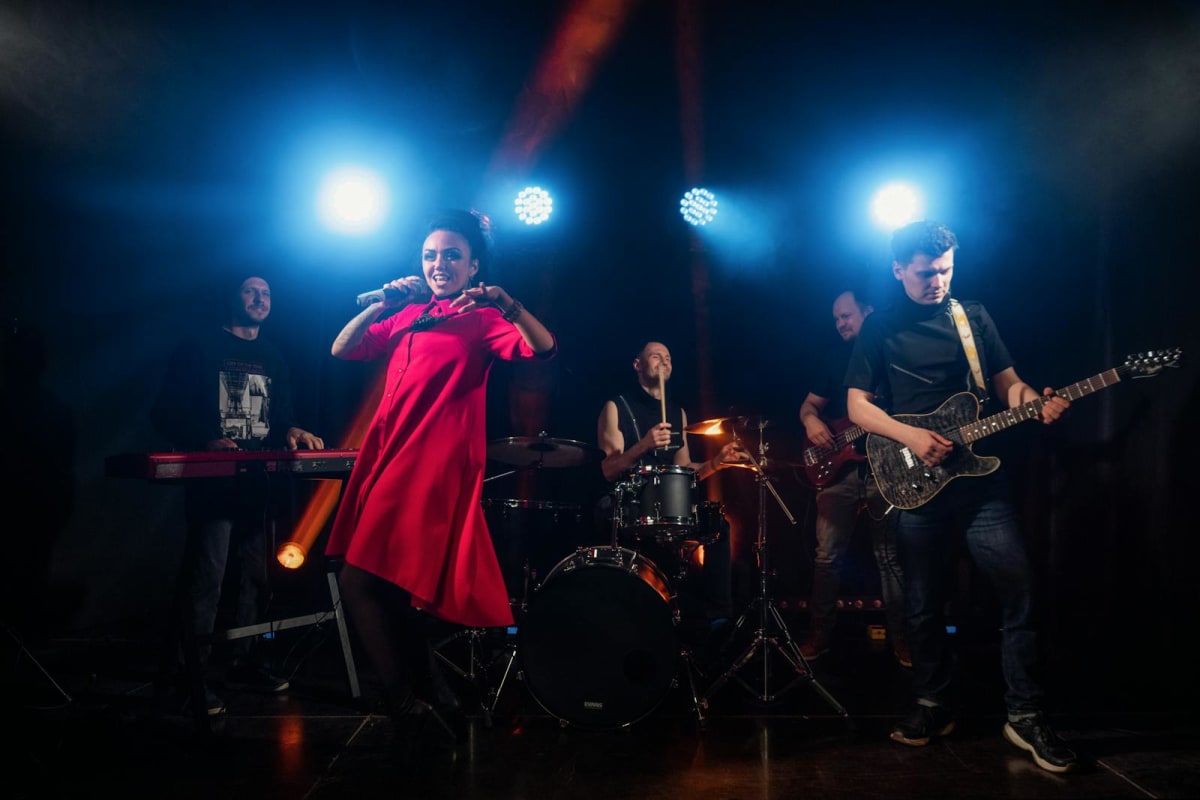
Photo: Alena Darmel via Pexels
Openings, endings, and phrase boundaries deserve separate testing
Openings and endings are disproportionately exposed. The opening has no momentum behind it yet. The ending arrives after accumulated fatigue, anticipation, and the temptation to “just get through it.” Both moments are easy to under-test because they are surrounded by the rest of the piece, and the rest of the piece can disguise their fragility.
There is a useful performance-science reason to take this seriously. In Flexibility of Expressive Timing in Repeated Musical Performances, Demos, Lisboa, and Chaffin found that tempo was slower and less stable at the beginnings and ends of phrases, while the middles of phrases were more stable. Even in polished public performances, phrase boundaries were where cognitive control and variability showed up more strongly. That is a good reminder that boundary moments are naturally more exposed and less automatic.
So do not let the opening piggyback on a successful full run. Test it cold, within ten seconds, after silence. Do not let the ending exist only as something you happen to arrive at after 90 seconds or 8 minutes of playing. Test the bar before it, the transition into it, and the final gesture itself. If the opening only works after you have settled in, or the ending only works after you have already survived everything else, neither one is ready enough.
Opening test
Stand up, wait ten seconds, sit down, and begin. If the opening still feels negotiated, keep training it.
Boundary test
Start one bar before phrase transitions and check whether tempo or control shifts there.
Ending test
Play the final approach and ending several times from nearby landmarks, not only from the very beginning.
Tempo and interpretation have to survive a nervous body
A piece is not public-ready if the tempo only holds when your body is calm. Furuya’s 2021 work under pressure is useful precisely because it shows how local tempo can destabilize when anxiety shifts control patterns. The 2021 choking study reinforces that point from another angle: musicians under pressure reported feeling rushed and out of body control, alongside memory recall problems and motor errors. That is almost a direct list of what public-readiness testing should try to expose.
This does not mean you need zero nerves before you perform. That standard would be useless. It means your interpretation must still exist when nerves enter the room. The phrase shape should still be recognizable. The pulse should still be governable. Dynamics and pacing should still feel chosen rather than merely survived.
That is why mock performances matter. One-take recordings, one-listener runs, and short public simulations reveal whether the interpretation remains intact under slightly less forgiving conditions. If the piece becomes rhythmically narrow, emotionally blank, or structurally cautious the moment the stakes rise, the readiness gap is still real. That is also where teacher feedback becomes valuable. A good teacher can help you decide whether the issue is underpreparation, bad pacing, weak anchors, or simple over-adrenalized tempo. That overlaps with knowing if your teacher’s advice is actually working.
Public-readiness checklist
- I can begin the opening cold and keep the first phrase under control.
- I can restart from several internal landmarks without a full lead-in run.
- I can continue after a mistake and land on the next structural anchor.
- I have tested the ending from nearby entry points, not only from the top.
- Tempo stays stable enough under mock pressure that the interpretation still sounds like mine.
- A one-take run tells the same musical story even if it is not perfect.
The strongest sign that a piece is ready to perform in public is not that nothing can go wrong. It is that the piece still functions when small things do go wrong. That is the real threshold. Not flawless comfort, but reliable control under exposure.


