Most tuner apps answer a very small question: am I sharp or flat?
For classical musicians, singers, and string players, the deeper question is the one basic tuners usually ignore: sharp or flat relative to which system? Equal temperament? A pure major third? A fifth that locks against a drone? A meantone key color in early music? Once you hear the difference, a lot of ordinary tuner apps start feeling shallow.
Transparency note: I checked the current official product pages and store listings for the apps below on March 14, 2026. I also built Stimmung, so I am not pretending to be neutral about it. The useful question is not “which app do I own?” It is “which app actually solves the tuning problem a classical musician has?”
Quick Picks
If you want the short version first, this is where I land.
| Use case | Best pick | Why |
|---|---|---|
| Best for temperament-aware classical work | Stimmung | Built around equal vs pure vs historical tuning logic instead of hiding temperament as an advanced extra |
| Fast everyday chromatic check | Cleartune | Simple, fast, low-friction interface with useful basics like transposition and reference-pitch control |
| Most precise strobe-style tuning | Peterson iStroboSoft | Virtual strobe display, 0.1-cent resolution, huge temperament library |
| Best all-round utility app | TonalEnergy | Tuner, drones, metronome, recorder, and a big temperament set in one mature package |
| Best for visual pitch feedback | Tunable | Waveform, spectrum, and tone-generator tools are especially useful for singers and winds |
Why “Sharp or Flat?” Is Not Enough
A normal tuner usually assumes equal temperament: the octave is divided into 12 equal semitone steps, which is what makes fixed-pitch keyboard playing in all keys practical. That system is incredibly useful. It is also not the only way musicians actually tune.
Just intonation works differently. Instead of forcing every interval into the same 12-step grid, it tunes intervals by simple frequency ratios. A pure major third is 5:4. A pure fifth is 3:2. Those ratios are not abstract theory. They change what you hear.
| Interval | Equal temperament | Pure ratio version | What you hear |
|---|---|---|---|
| Major 3rd | 400 cents | 5:4 = 386.31 cents | The pure third sits lower and sounds calmer against the harmony |
| Perfect 5th | 700 cents | 3:2 = 701.96 cents | The difference is much smaller, but exposed players still hear the lock |
| Minor 3rd | 300 cents | 6:5 = 315.64 cents | The pure version sits noticeably wider than the equal-tempered one |
The acoustics behind this are not mysterious. The UNSW Music Acoustics material is a good reference on how harmonic ratios and beating shape what we hear as consonance. Once you listen for beat speed inside an interval, tuning stops being just a needle-centering game.
If your tuner cannot change the target system, it is teaching equal temperament by default. That is fine for some tasks and actively unhelpful for others.
Why This Matters for Classical Musicians
This is not only an early-music problem.
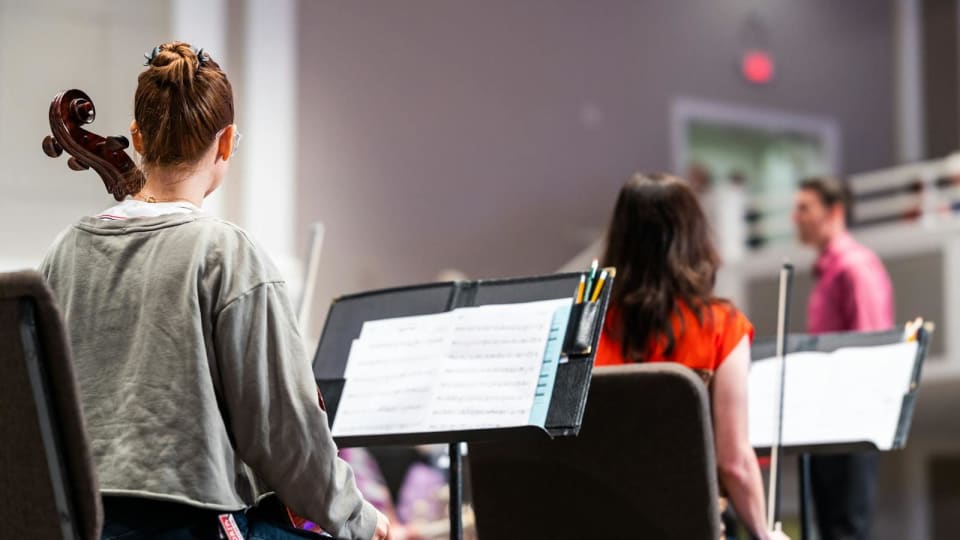
Singers constantly adjust pitch inside harmony. A high leading tone in a cappella singing is not the same thing as a pure third inside a held major chord. String players do the same thing instinctively when a fifth starts to lock or when a major third settles lower against a drone. Wind players live with pitch tendencies, alternate fingerings, and ensemble adjustments that a generic “green light” does not explain very well.
And then there is early music. If you work in meantone, Vallotti, Kirnberger, Werckmeister, or Young, equal temperament is not the point at all. Key color is the point. One of the reasons historical temperaments remain musically interesting is that not every key feels interchangeable.

Photo: Unsplash via Wikimedia Commons
That does not mean every rehearsal needs a temperament seminar. It means the right tuning tool depends on the job. If you are tuning open strings before rehearsal, a simple chromatic or strobe app may be perfect. If you are trying to hear why your upper third in a Schubert chord still feels sour against the piano, you need more than a generic tuner needle.
What the Main Tuner-App Categories Actually Do
The easiest way to choose an app is to stop shopping by star rating and shop by tuning logic.
| Category | Best for | Weak spot |
|---|---|---|
| Standard chromatic tuner apps | Quick note-centering, open strings, reference pitch, simple daily use | Usually weak on harmonic context and interval training |
| Strobe-style tuner apps | Very fine adjustment, instrument setup, stable sustained pitches | Can be overkill if you only need quick practical checks |
| Temperament-aware tuner apps | Classical harmony, drones, historical temperaments, ear training, ensemble intonation | More to learn, and not every player needs that depth every day |
This is similar to what happens with metronome apps: the best tool depends on whether you need a basic utility or something that changes how you practice. That is the same distinction I made in our metronome-app comparison.
The App Comparison
I am deliberately mixing different app philosophies here instead of pretending they are all trying to do the same thing.
| App | What it does best | Why it stands out | Main limitation |
|---|---|---|---|
| Stimmung | Temperament-aware classical tuning | Equal, just, and historical temperaments; drones; interval compare mode; triad/cadence explore mode; string, voice, and orchestra-A presets; delta-to-equal feedback in the tuner | Android only right now, and intentionally narrower than an all-in-one utility app |
| Cleartune | Fast chromatic tuning | Clean interface, note wheel, transposition, reference pitch, and temperament support from a very lightweight app | Not built around drones, interval listening, or deeper harmonic training |
| Peterson iStroboSoft | High-precision strobe work | Virtual strobe display with 0.1-cent resolution, plus 130+ temperaments and 80+ sweetened tunings on the current product page | The interface is precision-first, not especially inviting for ear-training style practice |
| TonalEnergy | Best all-round practice utility | Tuner, metronome, recorder, analysis tools, drones, and 50+ temperaments in one mature ecosystem | Very broad toolset, so the temperament side is one part of a larger app rather than the main concept |
| Tunable | Visual feedback for singers and winds | Live waveform and spectrum views, note analysis, and tone-generator tools are genuinely useful when you want to see pitch shape, not just a cents number | Less focused on historical temperament and key-centered classical tuning logic |
The product pages behind those claims are current and worth checking directly: Cleartune’s App Store listing highlights its note wheel, temperament system, transposition, and reference pitch; Peterson’s iStroboSoft page emphasizes the virtual strobe display, 0.1-cent resolution, and temperament library; TonalEnergy’s current site lists drones, a 7-octave keyboard, and 50+ temperaments; Tunable’s site focuses on waveform, spectrum, and tone-generator tools.
Stimmung is different because it treats the tuning system itself as the point of the app. In the local app code and current Android build, it supports equal temperament, key-centered just intonation, Werckmeister III, Kirnberger III, Vallotti, Young I, Young II, quarter-comma meantone, and Pythagorean tuning, plus a compare mode that can audition equal, selected, or pure interval targets. That is the exact problem many classical players run into with ordinary tuners: they want to hear why the pitch moves, not only how far.
Listening Examples: Thirds, Fifths, Drones, Key Color
If you want to know whether an app is musically useful, do not stop at tuning one isolated A. Try these instead.
| Exercise | What to do | What to listen for |
|---|---|---|
| Major 3rd against a drone | Hold a tonic drone and sing or play the major 3rd above it | The just third usually wants to sit lower than the equal-tempered tuner center |
| Perfect 5th lock | Play or sing root and fifth slowly against each other | A good fifth feels unusually stable because the beating is minimal |
| Scale degrees over a drone | Play a scale over a tonic or tonic-fifth drone | You start hearing that not every degree wants the same vertical pitch behavior |
| Historical key color | Cycle the same cadence through different keys in well temperament or meantone | The point is not “perfect intonation,” but that different keys stop sounding interchangeable |
This is one reason I like apps with drones and playback modes. They push pitch out of the isolated-lab world and back into harmonic context. If you record these experiments and listen back, the differences become much easier to hear, which is the same basic reason self-recording is so useful in ordinary practice too. I wrote more about that in the self-recording article.
Which App Should You Actually Download?
If you want the simplest answer:
- Choose Cleartune if you want a clean, quick, mostly traditional chromatic tuner.
- Choose Peterson if you care most about strobe-style precision and instrument setup.
- Choose TonalEnergy if you want one mature practice utility that does almost everything reasonably well.
- Choose Tunable if you are a singer or wind player who benefits from seeing live pitch behavior and spectral information.
- Choose Stimmung if your real question is not “am I centered?” but “centered relative to what tuning logic?”
That last category is where a lot of classical musicians quietly outgrow normal tuner apps. Once harmony matters, the target starts moving.
If that is the problem you actually want to practice, try Stimmung. It was built for that exact gap.