Not every piece is for you. Not now, not ever in some cases, and certainly not on the timeline you expected when you started learning it. This is a sentence most piano teachers will not say out loud, because the alternative — endless encouragement, "just keep practising," "you'll get there" — is easier in the moment and harder to argue with. But the cost of pretending every piece is reachable is months of dispiriting work on the wrong music, and an honest framework for diagnosing a resistant piece is one of the most valuable things an adult learner can have.
This article gives that framework. There are exactly three honest reasons a piece can resist you no matter how much you practise. Each one has distinct signals, distinct timelines, and a distinct correct response. Most pianists never differentiate them — which is why the standard advice ("be patient," "slow down further," "try harder") feels like a verdict on character rather than a useful diagnosis.
The experience of a piece that does not move
You know what this feels like. The piece has been on your music stand for weeks. You can play the easy sections. The hard section — the one with the rapid double thirds, or the polyrhythm, or the leap to the top of the keyboard — has not improved in any noticeable way. You have practised it slowly. You have practised hands separately. You have isolated the broken bars. The bars are still broken. Other pieces you started later have moved further. This particular piece has stopped giving feedback.
The instinct is to attribute this to insufficient effort. The instinct is usually wrong. The Pract.is article on why you keep plateauing on the same passage covers some of the general failure modes — wrong tempo, mindless repetition, no diagnosis. But a piece that fully resists is often not a practice-quality problem. It is a piece-selection problem, and the honest move is to figure out which of three categories it falls into.
"The cost of pretending every piece is reachable is months of dispiriting work on the wrong music."
The three reasons, named
The three diagnoses below are not subtle distinctions. Each produces different signals and points to a different action. Sitting with the question honestly for an hour usually reveals which category your resistant piece belongs to.
Diagnosis 1
Technically out of reach
The mechanical skill required does not yet exist in your hands. No amount of practice on this piece will install it directly.
Diagnosis 2
Stylistically wrong right now
The musical language is one you do not yet hear from the inside. You can play the notes but not the music.
Diagnosis 3
Just needs more time
The right piece on a longer-than-expected timeline. The work is real and accumulating; the perception of stalling is partially impatience.
Diagnosis 1 — Technically out of reach
The first diagnosis is that the piece simply demands a mechanical skill your hands have not yet developed, and there is no shortcut. Fast even double thirds. Wide leaps with accuracy at speed. Octave passages at endurance tempo. Polyrhythms more complex than two-against-three. Trills with weak fingers. These are not just hard — they are skills that have to be built in isolation, with targeted exercises and graduated material, before they can show up in real repertoire.
The most reliable signal is a particular pattern of failure: you can play the notes slowly, very slowly, with no problem. At tempo, the passage collapses completely — not "a little uneven" but "not playable." Three weeks of work produce no measurable tempo improvement. Recording at slow speed sounds fine; recording at performance speed sounds like a different pianist. The Pract.is article on why difficult passages fall apart at full speed covers this mechanism in detail — what works for tempo plateaus, and where the wall is something else.
The action for this diagnosis is to pause the piece and work the underlying skill on different material — etudes, exercises, simpler pieces that share the same technical demand at a lower difficulty. Trying to learn double thirds inside the Chopin etude that requires them is harder than learning them in dedicated exercises and then returning to the etude with the new skill installed. This is what etudes are for. Adult learners often skip the etude layer because it feels like a detour; in fact, it is the shortest path.
Diagnosis 2 — Stylistically wrong for you right now
The second diagnosis is harder to admit because it is not about your fingers. It is about your ear. Some pieces require a musical understanding — of phrasing, harmonic language, rhetorical timing, sound world — that simply has not yet developed in the listener you currently are. Late Schubert sonatas, late Beethoven, Scriabin's later works, much of Messiaen, the slow movements of Mozart — each of these has a musical grammar that takes time to internalise. You can produce the notes correctly without the music ever sounding like anything. The recording reveals it: technically clean, musically inert. The Pract.is article on why your slow movements sound empty covers a related case for slow movements specifically.
The signals for this diagnosis are different from technical resistance. The notes are not the problem — you can play them. The problem is that you cannot decide how to play them. Phrasing choices feel arbitrary. Dynamics feel imposed rather than discovered. You have no real opinion about the piece, only memorised executions of teacher instructions. Listening to professional recordings does not help much — it just makes the gap visible without closing it. The piece you wanted to feel about something feels about nothing.
The action here is not "force the maturity." It is to step away from the piece and spend time with simpler music in the same idiom. If late Beethoven feels closed to you, the Beethoven sonatas of Opus 10 are an honest preparation. If a Chopin nocturne sounds shapeless under your hands, the simpler Op. 9 No. 2 is a better entry than Op. 27 No. 2. The Pract.is essay on choosing pieces that actually make you better covers the selection principle from the other side. A piece is stylistically right for you when you can already form opinions about its smaller relatives.
Diagnosis 3 — Just needs more time
The third diagnosis is the most common and the most frustrating, because it is hardest to distinguish from the first two. Some pieces are absolutely right for you at this stage, technically and stylistically — and they still take twice as long as you expected. The work is happening; the result is not yet visible. Adult learners with limited time tend to expect linear progress and get pessimistic when the curve flattens for six weeks at a time. The flat stretch is not a sign that the piece is wrong. It is a sign that internal consolidation is happening below the visible surface.
The signals here are specific. Slow practice does produce gains, but only over weeks rather than days. Recording shows small but real changes from week to week — better evenness here, better voicing there — even if the overall impression has not jumped. Other pieces at the same approximate level have also taken longer than expected. You can articulate, in detail, what is currently wrong and what you are working on; the diagnosis is sharp even if the fix is slow. None of these are signs of a wrongly-chosen piece. They are signs of a normally hard piece on a normal timeline.
The action is to keep going — but with explicit evidence of progress, not based on feel alone. Record once a week. Compare. The Pract.is post on recording yourself practising piano and why you should covers this; the version for this diagnosis is simply to track week-on-week so the slow climb becomes visible. Without the evidence, the third diagnosis often gets misread as the first or second and pieces get abandoned that simply needed two more months.

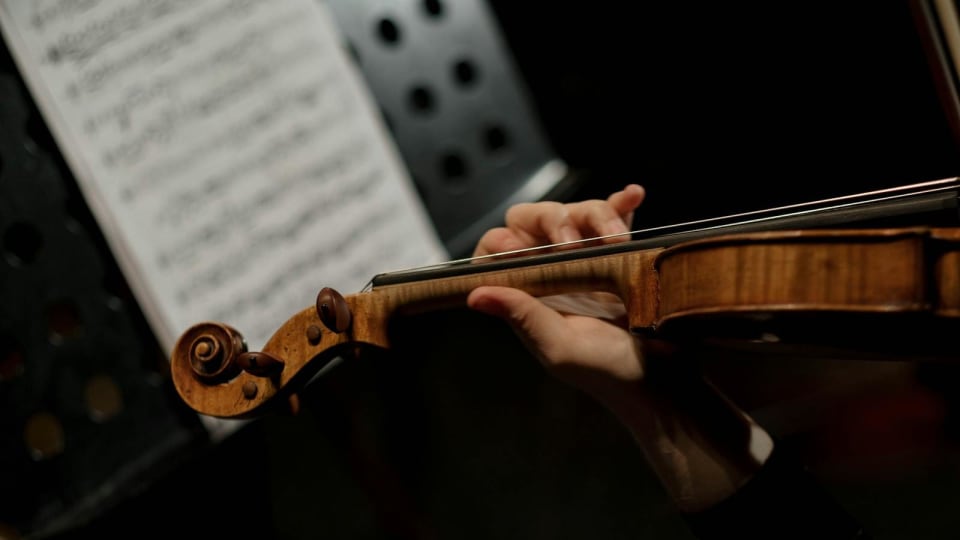
Photo: cottonbro studio via Pexels
How to tell the three apart
The diagnostic questions below separate the three reliably for most cases. Sit with the piece for a session and answer each honestly.
| Question | Out of reach | Stylistically wrong | Needs more time |
|---|---|---|---|
| Can you play the notes slowly? | Yes, but only very slowly | Yes, easily | Yes, slowly improving at tempo |
| Does it improve at tempo? | No, hits a hard wall | Yes — but it sounds blank | Yes, in small weekly increments |
| Can you describe what is wrong? | Specific mechanical bottleneck | You can't — it just feels lifeless | Yes, in detail; you have a plan |
| Are simpler pieces in the same idiom musical? | Not the relevant question | Also feel blank | Yes — you have opinions about them |
| How long has it been resistant? | 3+ weeks with no tempo gain | 6+ weeks with no shape | Variable; recording shows progress |
How to put a piece down without it feeling like defeat
The hardest part of the framework is acting on it once a piece has been diagnosed as out of reach or stylistically wrong. Adult learners often resist setting a piece down because it feels like quitting — a verdict on capability, a moment of failure to record. None of that is what is actually happening. Setting a piece down is a curating move, not a quitting move. Done well, it is one of the most professional decisions an amateur can make.
The frame that works for most pianists is to give the piece a pause status with a return date. Not "I am abandoning the Chopin etude," which feels like defeat. "I am pausing the Chopin etude until I have spent three months on Czerny Op. 740 and Heller Op. 47, and then I will reopen the question." That sentence does several things at once. It names a specific action — the underlying skill work. It names a duration — long enough to be real, short enough to be returnable. It names a re-evaluation point, which makes the pause an experiment, not a decision.
"Setting a piece down is a curating move, not a quitting move. Done well, it is one of the most professional decisions an amateur can make."
A small ritual helps. Mark the score with the date you set it down and a one-line note about why. Move the score to a different shelf or folder — physically, not just in your mind. Choose the replacement piece consciously, so that the absence is filled, not lingering. The Pract.is article on what a repertoire is and how pianists build one covers status taxonomy in more detail; paused is a legitimate category in any working repertoire system.
When to keep going anyway
There are honest cases where the answer is to stay with a resistant piece even when the diagnosis suggests pausing. The clearest is when the piece is the entire point of your current study — you are working on it for a specific recital, a lesson, an audition, a personal milestone. Pausing is not an option, and the work needs to happen now even if the curve is steeper than expected.
The second case is when the diagnosis is borderline — you cannot tell whether it is "needs more time" or "stylistically wrong." Give it another six weeks of structured work with weekly recordings before deciding. Borderline cases often turn out to be Diagnosis 3 in the end; the apparent resistance was impatience, and the recording history proves it after the fact.
The third case is harder. Sometimes a piece is genuinely important to you — emotionally, musically — and you want to do the work even if it is not "efficient." That is a legitimate choice. Music is not only an optimisation problem. A piece you care about enough to spend two years on is a piece worth two years, even if a different piece would have produced more visible progress in the same time. The Pract.is essay on why you are not improving at piano covers the general progress-vs-meaning trade-off; the resistant-piece version is a specific case where you may simply choose meaning.
Coming back to a paused piece
If you set a piece down well, returning to it is often surprising. Many pianists report that a piece they could not play six months ago is suddenly tractable — sometimes within a single session. The intervening time was not idle; the underlying skill or musical understanding has grown, and the piece that resisted before now responds. This is the strongest argument for the pause framework: it works.
The return looks different from the original learning. You re-read the score from scratch, as if for the first time. You may use different fingerings; you may hear different musical possibilities. The piece is not the same piece — you are not the same pianist. The Pract.is article on how to restart an instrument after months or years away covers the same principle at a larger scale. The return is often easier than the start was, because the foundation is now present.
Not every paused piece returns. Some, on revisit, reveal that they were never going to be your piece — different taste, different priorities, a younger self who chose them for reasons that no longer apply. That is also useful information. The pause framework lets you keep the option open without committing to the cost, and the eventual decision — to return or not — becomes clearer after time, not before.
What this changes about practice
The framework above is not a prescription to abandon difficult pieces. It is a prescription to be honest about why a piece is hard. Adult learners who use the three-diagnosis question routinely tend to make better selection choices, work on the right material, and accumulate more visible progress over a year. They also report less frustration, because the resistant piece stops being a referendum on their ability and becomes one of three solvable diagnoses.
The deeper shift is in the relationship to repertoire itself. A repertoire is not a list of pieces you eventually conquer. It is a collection of pieces you have chosen, paused, returned to, retired, and rediscovered across years of playing. Treating it as an editable system rather than a backlog to grind through is one of the most freeing moves an adult pianist can make. The right piece, at the wrong time, can wait. The wrong piece, no matter the timing, deserves a clear pause.
A piece that resists is not a failure. It is information. The work is in reading the information honestly — which of the three is it, what does that imply, what is the appropriate next move — and then doing what the diagnosis recommends, whether that is more work, different work, or a clean and respectful pause until you are ready for it.