

Memory becomes fragile when the only answer to “what comes next?” is whatever your fingers did last time. That kind of memory can feel strong right up until the moment it breaks. One interruption, one blank second, one spike of pressure, and the whole chain can disappear because every bar was only cueing the next bar.
Secure memorization works differently. It still includes motor memory, because of course it does. But it also includes structure, harmony, sound, visual landmarks, and deliberate restart points. The goal is not just to remember. It is to remember in more than one way.
| If memory is mostly finger memory… | If memory is layered… | What changes in performance |
|---|---|---|
| You need the previous bar to reach the next bar | You can jump in from named sections or cues | Interruptions stop being catastrophic |
| A blank spot forces you backward | A structural or harmonic cue can restart you forward | Recovery becomes possible mid-performance |
| Practice is mostly replay | Practice includes deliberate retrieval and random starts | Memory survives longer after breaks |
| The piece feels memorized only from the beginning | The piece is accessible from multiple locations | Pressure reveals fewer hidden holes |
Why does finger memory fail first?
Finger memory is useful, but it is serial. One event cues the next, which cues the next, which cues the next. That is efficient when nothing goes wrong. It is much less helpful when a distraction, hesitation, or surge of anxiety breaks the chain. If the whole piece lives as one long procedural run, there may be no easy way back in once the chain snaps.
Roger Chaffin and Gabriela Imreh described this well in Practicing Perfection: Piano Performance as Expert Memory. Their case study showed that expert memorization is not just a result of repeating motions until they stick. The performer also built deliberate performance cues tied to structure, interpretation, and technical decisions. That broader cue network was part of what made long-term recall possible two years later.
A later summary in Developing Familiarity in a New Duo makes the distinction even clearer: serial cuing happens naturally as one phrase triggers the next, but secure memorization also depends on content-addressable memory, where you can enter at a specific passage because you know what it is, not just because the last passage happened. That is the difference between “my hands know this” and “I know where I am.”
Finger memory is part of the system, not the whole system. If it is the only layer you have, the piece is more recoverable from the beginning than from the middle.
What should a secure memory actually contain?
A stronger memory has multiple handles. You know the formal sections. You understand the harmonic route. You can hear the next gesture internally before you play it. You have visual landmarks in the score and physical landmarks in the movement. And you have a few named moments that can restart the piece if the chain breaks. None of those layers has to be perfect on its own. Together they make the memory much harder to knock over.
This is why mental work away from the instrument matters more than many players expect. Yamaha’s overview of practice types points out that visualization and mental practice can be used to learn and memorize music away from the instrument, not just rehearse it physically. That matters because a memory that only exists in the fingers often collapses the moment the fingers hesitate. A memory that also exists in sound, structure, and imagery has more routes back into the same passage.
Memory layer
Structure
You know sections, transitions, cadences, and where the piece turns.
Memory layer
Harmony
You understand chord function, tension, and where the line resolves.
Memory layer
Sound
You can hear the next phrase inwardly instead of waiting for the hands to discover it.
Memory layer
Landmarks
You have named restart points that can bring back the phrase on demand.
Memory layer
Touch
The physical pattern feels familiar, but it is not carrying the whole burden alone.
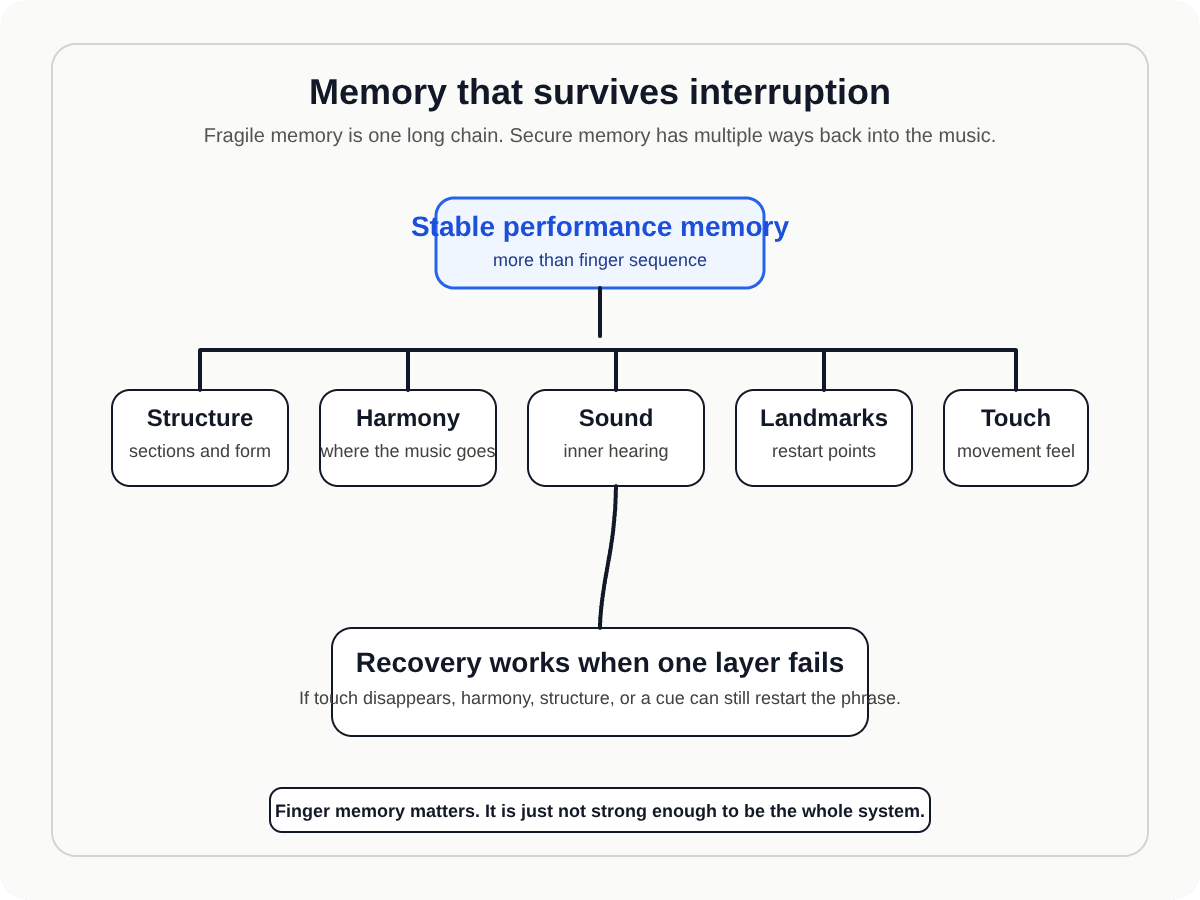
That kind of layering is also why memorized pieces last longer after you first learn them. If you want to keep old repertoire from decaying into a vague hand-memory blur, maintenance has to refresh more than the finger sequence.
How do you build restart points instead of one long chain?
Restart points are one of the clearest differences between fragile and durable memorization. A restart point is a location you can name and enter without needing a long runway. It might be the beginning of the development section, the second-theme return, the phrase after the fermata, or the bar where the left hand sequence flips pattern. What matters is that the point exists in memory as a location, not just as the result of whatever came before it.
Tania Lisboa’s Recording Thoughts While Memorizing Music case study is useful here because it shows how performance thoughts prepared during practice later functioned as retrieval cues. The student did not simply repeat until the piece felt familiar. She marked and rehearsed thoughts that could bring specific passages back to mind. That is much closer to building a map than strengthening a chain.
The same principle appears in Recovery from Memory Failure when Recalling a Memorized Performance. Recovery from a lapse depends on having landmarks you can jump to instead of searching blindly for the lost spot. That is one reason a piece is not really performance-ready until you can restart from more than the top.

Photo: Tima Miroshnichenko via Pexels
How should you practice retrieval instead of just replaying?
Replaying proves familiarity. Retrieval proves accessibility. Those are not the same thing. If you only start from the beginning and let the piece unspool, you mainly reinforce serial flow. Retrieval practice asks a harder question: can you call up section B, the cadence into the recap, or the left-hand sequence after the modulation without being carried there automatically?
This matters well beyond music. Jeffrey Karpicke and Henry Roediger showed in their retrieval-practice work that repeated recall improves long-term retention, and that spacing the recalls matters. Douglas Larsen and colleagues showed the same basic pattern in applied learning settings: repeated testing outperformed repeated study for long-term retention. The domain changes, but the lesson stays useful. Memory becomes stronger when you have to bring the information back, not merely re-expose yourself to it.
Recall silently first
Name the section, hear the opening, and picture the first technical setup before touching the instrument.
Start from the middle
Enter from a chosen landmark with no run-up. If it fails, the cue needs more work.
Space the retries
Come back after other material or after a break so the memory has to be rebuilt, not merely continued.
Link cue to sound and motion
Do not memorize a label alone. Attach it to the expected sound, harmony, and physical setup.
Patch weak spots specifically
If one entry point collapses, isolate and rebuild it the way you would fix any other stubborn passage.
If a memory hole is local, treat it locally. The same repair logic for repeated mistakes applies to repeated memory gaps: isolate the trigger, rebuild the lead-in, and stop trusting one lucky clean try.
Why does memory collapse under pressure, and how do you test it?
Pressure exposes whatever part of the memory system is thinnest. If the piece is mostly procedural, pressure can disrupt it in two different ways. It can distract attention away from recall, or it can make you over-monitor a skilled chain that normally runs automatically. Both problems show up in the choking literature, and both are bad news for memory that has only one route through the piece.
That is one reason memory slips show up in pieces that felt secure at home. In Factors of Choking Under Pressure in Musicians, memory failures were one of the experiences captured when well-prepared pianists performed under pressure. A memorized piece can feel stable in the practice room and still prove fragile when the context changes. That is also why performance transfer matters so much: memory has to survive interruption, self-consciousness, and altered attention, not just repetition in a familiar room.
Bottom line
Memorization becomes durable when the piece exists as a map, not just a chain. Build structure, harmony, sound, landmarks, and retrieval drills into the memory before you trust it on stage.
A practical test is simple: can you start from four or five named points, after a short delay, with no run-up and no panic? If the answer is yes, the memory is becoming portable. If the answer is no, the piece may be memorized from the beginning but not yet secure.


