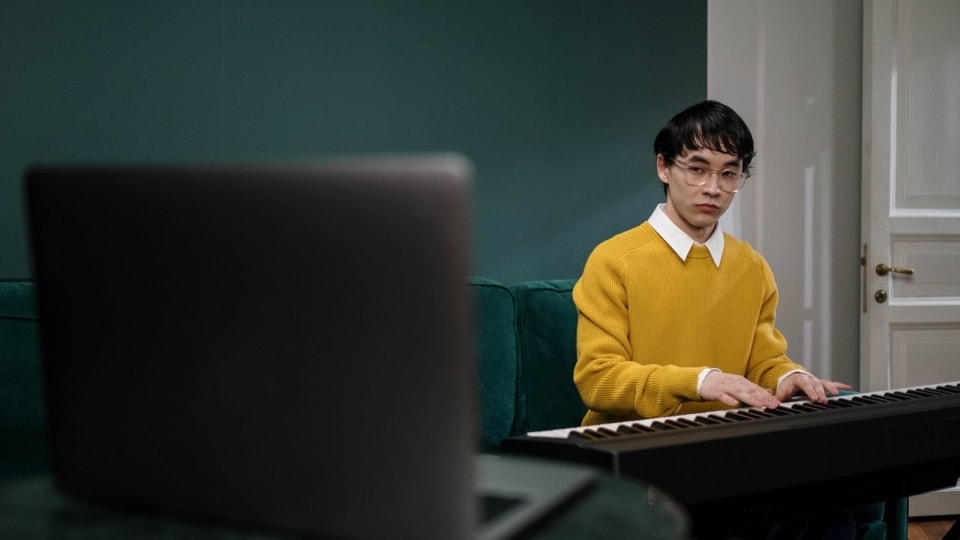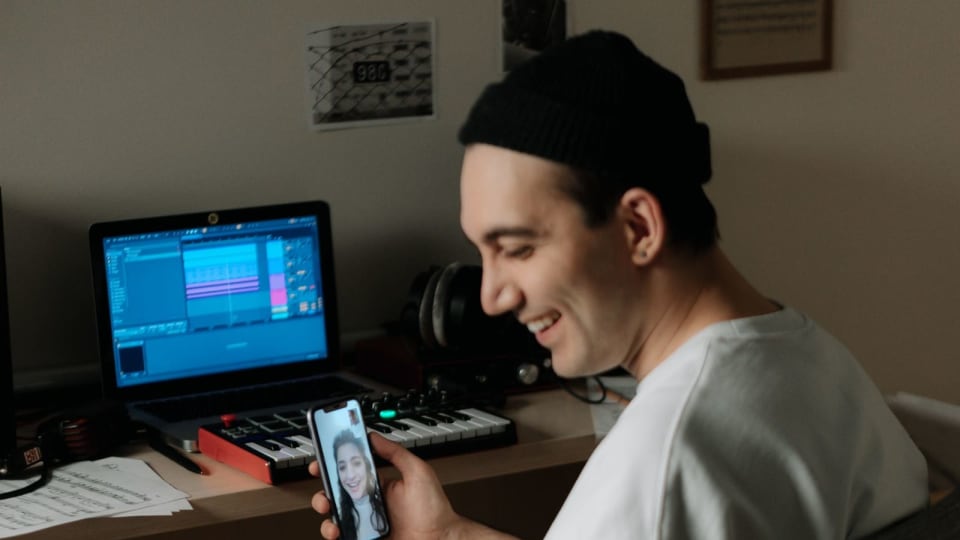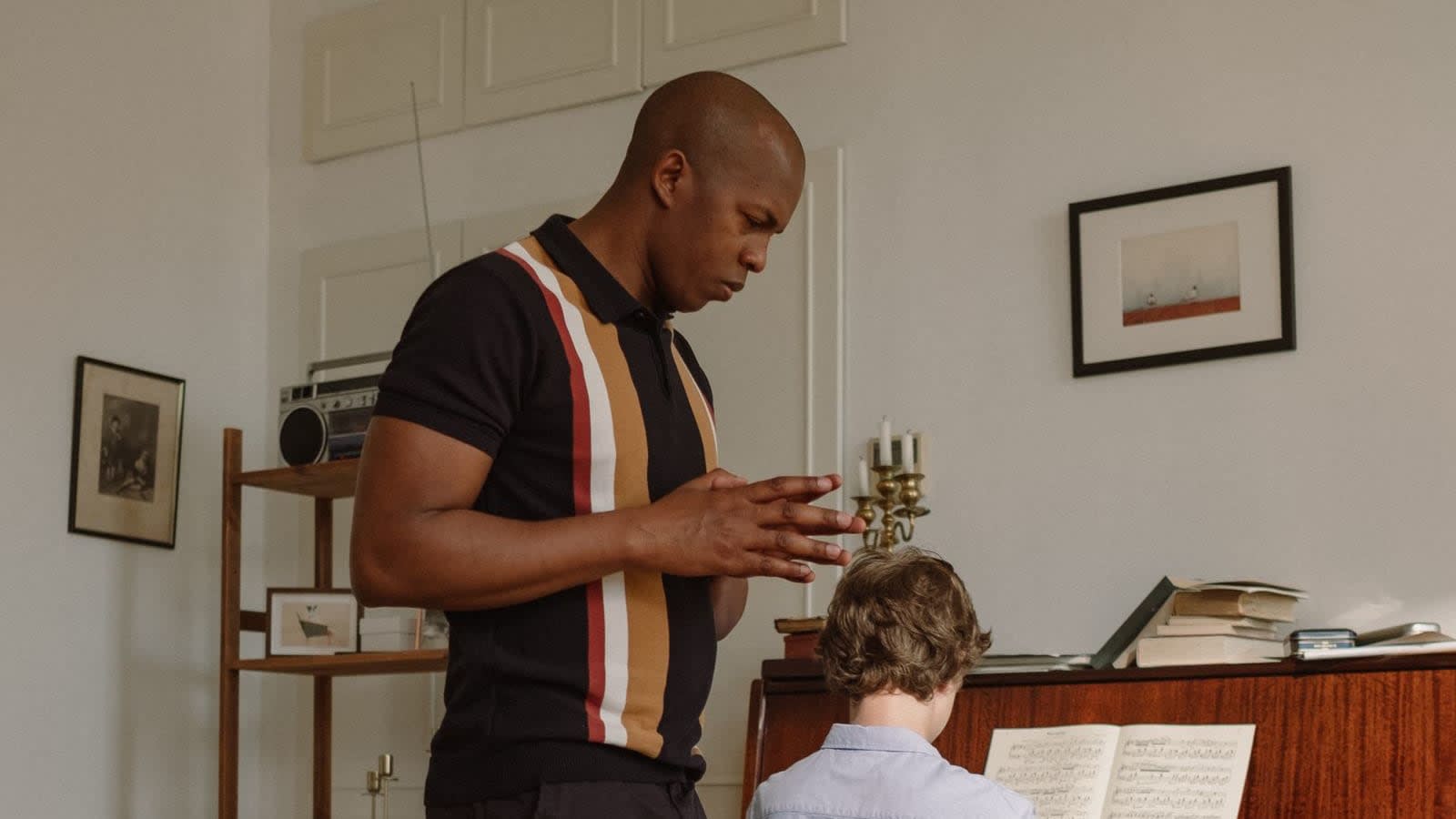
Ask this question in any piano forum and you'll get two confident, opposite answers within the hour. "Nothing replaces a teacher in the room" — usually from someone who trained decades ago. "My Zoom teacher is better than any local option I had" — usually from someone who actually switched. Both are telling the truth about their experience, which is exactly why the honest answer is more useful than either slogan: for most students, the two formats now produce results you can't tell apart — but not for all students, and not on all dimensions.
This post is the dimension-by-dimension version of that answer: what the research actually found, where in-person still genuinely wins, where online quietly wins more than people expect, and the small amount of setup that determines which experience you actually get. (If you're an adult beginner weighing lessons across any instrument, we've also written a version of this question specifically for you — online vs in-person music lessons for adult beginners — including why some instruments handle remote teaching better than piano's cousins do.)
What the evidence says
Start with the strongest data point available, because it should reframe the whole debate. A controlled comparison published in Education and Information Technologies put piano students through online and traditional face-to-face instruction and measured the skills they came out with — and found no significant statistical difference between the groups. Students in both formats also reported high satisfaction. That doesn't make the formats identical; it means that under reasonable conditions, the format itself is not what decides your progress. The teacher, the practice between lessons, and the setup are.
That matches what a decade of forced experimentation did to the profession. When every teacher on earth taught through a webcam for two years, the good ones developed genuine remote technique — camera angles, demonstration setups, ways of hearing through compression — and the format's old reputation ("a degraded copy of the real thing") stopped being true for teachers who adapted. The gap that remains is real but specific, so let's be specific about it.
| Dimension | Edge | Why |
|---|---|---|
| Physical technique correction | In-person | Hands can be repositioned, not just described |
| Acoustic sound & touch feedback | In-person | Compression flattens tone and dynamics |
| Very young children (≈under 7) | In-person | Presence holds attention a screen can\u2019t |
| Choice of teacher | Online | The whole world vs. a 20-minute radius |
| Consistency over months | Online | No commute — fewer cancelled weeks |
| Learning on your own instrument | Online | You\u2019re taught on the piano you practise on |
| Lesson records & rewatching | Online | Recording a Zoom lesson is one click |
Where in-person genuinely wins
Three advantages survive every improvement in webcams, and it's worth naming them without hedging. First, physical correction: a teacher in the room can take your wrist and move it, place a hand on your shoulder to release it, feel the tension you can't see. Over video this becomes description and demonstration — often enough, but a slower path for stubborn physical habits. Second, sound: even with the best settings, video-call audio compresses exactly what an advanced player is refining — tonal colour, the difference between eight dynamic levels and three. For beginners and intermediates this barely matters; for a conservatory-bound student polishing repertoire, it does. Third, very young children: a five-year-old's attention is held by a person in the room in a way no screen matches, which is why early-childhood teachers remain the most in-person-resistant group.
Notice what those three have in common: they concern the edges of the student population — the very young, the very advanced, and the physically stuck. That's precisely why the averaged studies find no difference while individual cases still can.
"In-person wins at the edges — the very young, the very advanced, the physically stuck. In the wide middle, the format stopped mattering."
Where the format still matters — and where it doesn't
Where online quietly wins
The pro-online case is usually argued on convenience, which undersells it badly. The deepest advantage is selection: in-person, your teacher pool is whoever lives within driving distance; online, it's everyone. A student in a small town whose local options are a retired organist and a guitar shop can instead study with a Vienna-conservatory-trained pianist — that's not hypothetical, it's literally the top pick in our guide to the best online piano teachers, teaching worldwide at $45 an hour. For most students, upgrading the teacher matters more than any property of the format, and online is the only way most people can make that upgrade. (How to vet the one you find is its own skill — we built a nine-question kit for exactly that.)
The second underrated win is consistency. Lessons compound weekly or they don't compound at all, and the commute is the silent killer of in-person schedules — the rainy Tuesday, the traffic, the sick sibling who needs the car. Online lessons survive all of it, which is why remote students often accumulate more actual teaching hours across a year despite the "lesser" format. Add two structural bonuses: you're taught on the instrument you actually practise on (no more "it worked on my teacher's grand"), and every lesson can be recorded and rewatched — a superpower in-person students simply don't have when Thursday's brilliant explanation has evaporated by Sunday.
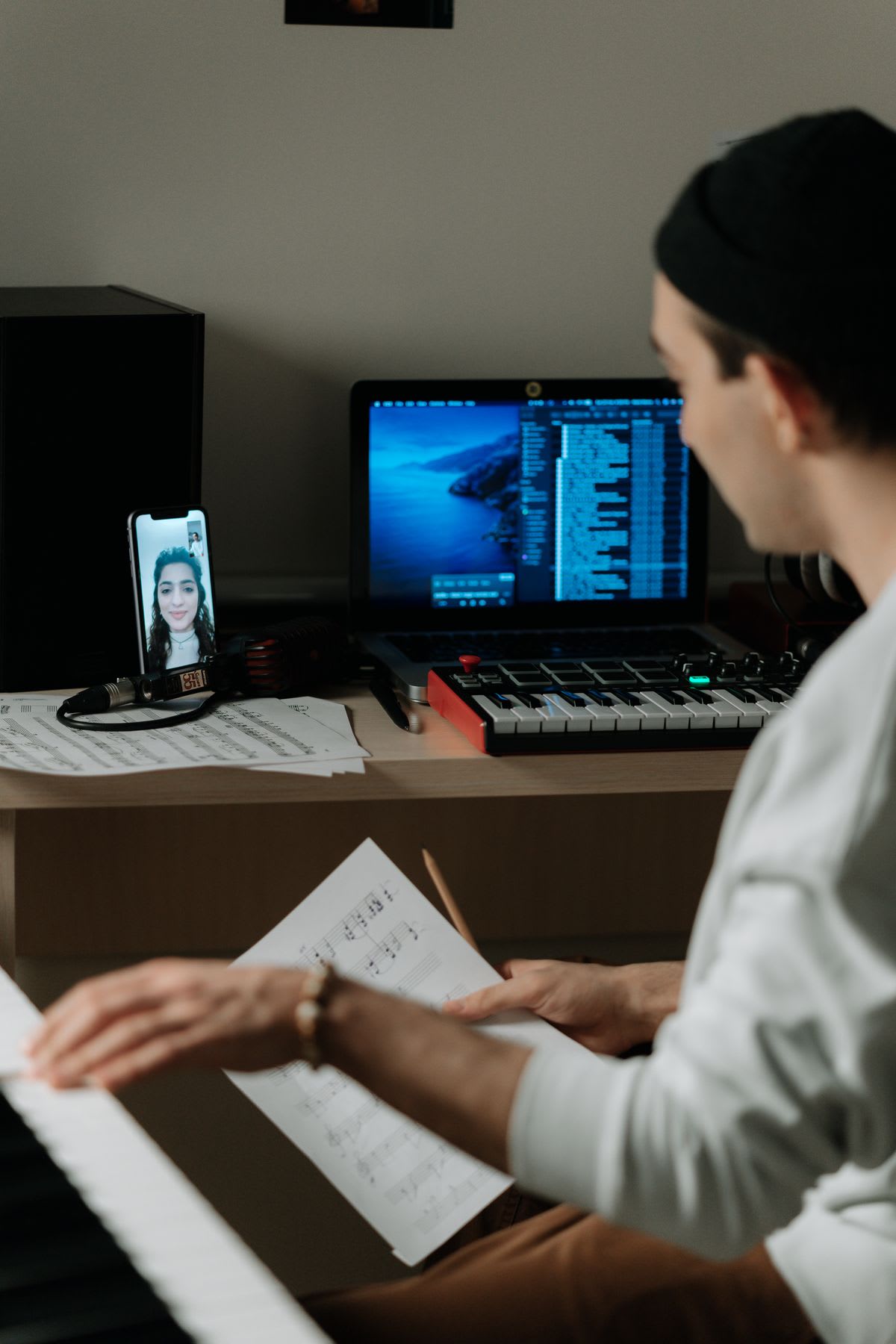
The $30 of setup that decides which experience you get
Here's the part both camps underrate: most "online lessons don't work" stories are actually setup stories. A laptop on the music desk pointing at your face shows the teacher everything except the thing they teach. The fix costs almost nothing and takes ten minutes once:
The online-lesson setup that works
With that setup, the remaining gap for a typical adult or teen student is small enough that the other factors — teacher quality, your practice week, sheer consistency — dominate it completely. Without it, you're genuinely getting the degraded experience the sceptics describe, and no teacher can fully compensate for watching the top of your head.
"Most 'online lessons don't work' stories are setup stories. A side-on camera and one audio toggle close most of the gap for $30."
The verdict, by student
So: as good? For a child under about seven, in-person still earns its logistics if a good local teacher exists; if not, online with a parent sitting in works far better than the sceptics claim. For school-age kids, teens, and adults — the wide middle of piano learners — the formats are functionally equivalent once the setup is right, which means you should choose on the things that actually differ: pick whichever route gets you the better teacher and the more consistent schedule, and for most people in most places, that's online. For the advanced student refining tone and sound at a high level, in-person time still matters — though even conservatory-bound players increasingly run a hybrid, doing technique and repertoire work remotely and saving in-person sessions for polish. And if you're still one level up from this question — teacher versus app versus some mix — start with the full 2026 map of online piano lessons.
Common questions
Are online piano lessons harder for complete beginners?
Slightly, in the first weeks — posture and hand position are being built from nothing, which is where physical correction helps most. A good online teacher compensates with a strict camera setup and slower early pacing, and past the first month the difference fades. If you're a nervous absolute beginner with a strong local option, in-person starts are gentler; if your local options are weak, a better teacher online beats a mediocre one in the room from day one.
Do I need a special keyboard or two cameras?
No. Any piano or 88-key digital works, and one well-placed phone beats two badly placed devices. A second angle (overhead) is a nice-to-have some teachers request for specific technique work, but nobody should demand studio gear from you — decent light, a side-on camera, and original sound cover a full lesson's needs.
Doesn't lag make playing together impossible?
Real-time duet playing, yes — latency rules it out, and honest teachers structure lessons so it never matters: you play, they listen, they demonstrate, you play again. The turn-taking format loses almost nothing for solo piano teaching. What lag actually kills is ensemble coaching, which is why chamber groups and duet partners still meet in rooms.
The question "are online lessons as good?" quietly assumes the alternative is a great in-person teacher ten minutes away — and for a lucky few, it is, and they should use them. For everyone else, the real comparison is the best teacher you can reach online versus the best one you can reach by car, taught on your own piano, on a schedule that survives real life. Framed that way, the research's "no significant difference" is almost beside the point: the format stopped being the thing worth optimising. The teacher is. Go find the best one you can — wherever they happen to live.