
What to Charge for Piano Lessons in 2026 (Data + a Calculator Mindset)
Set sustainable piano lesson rates for 2026 using current benchmarks, real workload, collected hours, payment fees, and a practical rate-floor formula.
Pract.is Editorial
Research-based practice guidance for musicians from the Pract.is editorial team.

A sustainable piano lesson rate is not the highest number a nearby teacher charges or the lowest number a prospective student will accept; it is the price that covers the whole teaching job across a realistic year. Current benchmarks can show the neighborhood, but your calendar has to supply the address.
That distinction matters in 2026 because public rate figures mix countries, experience levels, lesson formats, and business models. The useful question is not simply what piano teachers charge, but what this studio must collect per teaching hour after the unpaid parts of the job are counted.
A market average is a reference, not your rate
The best public teaching surveys do not produce one global piano-lesson price. They produce several local snapshots, each with a different method. The 2024 MTNA member survey reports an average of $65.72 and a median of $60 for a 60-minute lesson among independent US music teachers during the 2023–24 school year. The reported range was $0 to $310, which is a useful warning against treating the average as a prescription. It is the latest official MTNA snapshot available for this comparison, not a claim that every US piano teacher should charge $60 in 2026.
The current UK data tells a similar story. The ISM’s 2026 fees survey, based on 1,084 usable responses, found a £40 median for private teaching, with reported fees spanning £9 to £105 per hour. Meanwhile, the Musicians’ Union publishes a 2026–27 recommended minimum of £45.50 for self-employed one-to-one and small-group teaching. Those figures are not contradictory: one describes what respondents reported, while the other is a recommended floor designed to account for obligations such as leave, pension contributions, and sick pay.
| Reference | Published figure | What it can tell you | What it cannot tell you |
|---|---|---|---|
| US: MTNA, 2023–24 | $65.72 average; $60 median | A broad independent-teacher benchmark | Your city, instrument, or 2026 floor |
| UK: ISM, 2026 | £40 private-teaching median | Current reported market behavior | A recommended or guaranteed viable rate |
| UK: MU, 2026–27 | £45.50 recommended minimum | A self-employed floor with on-costs in mind | A ceiling or local quote |
| Queensland: QMTA, 2026 | A$87 professional; A$77 associate; A$67 student | Accreditation-based recommended minimums | Rates elsewhere in Australia |
The Queensland figures come from the QMTA’s 2026 recommended tuition rates, which explicitly exclude on-costs such as superannuation, annual leave, and GST. That footnote is as important as the headline numbers. Start with the most relevant local reference you can find, but do not stop there.
“Average rates tell you where the road is. Collected hours tell you whether your studio can stay on it.”
Find the rate your calendar actually requires
Begin with a year, not a lesson. Decide what the studio needs to produce as owner compensation before personal income tax, then add business expenses and a reserve for the benefits an employer would normally help fund. Equipment, professional memberships, software, accounting, room rent, insurance, retirement contributions, and paid time away all belong somewhere. Tax and employment rules vary, so the categories should be checked with a qualified local adviser; the arithmetic below is a planning model, not individualized tax advice.
The rate-floor equation
Required annual studio revenue ÷ realistically collected lesson hours = minimum effective hourly rate
$60,000 ÷ 792 = $75.76 per collected lesson hour. In this example, a listed rate around $80 gives the studio a little room for payment costs and ordinary variance.
The collection rate is the part teachers most often make too optimistic. Twenty available hours are not twenty paid hours if the schedule starts half empty, invoices arrive late, or cancellations are refunded. Use the previous twelve months if they exist. For a new studio, model a cautious 80–90% rather than assuming a flawless calendar. Our post on the economics of being a music teacher goes deeper into why a full-looking week can still produce a fragile annual income.
Price 30, 45, and 60 minutes without pretending they cost the same
It is tempting to take an $80 hourly rate and publish $40, $60, and $80 for 30-, 45-, and 60-minute lessons. That is tidy, but it assumes every task scales with lesson length. Sending notes, checking a student’s practice history, answering a parent, processing a payment, and resetting the room may take five minutes whether the lesson lasts half an hour or a full hour. Shorter lessons therefore consume more support time per minute taught.
A simple correction is to add the average per-student support time before applying the effective hourly rate. In the worked example below, the target is $80 per working hour and each appointment carries five minutes of preparation or follow-up. The numbers are not recommended prices; they show how the method behaves. Round to a clear amount that fits your market and billing system rather than publishing awkward cents.
| Booked lesson | Working time | Raw calculation at $80/hour | Practical range to test |
|---|---|---|---|
| 30 minutes | 35 minutes | 35 ÷ 60 × $80 = $46.67 | $47–$50 |
| 45 minutes | 50 minutes | 50 ÷ 60 × $80 = $66.67 | $67–$70 |
| 60 minutes | 65 minutes | 65 ÷ 60 × $80 = $86.67 | $87–$90 |
There is no rule that all three lengths must remain on the menu. A teacher may decide that 30 minutes works for young beginners, 45 minutes is the standard appointment, and 60 minutes is reserved for advanced repertoire or exam preparation. Fewer options make scheduling easier and help families choose. Price each option for the work it creates, not merely for its fraction of an hour.
Pick the billing model before you publish the number
The same nominal lesson rate behaves differently under pay-as-you-go, monthly tuition, and term packages. Pay-as-you-go is easy to understand and friendly to irregular adult schedules, but income moves with every absence. Monthly tuition can stabilize the studio when it sells a reserved weekly place plus a clearly defined number of lessons across the year. Term billing matches a school calendar well, though each renewal creates a point where students can drift away.
Pay as you go
Best when flexibility is part of the offer. Build expected cancellations directly into the collection rate.
Monthly tuition
Best for a recurring reserved place. State the annual lesson count and what happens during holidays.
Term package
Best around school terms or cohorts. Set payment and make-up rules before enrollment opens.
For example, forty $80 lessons produce $3,200 in annual tuition. Billing that amount over ten active months gives a family a predictable $320 monthly payment; spreading it over twelve gives $266.67. Neither plan creates extra revenue by itself. The advantage is that the family and teacher can see what the payment reserves. Write the included lesson count, studio closures, cancellation rules, and exit terms in plain language before automating the invoice.
This is also where better administration protects the rate. If notes, reminders, payments, and schedule changes consume several unpaid hours every week, the answer may be a higher price, a simpler policy, or a better workflow. Our guide to cutting music-teacher admin can help separate work that deserves payment from work that should be removed.
Add the costs that disappear from an hourly quote
Payment processing, marketplace commission, travel, room hire, and specialized preparation should not be discovered after the price is public. Processor fees differ by country and payment method, so check the current pricing for the account you actually use. If an $80 charge costs your studio 3% plus $0.30, it nets $77.30, not $80. Use your real statement rather than copying that hypothetical percentage.
Marketplaces need the same treatment. Lessonface says its commission is 4–15% of private lesson fees. To net $80 after a 15% platform fee, the listed rate would need to be $80 ÷ 0.85, or $94.12. A platform may still be worthwhile if it brings suitable students and handles useful operations; the commission simply belongs in the acquisition budget, not in the category of surprises.
Travel is usually more expensive than it looks because it blocks bookable time on both sides of the appointment. A 60-minute home lesson with thirty minutes of total travel uses ninety minutes before any follow-up. Online lessons remove the drive, but they still require equipment, internet, and setup, so “online” is not an automatic reason to discount. Our student-facing breakdown of what online piano lessons cost is useful for checking how families will interpret different price tiers.
“Price the whole teaching promise, not only the minutes beside the piano.”
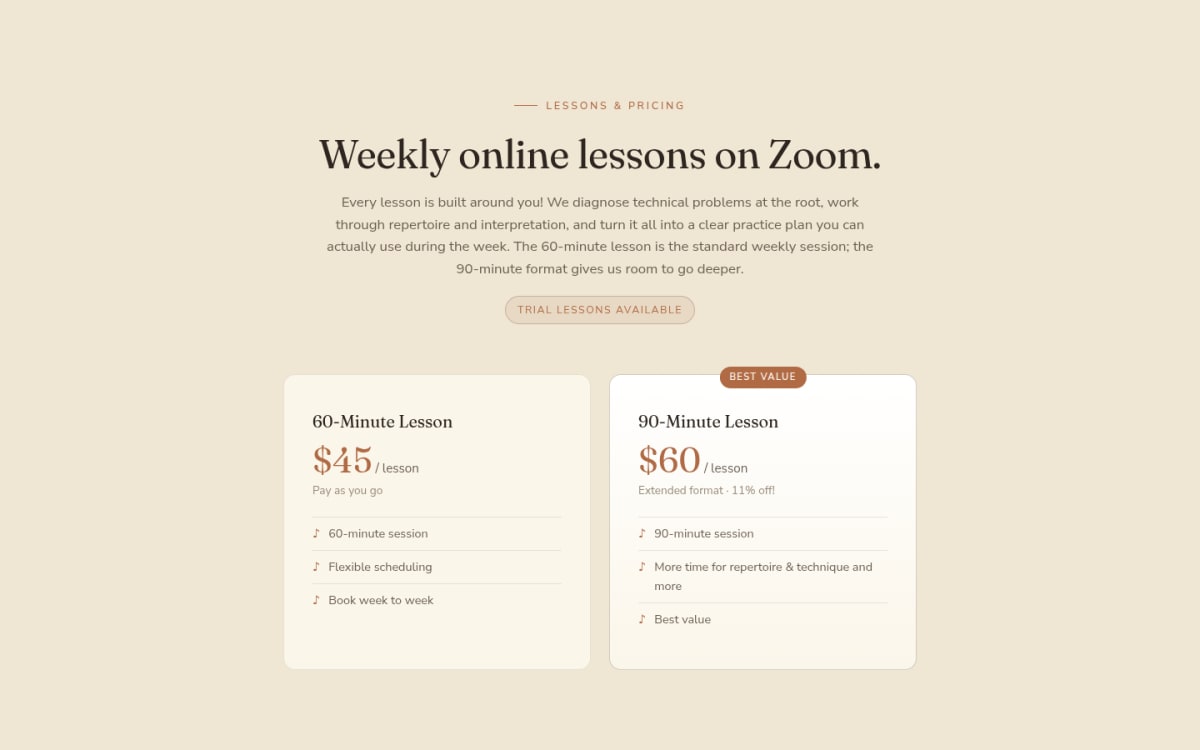
Public pricing is easiest to trust when the choices are concrete. PianoTechSupport, for example, currently presents a 60-minute pay-as-you-go lesson at $45 and a 90-minute lesson at $60, then explains the schedule and purpose of each. This is not a universal benchmark; it is a useful example of making the trade-off visible instead of hiding every number behind an inquiry form.
Raise rates before resentment sets the schedule
A rate should have a review date even when it does not have an automatic increase. Once a year, compare actual collected revenue, teaching weeks, unpaid hours, expenses, waitlist pressure, and the local market. A teacher who is consistently full, doing more specialized preparation, and absorbing higher costs has useful evidence for a change. A teacher with several open slots may need to improve positioning or retention before assuming price is the only lever.
Rate increases are normal studio maintenance, not a confession. In the ISM’s 2026 survey, half of private teachers had raised their hourly rate since September 2024, with an average increase of £3.20. Give reasonable notice, state the effective date, and keep the explanation short. Families need the new amount and any policy change; they do not need an apology-filled account of every expense.
A plain rate notice
From September 1, the fee for a 45-minute weekly lesson will be $68. This update supports the preparation, lesson notes, and reserved weekly time included in tuition. All other scheduling and cancellation terms remain unchanged.
Open a spreadsheet and calculate the last twelve months before looking at another teacher’s website. Add what the studio must provide, divide by hours it can realistically collect, and compare that answer with the best local benchmark available. If the current price falls below the floor, choose a review date and write the notice now; waiting until the calendar feels unbearable only makes the eventual change harder.
More on teaching.
Tonara Alternatives for Teachers and Studios After the Shutdown
Tonara alternatives for teachers and studios, compared by assignments, practice logs, recordings, messaging, admin tools, pricing, and migration friction.
Pract.is Editorial
How to Start Teaching Piano Online in 2026 (From First Student to Full Studio)
Start teaching piano online with a clear offer, first-student plan, studio policy, lesson workflow, and growth system that stays manageable.
Pract.is Editorial

The Online Piano Teacher's Tech Stack (2026)
Build an online piano teacher setup students can hear, see, book, and use between lessons, without turning your studio into a broadcast rig.
Pract.is Editorial