
Why Your Self-Taught Piano Progress Stalled (And What a Teacher Sees in 10 Minutes)
Self-taught piano progress often stalls when the player creating the problem is also the only person trying to diagnose it. Here is what a teacher can see in ten minutes, how they test the cause, and how to turn one correction into a better month of practice.
Pract.is Editorial
Research-based practice guidance for musicians from the Pract.is editorial team.

If your self-taught piano progress has stalled, the most likely problem is not motivation or a shortage of new material. It is that the same person producing the error is also judging it and choosing the remedy. That arrangement can work for a long time, then suddenly become the bottleneck.
A good teacher's advantage is not access to secret exercises. It is diagnostic speed: they can hear one performance, separate a symptom from several possible causes, change one variable, and listen again. Ten focused minutes can save months spent practising the wrong solution.
A plateau is a symptom, not a diagnosis
"I cannot get this passage faster" sounds like a useful description, but it is no more a diagnosis than "the car makes a noise." The speed wall could come from fingering that forces a collision, a pulse that was never stable slowly, tension that appears before the difficult notes, or eyes arriving at the next group too late. Each cause needs a different response. Running the passage again addresses none of them.
This is why self-taught players can be both diligent and stuck. They notice the visible event — the missed note, the hesitation, the memory lapse — and prescribe the most obvious cure: slower practice, more repetitions, or another tutorial. Sometimes that works. When it does not, they often increase the dose instead of questioning the diagnosis.
| What you notice | What may actually cause it | First test |
|---|---|---|
| A fast passage breaks | Fingering collision, hidden tension, weak rhythm map, or late reading | Loop two beats with one variable changed |
| The tempo drifts | Unclear subdivision, coordination load, or following the hands instead of the beat | Tap and speak the rhythm away from the piano |
| Memory fails in one place | A weak harmonic landmark, fixed start-to-finish chaining, or uncertain fingering | Start from the bar after the failure |
| The piece sounds flat | No voicing plan, shallow listening, or dynamics added too late | Play the melody alone, then place it above the accompaniment |
Research on practice quality makes the same point from another direction. In a study of 17 advanced pianists learning a difficult three-measure passage, practice time and number of trials did not predict the ranking of next-day performances. Correct trials and the strategies used during practice mattered more. The paper's title says it plainly: "It's Not How Much; It's How." A self-taught plateau is often not a request for more work. It is a request for better information.
What a teacher can learn in the first two minutes
The first useful thing a teacher may do is nothing. They ask for a piece you know well and let you play without interrupting. While you are trying to show the best version, they are listening for where the tempo changes, where the sound hardens, whether an error begins before the wrong note, and what you do immediately after it. They also watch the route: eyes, shoulders, wrists, breath, pedal, and the shape of a restart.
That uninterrupted pass matters because the mistake itself is only one frame. The lead-in often reveals the cause. A shoulder rises two beats before a leap. The eyes leave the page before a memory slip. A left hand begins to rush, then the right hand misses while trying to catch it. If you stop only at the wrong note, you erase the evidence.
App-led learners can arrive with a recognizable set of app-specific blind spots, but this diagnostic problem is broader than apps. A player can learn from scores, books, videos, or excellent courses and still be unable to see the movement pattern happening from their own point of view.
The ten-minute diagnostic, minute by minute
No serious teacher follows a stopwatch script, and not every problem yields in ten minutes. The sequence below is a realistic model of what a focused diagnostic exchange can look like: observe, narrow, test, and leave with a next action.
A representative ten-minute lesson
Minutes zero to two: perform. Play a familiar section at a normal, manageable tempo. The teacher needs your usual version, not a newly cautious one. Minutes two to four: replay. They choose the smallest window that still contains the failure, often including the beat before and after it. Minutes four to six: explain. You describe what you think is happening. The gap between your account and the sound is valuable evidence, not a test you failed.
Minutes six to eight: change one variable. Use a fixed fingering, remove one hand, sing an inner voice, shift the starting point, or tap the rhythm. Minutes eight to ten: retest. Put the passage back into something close to its original setting. If it improves, the hypothesis has support. If it does not, that is useful too: one possible cause has been ruled out.
"A teacher does not need ten minutes to list everything wrong. They need ten minutes to find the first thing worth testing."
A teacher listens through four lenses at once
A self-taught player usually listens through the lens most familiar to them. Strong readers watch notes. Ear players follow sound. Technically minded players monitor movement. A teacher can hold several views of the same take at once and look for where they disagree.
The teacher's diagnostic lens
One performance produces several signals. The lesson begins by testing the one most likely to explain the rest.
Pulse asks whether the beat continues through difficulty. Sound asks what reaches the listener: balance, articulation, voicing, pedal, and phrase. Motion asks whether the body is making the musical task harder than it needs to be. Method asks how this version was learned: where you start, what you repeat, what you ignore, and how you decide a passage is ready.
Research on piano lessons supports the value of active, fast feedback cycles. An observational study of teacher-student interaction in adult and child piano lessons found that more effective teaching was associated with more modelling and feedback, shorter stretches of uninterrupted student performance, and a quicker lesson pace. That does not mean constant interruption. It means the teacher hears enough to form a useful idea, then puts that idea back into the student's hands.
The first useful correction is an experiment
Weak correction sounds like "be more even" or "practise that slowly." It may be true, but it does not tell you what to change. A diagnostic correction is deliberately testable: "Keep this fingering for four repetitions and release the thumb after the turn," or "Tap the left hand while speaking the right-hand rhythm, then play both." If the result changes immediately, the teacher has learned something about the cause.

The logic has a solid motor-learning basis. A 2025 piano study in Communications Biology tested whether highly trained pianists could move beyond an apparent performance ceiling. Breaking a complex sequence into components and giving precise timing-error feedback helped skilled players improve in ways ordinary repetition did not. The experiment involved expert-level motor skill, so it should not be treated as a universal recipe for beginners. Its practical lesson is still useful: when the whole action hides the error, make the action smaller and the feedback more precise.
You can borrow that logic alone. Record one normal take, name one observable problem, choose one suspected cause, and change only that cause for three to five attempts. Then restore the original context and record again. Our post on how to review your own practice like a teacher gives you the full self-review loop. The crucial restraint is changing one thing. If you slow down, alter fingering, remove the pedal, and split the hands all at once, an improvement tells you almost nothing.
"The correction is not the verdict. It is the experiment that tells you whether the diagnosis was right."
Good feedback tells you what to do next
An outside pair of ears is not automatically useful. "That was rushed" describes the past. "Mark the half-beat before each left-hand arrival, then practise from three different starting bars" changes tomorrow's practice. The difference is feed-forward: a clear next action rather than a running commentary on what already happened.
This distinction is not academic nit-picking. A 2025 analysis of feedback in collegiate instrumental lessons found that about 83 percent of teachers' comments were feedback about a student's current or past performance, around 16 percent were feed-forward, and less than 1 percent involved goal setting. The study covered six experienced teachers and 18 students, so it is not a verdict on all music teaching. It is a useful warning: even expert observations need to become an assignment before they can improve the next week. You can read the full feedback study here.
A worthwhile diagnostic lesson should leave you able to answer four plain questions: What is the main bottleneck? What evidence points to that cause? What exact task should I repeat this week? How will I know the fix has transferred back into the piece? If a teacher gives you a long inventory of faults but no order, ask which one comes first. If you are choosing someone new, use those questions alongside our guide to choosing an online piano teacher.
Turn ten minutes of diagnosis into four weeks of practice
The ten minutes are valuable only if the correction survives after the lesson. Give one diagnosis a month rather than trying to rebuild your whole playing at once.
Week one: establish the baseline. Keep a short recording of the original passage and write the diagnosis in one sentence: "The right hand rushes because finger four arrives late after the thumb turn." Then follow the assigned drill at a tempo where the new movement is dependable.
Week two: vary the entry. Start one beat before the problem, on the problem, and one beat after it. Change the rhythm or register if the task allows. The goal is to make the new solution available from more than one route rather than tying it to a single carefully prepared run-up.
Week three: restore the neighbourhood. Expand from two beats to two bars, then to the whole phrase. Bring back pedal, dynamics, or the other hand one layer at a time. If the old version returns, shrink the window again without treating it as failure; you have simply found the point where the new pattern stops transferring.
Week four: stress-test it. Play from a cold start, after another piece, and once while recording. Compare it with the baseline. A fix is trustworthy when it appears under ordinary conditions, not only after ten warm-up repetitions.
Keep the diagnosis, task, and retest result together. Paper is fine. A simple note is fine. Practis is designed for exactly this kind of thread: a note tied to the piece, the practice sessions that followed, and the change you can review later. The tool matters less than preserving the reasoning, because "practise bar 28" is easy to forget and "test whether the thumb release fixes bar 28" is a plan.
If you want an outside diagnosis without pretending you need to start piano again from page one, PianoTechSupport is the option we recommend. Its online lessons are built around root-cause diagnosis and a practical weekly plan, and a trial lesson lets you bring one stubborn piece and see whether the teaching style fits. If apps carried you this far but no longer tell you what to fix, our post on what to use after piano apps stop working maps out the other ways to add feedback without throwing away what already works.
A teacher's ten minutes are not valuable because they prove you cannot teach yourself. They are valuable because they stop you spending the next hundred hours solving the wrong problem. Bring one piece, play it honestly, and leave with one cause worth testing. That is enough to make a stalled month move again.
More on lessons.

Trusted Online Piano Lesson Providers in 2026 (And How to Vet Them)
Every affiliate list calls every provider "trusted." Trust isn't a vibe — it's a short set of things you can actually check. The signals that separate a trustworthy online piano provider from a slick one, and a vetted shortlist by category.
Pract.is Editorial

A Week Between Piano Lessons: How Good Teachers Structure Your Practice
Piano practice between lessons works best when the teacher leaves you with a result, a method, and evidence to bring back. Here is what a well-structured week looks like, even when the week itself is messy.
Pract.is Editorial
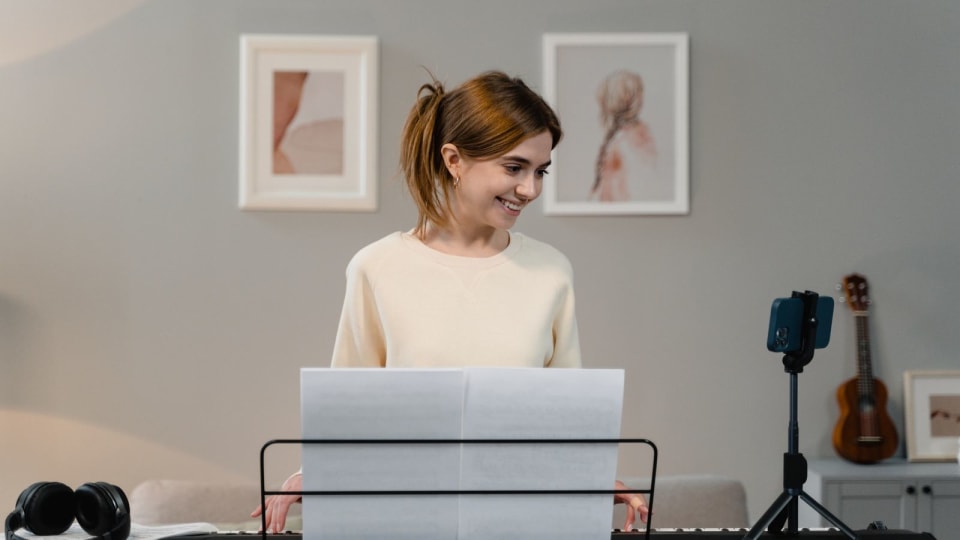
The First Online Piano Lesson: What Happens, What to Prepare, What to Ask
Almost everyone is a little nervous before their first online piano lesson — and almost nobody needs to be. Here is exactly what happens in that first session, the fifteen-minute setup that makes it go smoothly, and what to prepare so you walk in ready instead of anxious.
Pract.is Editorial