
The First Online Piano Lesson: What Happens, What to Prepare, What to Ask
Almost everyone is a little nervous before their first online piano lesson — and almost nobody needs to be. Here is exactly what happens in that first session, the fifteen-minute setup that makes it go smoothly, and what to prepare so you walk in ready instead of anxious.
Pract.is Editorial
Research-based practice guidance for musicians from the Pract.is editorial team.
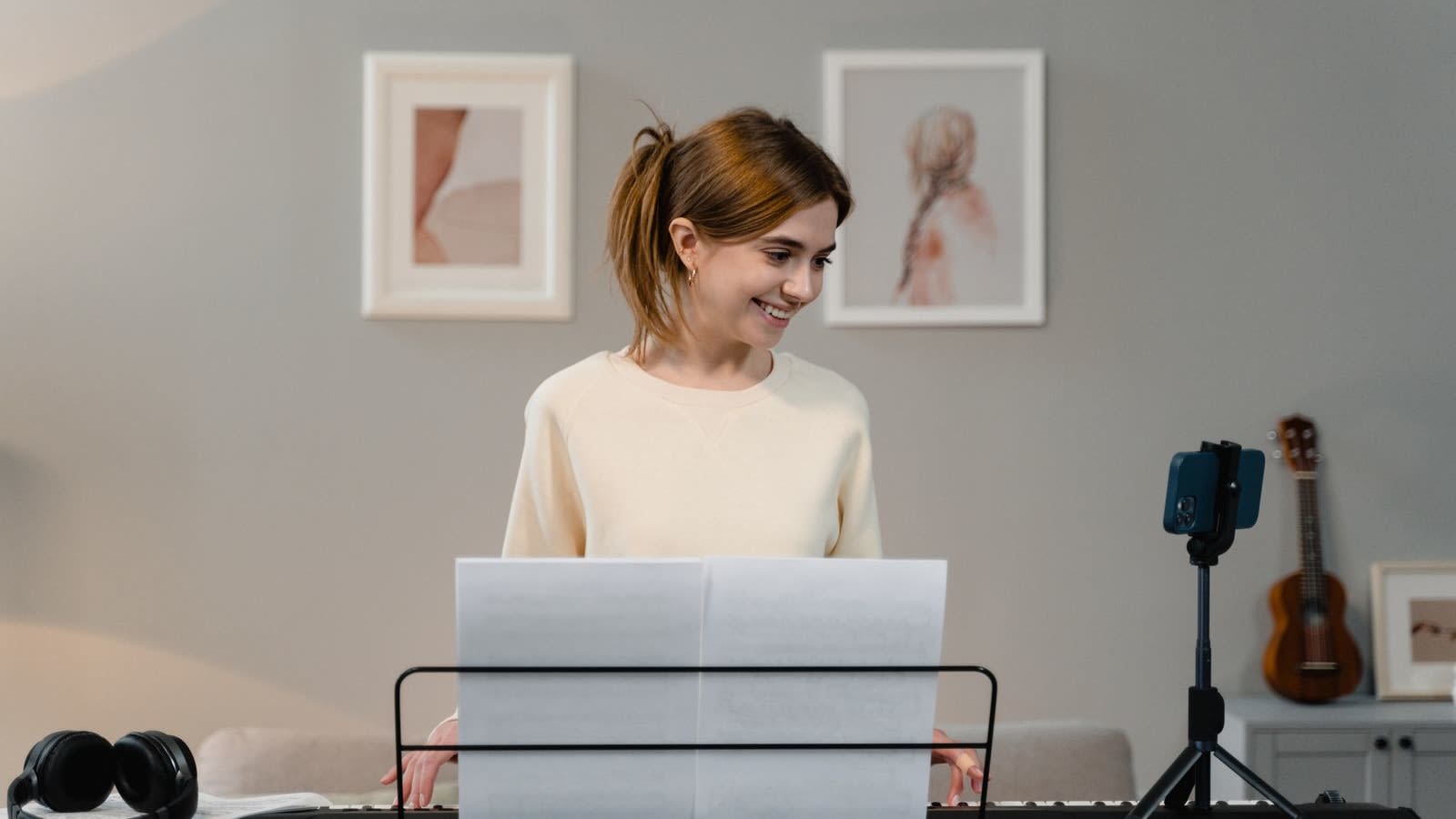
There's a particular flavour of nerves that arrives the night before a first piano lesson — and it's sharper when the lesson is online, because now you're worried about the playing and the technology. Will the teacher judge how little you can do? Will the audio be a mess? What if you freeze? Here's the reassuring truth, from the other side of the screen: teachers who take beginners have run this exact first lesson hundreds of times, they expect you to be a beginner, and the whole session is built to put you at ease. The unknown is the only scary part — so let's remove it.
This is the complete walkthrough: what actually happens in a first online lesson, the fifteen-minute setup that makes it run smoothly, what to have ready, and the handful of questions worth asking. Read it once and you'll arrive prepared instead of anxious — which, as it happens, is most of what a good first lesson needs from you.
The fear vs. the reality
Nearly every first-timer walks in braced for a version of the lesson that doesn't exist. It's worth seeing the gap plainly, because the anxieties are so predictable that teachers can name them before you do:
What you're afraid of vs. what actually happens
Hold onto the second column. Every practical tip below exists to make that reality the one you actually get.
The fifteen-minute setup
Most first-lesson friction is technical, not musical, and it's all preventable in the quarter-hour before you start. Do this once and it becomes automatic forever:
Before you press “join”
If your instrument is a digital piano, that's completely fine — and if you're still weighing whether online is right for you at all, we've made the honest case in online vs. in-person lessons, setup nuances included.
What to have ready
Beyond the tech, arrive with four things and the lesson almost runs itself:
- Something you can play — even eight bars, even badly. A teacher learns more from thirty seconds of you playing than from ten minutes of you describing your playing. Total beginner with nothing to show? That's fine too; say so.
- Your goal, in one sentence. “I want to play pop songs to relax,” “I'm returning after twenty years,” “I want to pass Grade 3.” It doesn't need to be grand — it just points the lesson.
- One specific frustration. The passage that won't work, the thing that always trips you. Concrete problems get concrete help.
- A way to take notes. A notebook, or a practice log open on your phone — you'll be given a couple of things to work on, and memory alone won't survive the week.
What actually happens, start to finish
Different teachers vary, but a first online lesson has a reliable shape. Here's the typical arc so none of it catches you off guard:
A first lesson, minute by minute
Notice what the first lesson is not: a test, a performance, or a judgement. It's a conversation with playing in the middle, run by someone whose entire aim is for you to book a second one. If you brought nothing to play because you're starting from zero, the arc simply shifts — they'll have you make your first sounds instead, and you'll still leave with a plan.
"A first lesson isn't a test or a performance. It's a conversation with playing in the middle, run by someone who wants you to book a second one."
What to ask — during and after
You don't need a script, but a few good questions turn a nice first lesson into a useful one. Split them by moment:
| Ask during the lesson | Ask near the end |
|---|---|
| “Can you show me that slowly?” | “What should I practise this week?” |
| “Is my hand position okay?” | “How should I practise it — not just what?” |
| “Why does that fix work?” | “What does progress look like from here?” |
If part of the reason you're reading this is that you haven't chosen a teacher yet, that's a slightly different task — vetting rather than attending — and we built a dedicated tool for it: nine questions that expose a good online teacher in a single trial lesson.
After the lesson: the part that decides everything
The lesson ends; the learning doesn't. What separates students who progress from those who drift isn't talent shown in the first hour — it's what happens in the days after. Do three things and your second lesson will start miles ahead of your first: practise the specific assignment you were given (not just “play a bit”), log what you did so the week is documented rather than half-remembered — a simple tool like Practis is built for exactly this — and note any question that comes up so you arrive with something to ask. Walking into lesson two with your week visible turns the teacher's time into correction instead of reconstruction.
"The first lesson opens the door. What you do in the six days after it is what actually walks you through."
It's usually a trial — so treat it as one
Here's the low-stakes secret that should dissolve the last of the nerves: most first lessons are trial lessons — low-cost or free, no commitment, designed precisely so you and the teacher can see if you fit. You're not signing up for a year; you're spending one honest session finding out whether this teacher, and online learning itself, feels right. If it does, you book more. If it doesn't, you've lost an hour and learned something. That's the whole risk.
When you're ready to take that first session, our top pick among online piano teachers, PianoTechSupport, offers exactly this kind of trial lesson — a Vienna-conservatory-trained teacher, one relaxed session to test the water, no commitment beyond your curiosity. It's the gentlest possible way to turn “I've been meaning to” into “I started.”
Common questions
What if I can barely play anything yet?
That's not a problem — it's the most common starting point there is. A teacher who works with beginners has begun with absolute beginners countless times and knows exactly how to build from nothing. You'll spend the first lesson making your very first deliberate sounds and leaving with a tiny, doable plan. There is genuinely no level too low to start.
Do I need a real piano, or is a keyboard fine?
A keyboard is fine to start — ideally with enough keys to work comfortably, and weighted keys eventually if you can. Your teacher can advise on when and whether to upgrade based on your goals. Don't let “I don't have the perfect instrument” postpone a first lesson; plenty of strong players began on modest keyboards.
I'm an adult and a bit embarrassed. Is that normal?
Completely normal, and the online format is unusually kind to it — you're in your own home, on your own instrument, with none of the exposure of a studio waiting room. The self-consciousness fades within a session or two for almost everyone. We wrote about why grown-ups do so well at this in online piano lessons for adults.
The nerves before a first lesson are really just the mind filling an unknown with worst cases. Now the unknown is filled in: a warm hello, a quick setup, your story, a little playing, one real improvement, and a plan for the week — run by someone who does this every day and wants you to come back. Set the camera to the side, turn on original sound, bring something to play, and press join. In an hour you'll wonder what you were worried about — and you'll have started.
More on lessons.

Trusted Online Piano Lesson Providers in 2026 (And How to Vet Them)
Every affiliate list calls every provider "trusted." Trust isn't a vibe — it's a short set of things you can actually check. The signals that separate a trustworthy online piano provider from a slick one, and a vetted shortlist by category.
Pract.is Editorial

A Week Between Piano Lessons: How Good Teachers Structure Your Practice
Piano practice between lessons works best when the teacher leaves you with a result, a method, and evidence to bring back. Here is what a well-structured week looks like, even when the week itself is messy.
Pract.is Editorial

Why Your Self-Taught Piano Progress Stalled (And What a Teacher Sees in 10 Minutes)
Self-taught piano progress often stalls when the player creating the problem is also the only person trying to diagnose it. Here is what a teacher can see in ten minutes, how they test the cause, and how to turn one correction into a better month of practice.
Pract.is Editorial