Musicians are bad at taking breaks because breaks feel like an interruption of momentum. If the passage is finally starting to click, if the groove feels warm, if the hand is cooperating, if the voice feels open, the last thing you want to do is stand up and walk away. The break feels like quitting right when the useful part begins.
That feeling is one of the most misleading signals in practice.
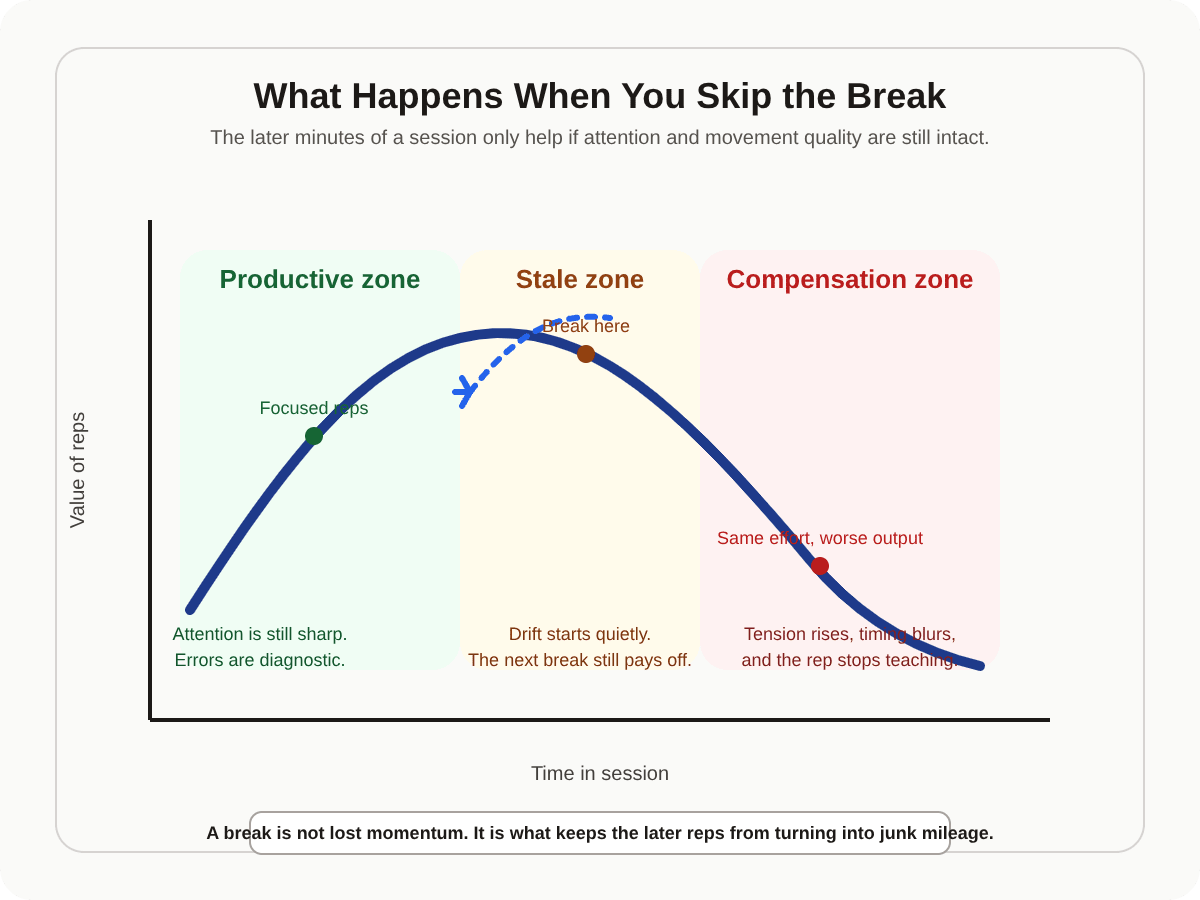
A lot of musicians stay seated not because they are lazy about recovery, but because they are scared of losing fluency. They tell themselves one more run, one more correction, one more slow pass, one more attempt at full tempo. The problem is that practice quality often drops before the musician notices it. Attention gets narrower, tension rises, timing gets blurrier, and the session starts rewarding endurance more than learning.
This is why bad break habits matter. They do not just make you more tired. They make the back half of a session less trustworthy.
Why breaks feel wrong even when they are right
Music practice gives immediate rewards for staying in motion. The instrument feels more familiar after a few minutes. The fingers remember where they are. The phrase seems smoother. The repeated passage feels more available. All of that is real. What musicians often miss is that this short-term fluency can survive a while after the quality of attention has already started to decline.
That is one reason the “just keep going” instinct is so sticky. The session still feels active. It still feels like work. But the useful question is not whether you are still working. It is whether the reps are still teaching.
BAPAM's guidance for instrumental musicians is blunt about this. In its return-to-play recommendations, it advises musicians to take a 3-5 minute break from playing every 20-25 minutes, return to neutral postures, and stop or pause at signs of reduced concentration, fatigue, or discomfort. That is not recovery advice for weak people. It is practice design advice for people who want later reps to stay honest.
The same principle shows up at HSS in their musician injury-prevention guidance: take a minimum 10-to-15-minute break every hour, do not cram, and supplement physical practice with mental or shadow practice to preserve endurance. That is a useful pairing because it makes the real point clearly: breaks are not separate from smart practice. They are part of smart practice.
Pushing through fatigue changes your playing before you notice it
The reason constant pushing hurts playing is not only that it feels bad. It changes what the later reps are made of.
J. Matt McCrary and colleagues' 2022 study on load and fatigue monitoring in musicians is useful here because it treats fatigue and overload as everyday variables, not abstract dangers. The authors note that fatigue and playing overload are key risk factors for musicians’ injuries, and their data showed something psychologically important: increased playing time, exertion, and feelings of having to play too much were still associated with higher self-rated performance quality. In other words, musicians can feel productive while simultaneously moving deeper into overload.
That matters because it explains why people keep overshooting. The body can be sending one message while identity sends another. “I am tired” and “I am doing serious work” can show up at the same time.
There is also more direct evidence that fatigue alters actual musical output. In a 2021 pilot study of pianists, Goubault and colleagues found that muscle fatigue negatively affected several musical parameters. That does not mean every tired rep is useless. It means fatigue is not neutral. Once it changes the output, the musician is no longer practicing under the same conditions they think they are practicing under.
| What it feels like in the room | What is often happening underneath |
|---|---|
| “I’m still locked in.” | You may be relying on short-term familiarity while attention quality is dropping. |
| “I just need five more minutes.” | The next five minutes may be where tension and timing drift become the dominant pattern. |
| “I can’t stop now or I’ll lose the feel.” | You may be protecting a feeling of fluency rather than the quality of the learning. |
| “I’m still getting reps in.” | Yes, but the reps may now be training compensation instead of control. |
This is also why the argument in 10,000 hours is a misleading idea matters. Musicians often count the second half of a fatigued session as if it were equivalent to the first half. It usually is not.
What a real break does, and what it does not do
A real break is not magical. It does not automatically solve a technical problem, and it does not replace the need for spaced learning across days. But it does something critical: it gives you a chance to restore attention, release unnecessary holding, and return to the task before the practice becomes pure momentum theater.
BAPAM's broader practice guidance makes this even more concrete. When talking about building fitness to perform, it recommends splitting practice into two or three sessions across the day with at least an hour break in between and using mental rehearsal or visualization to reduce physical load. That is a better model than one heroic block, because it treats rest as part of the architecture rather than an accidental pause.
There is a memory argument here too. In their 2021 open-access study Optimizing song retention through the spacing effect, Katz, Ando, and Wiseheart found strong evidence that spaced learning outperformed massed learning for song retention after three weeks. The point is not that every five-minute break triggers a long-term miracle. The point is that learning across separated intervals tends to retain better than one uninterrupted cram block.
A break can do this
Restore attention, soften unnecessary effort, refresh hearing, and keep the next rep diagnostic.
A break cannot do this alone
Replace a bad strategy, fix a wrong fingering, or guarantee long-term retention without later revisits.
The useful mindset
Breaks protect the quality of the next reps. They do not replace the need to design those reps well.

Photo: Thirdman via Pexels
The easiest signs that you need a break now, not later
Most musicians wait too long because they expect a dramatic signal. In real sessions, the signs are usually smaller and more embarrassing than dramatic.
You keep repeating without changing anything
The session has become persistence theater instead of problem-solving.
Timing and counting start to smear
You are still moving, but the precision work is no longer clean enough to trust.
You add force to fix clarity
More pressure starts substituting for better setup, hearing, or coordination.
You feel irritated by normal mistakes
The emotional cost of the session is climbing faster than the learning value.
Your body never returns to neutral
Hands, shoulders, jaw, breath, or posture stay locked between attempts.
If those signs show up, the useful move is not one more heroic rep. It is to interrupt the pattern before the compensation hardens. That is especially true if fatigue is already spilling into pain or stiffness, which is where pieces like why your hands hurt after practicing become relevant.
A break protocol that works better than waiting until you are cooked
The practical answer is to stop treating breaks like emergencies. Build them into the session before the session starts.
| Session length | Useful break pattern | What to do in the break |
|---|---|---|
| 20-30 minutes | Usually no full break needed unless attention drops early | Pause briefly, reset posture, drink water, then continue or stop cleanly |
| 40-60 minutes | One real break around the middle or slightly earlier | Stand up, walk, stretch lightly, and avoid replacing instrument fatigue with phone fatigue |
| 75-120 minutes | Split into two or more blocks with a meaningful reset | Change environment, eat or hydrate, and consider mental rehearsal instead of nonstop physical reps |
The key detail is that the break should actually change the state you were in. If your “break” is scrolling while hunched over the same muscles and same attention loops, it may not be much of a break at all.
That is one reason the BAPAM guidance on scheduled recovery is so useful. It explicitly says not only to plan breaks, but also to restrict other upper-limb activities during those breaks so the tissues get real rest. Their recommendation to split work into multiple sessions and use mental rehearsal is especially smart because it preserves musical engagement while reducing physical load.
This also connects with the 2021 study Imagine, Sing, Play, where combined mental, vocal, and physical practice improved musical performance in advanced trumpet students. That does not mean every break should become a homework assignment. It means the alternative to endless physical repetition is not always “do nothing.” Sometimes the smarter move is to change mode.
Better rule
Do not ask whether you are still willing to work. Ask whether the current rep still deserves to count as practice.
If you want the bigger context behind this, the closest companions are musician burnout and more repetition or a better strategy. The common thread is simple: better musicians are not the ones who can push forever. They are the ones who know when the push stops producing useful work.