
Why You Can't Play Comfortably in Front of People You Know Well
Most musicians can play for strangers at a recital and freeze in front of family in the living room. The cause is not general performance anxiety — it is something more specific, and it needs a different fix.
Pract.is Editorial
Research-based practice guidance for musicians from the Pract.is editorial team.

It is your aunt's birthday. The piano is in the corner of the living room. Someone says, "Oh, you play, don't you?" Every adult in the room turns. You have performed this piece for strangers at recitals, recorded it cleanly, sent the file to your teacher. You cannot, right now, in front of your aunt and three cousins and your father, play any of it. Your hands feel like they belong to someone else. The chord you have played five hundred times comes out as the wrong chord. You stop, apologise, smile, and sit down with the unique discomfort of someone who has just been worse than expected in front of people who will see you tomorrow.
This is not generic stage fright, and the standard performance-anxiety advice — visualise success, breathe deeply, simulate the recital — does not fix it. The trigger is different. Playing for strangers and playing for family are not the same psychological problem. The Pract.is article on performance anxiety for musicians: what actually helps covers the broader case; this one is about the specific, surprisingly common failure mode of being unable to play well for the people you know best.
Strangers are not the hard case
Most adult learners discover this paradox slowly. They sign up for a recital, get nervous, prepare, perform, survive. They go home, tell themselves they have done a difficult thing, and feel proud. Six weeks later, a relative visits, asks them to play something, and they cannot get through the first page of a piece they performed cleanly at the recital. The reaction is confusion: "I just did this in front of forty people. Why can't I do it for my brother?"
The answer is that strangers, ironically, are easy. A stranger has no prior view of you. They will not see you tomorrow. They have no opinion to update. They have low expectations — they assume you must be at least adequate, since you are sitting at the piano. They will leave the room and probably never think about your playing again. The cost of a mistake is bounded. Identity stays intact.
Family is the opposite of every one of those things. They have known you for decades. They have an opinion of who you are, and that opinion is about to be updated either upward or downward by what you play. They will see you tomorrow at breakfast. They remember when you were nine and did not practise. They have, in some cases, paid for lessons, attended recitals, opinions about whether this hobby is "going somewhere." The stakes are not bounded by the performance; they bleed into the rest of the relationship.
"Strangers, ironically, are easy. They have no prior view of you, and they will not see you tomorrow."
Three reasons family is harder than a hall full of strangers
The mechanism behind the freeze is worth understanding because it is the only way to choose a fix that actually addresses it. Three specific factors, each measurable in the body's response, make a small home audience harder than a much larger anonymous one.
The first is identity stakes. At a recital, you are "a person playing the piano." In the living room, you are "their daughter who plays the piano," "the cousin who took it up at thirty-five," "the brother who said he would master Chopin in a year." Family audiences see you through a stable identity that pre-dates the piano. Playing well confirms or expands that identity. Playing badly threatens it. The body responds to identity threat exactly the way it responds to physical threat — adrenaline, narrowed attention, motor disruption. The mechanism is described in Kenny's work on music performance anxiety (her 2011 book, The Psychology of Music Performance Anxiety, is the standard reference). The trigger does not have to be objectively dangerous to produce a physiological response.
The second is role confusion. In a recital, your role is unambiguous: you are the performer, they are the audience. Both sides know the contract. In the living room, you are simultaneously the player, the host, the family member, the person who has just been put on the spot, and the person who will have to sit with everyone after the piece ends. There is no protective frame around the playing. You cannot exit the role when the piece is over because you are not in a role.
The third is expectation history. Family has heard you stumble. They have witnessed years of half-practised pieces, abandoned method books, the weeks you did not touch the instrument, the months you were going to "get back into it." Their expectation is built from data they actually have, not from the polite assumption a stranger brings. That data is often less flattering than the recital-prepared version of yourself. The body senses the gap between who you are about to be and who they have known, and it reacts.
Why generic performance-anxiety advice doesn't apply
Most advice for stage fright is built around the recital problem: a defined performance, in a defined room, in front of strangers, with a predictable end. Visualisation, mock performances, deep breathing, beta-blockers — all of these work, more or less, for that case. They work less well for the living-room case because the living-room case is not a performance in the same sense. It is an unstructured social moment that happens to include playing the piano. The advice cannot reach it because the trigger it is built to address is not the one firing.
The Pract.is essay on why you sound fine in practice but fall apart in performance covers the performance-transfer problem in general terms. The family-audience version is a specific subcase: not a stage transfer problem, but an identity transfer problem. The hands work in the practice room because the practice room contains no identity threat. The hands stop working in the living room because the threat is right there at eye level.
This is also why "play it for me, I won't judge you" reassurance from family members does not help. They are not lying; they probably will not judge harshly. But the threat is not their judgement. The threat is that their existing view of you is about to be revised, by them, unconsciously, in real time. No amount of reassurance changes that mechanism.
The graduated exposure ladder
The fix that works is not "perform more." It is deliberate graduated exposure to playing in increasingly identity-loaded contexts, starting much lower than most people think is necessary. The ladder below is built so that each step is only slightly harder than the one before it. Skipping steps is the most common mistake; you cannot jump from "alone in the practice room" to "playing for grandparents at Sunday lunch" and expect the hands to cooperate.
Graduated exposure ladder
Each step should feel only slightly uncomfortable. If a step produces the full freeze response, drop one rung and stay there until it does not. Most adults need three to six months on the ladder, not three to six weeks.
What each rung is actually training
The ladder is not a confidence exercise. It is doing two specific things in parallel. The first is teaching the body that being heard by familiar people does not produce a catastrophic outcome — the next-day breakfast still happens, the relationship is intact, no one's view of you collapsed. The body learns this by repetition, not by reasoning. Each completed rung is a small piece of evidence that the threat is not what the nervous system thought.
The second thing the ladder does is decouple identity from playing. By rung four, you have played in front of a family member while they ignored you. By rung five, you have invited evaluation but framed it as feedback, not performance. By rung seven, you are introducing the piece in a way that protects you from being judged on it. The framing is not deception; it is honest accuracy about what you are doing. This is a practice run with witnesses, not a recital.
"The body learns the threat is not what it thought by repetition, not by reasoning."

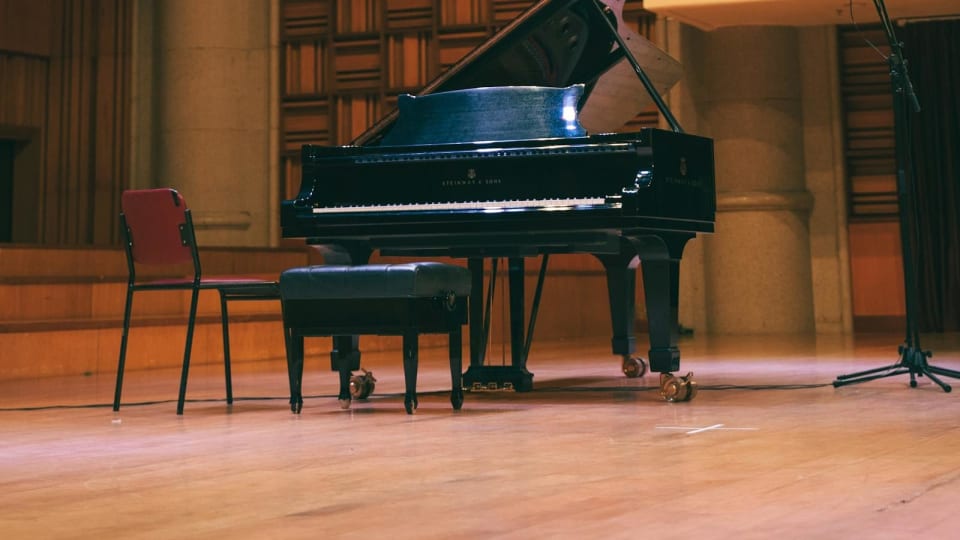
Photo: cottonbro studio via Pexels
Reframing the moment, not just the breathing
Beyond the ladder, several specific reframes change how the body responds in the living-room moment. They are not magical and they do not eliminate adrenaline, but they consistently lower the freeze rate for adult learners who try them.
The first is to announce a frame before you play. "I'm going to try the slow movement — I haven't played it for anyone yet, so we'll see what happens" is a sentence that does work most pianists do not realise. It tells the audience this is exploratory. It tells your own nervous system the same thing. It protects you from being measured against a recital standard that no one was actually applying. A piece played with this frame can fall apart in the middle and still feel successful, because that is what was promised.
The second is to start with something below your level. The instinct is to play the most impressive piece you have, because family is supposed to see your best work. The instinct is wrong. The first piece you play for a family audience should be a piece you cannot fail at — something that has been performance-ready for months, something that does not require your top concentration. The harder piece can come later in the visit, once the body has registered that this room is safe.
The third is to accept the early failure. The first few times you play for family, the playing will be worse than what you produce alone. That is not a sign you have not practised enough; it is the system updating. Each round of "worse than expected" followed by "no consequences" is what eventually changes the response. The Pract.is article on practising for performance instead of just for the practice room covers the general principle of performance training; the family case is the version that adult learners forget needs the same deliberate work.
Specific traps in the living-room context
A few patterns make the family-audience problem worse, and they are worth recognising because most pianists fall into one of them.
The first is the unsolicited request — "play something for us." The request itself bypasses the frame. You did not choose to play; you are now playing because someone asked, which means stopping or playing badly will feel like letting them down. The fix is to have a prepared response: "Let me practise something first; I'll play it for you tomorrow." This reframes the situation as a planned mini-performance rather than an ambush, and you get to be in control of the frame.
The second is playing in the wrong room. Family living rooms often have a slightly out-of-tune piano in a hard space with unfamiliar acoustics. Adult learners notice the bad sound, get distracted, lose focus, and the piece collapses. Some of the freeze is purely acoustic; the instrument you know how to play is not the instrument under your hands. Acknowledging this — "this piano sounds different from mine, give me a minute to find it" — is fair and helpful.
The third is following someone better. If your cousin who plays professionally just performed a Liszt etude and now everyone wants to hear you, the freeze is almost guaranteed. The fix here is structural: do not play right after them. Wait an hour. Play in a different context. The audience comparison frame is too strong to overcome with breathing exercises.
What changes after six months of ladder work
Adult learners who work through the ladder consistently — one rung every couple of weeks, with practice in between — usually report a real change by month four to six. Not that family performances become easy; they continue to require attention. But the catastrophic freeze stops happening. Mistakes stay localised instead of cascading. The piece is recoverable when something goes wrong. The hands belong to you again.
Two practical habits compound this. First, keep a short list of "safe" pieces specifically for family audiences — pieces well below your current level that you can play in any state of nerves. Second, every successful family playing moment, however small, deserves the same kind of post-session note as any other practice. Not for self-congratulation; for evidence. The Pract.is essay on reviewing a practice session so tomorrow goes better covers the underlying habit. The family-audience version is the same review applied to a different stress.
The longer story
The freeze in front of family is one of the most under-discussed problems in adult music study. It does not happen on stage. It does not happen alone. It happens at the exact intersection of music and identity that most pianists never deliberately train for. The reason it feels so personal is that it is — the trigger really is about who you are to the people in the room, not whether you can play the notes. That is uncomfortable but useful, because it points to the actual fix.
The fix is not less anxiety. It is more low-stakes data. Each successful evening of being heard by family without consequence builds the body's certainty that the threat is smaller than it once felt. The ladder is slow and not glamorous, but it works in cases where general performance advice does not, because it addresses the actual cause. The aunt's birthday, eventually, becomes a room where you can play.
More on motivation.
Why Some Piano Prodigies Disappear in Their 20s
The transition from 'wunderkind on YouTube at 12' to 'working pianist at 24' is brutal — and most do not survive it. The structural reasons are specific and the few who navigate the gap share a recognisable pattern.
Pract.is Editorial
The Hidden Economics of Being a Concert Pianist in 2026
Most working concert pianists below the very top tier earn the majority of their income from teaching, adjudicating, and masterclasses — not from concerts. An honest breakdown of how the career math actually works in 2026.
Pract.is Editorial

Why Japanese Piano Education Produces So Many World-Class Pianists
Uchida, Sumino, Fujita, Kobayashi — the list of world-class Japanese pianists is striking and growing. The reasons are structural: Yamaha and Kawai's institutional reach, competition culture, early starts, and a pedagogy that treats music as serious work from age four.
Pract.is Editorial