
10 Classical Music Facts That Actually Go Viral on TikTok
The classical facts that spread fastest online all have the same shape: a famous name, a sharp reversal, and one detail that makes people argue in the comments.
Pract.is Editorial
Research-based practice guidance for musicians from the Pract.is editorial team.

The classical music facts that spread online are almost never the most important ones. They are the ones that compress well: one famous name, one sharp twist, one sentence that makes people say, "Wait, what?" TikTok did not invent that dynamic, but it has become very good at rewarding it.
That is why the same handful of classical facts keep coming back. They are short, strange, arguable, and easy to attach to a clip, a performance, or a creator explanation. If you have been seeing more of that material lately, it is not imagined. TikTok and Southbank Centre said in September 2025 that posts under #ClassicalMusic were approaching one million and had grown by more than 60% over the previous year.
Famous name
Beethoven, Chopin, Mozart, Liszt. The wider the recognition, the easier the share.
Myth reversal
"Moonlight" was not Beethoven's title. A440 is not eternal truth. Those reversals travel fast.
Argument bait
Anything that triggers pedants, romantics, and conspiracy-minded listeners at once will perform well.
Visual proof
A score page, a keyboard, a portrait, or one memorable recording gives the fact something to stick to.
Viral classical fact recipe
Big familiar name
Beethoven, Mozart, Chopin, Liszt
Unexpected twist
not what people think, not the original title, not the full story
Clipable proof
score, portrait, keyboard, excerpt
Comment war
myth vs correction vs counter-myth
Repeat share
same fact, new creator, new audience
That same mechanic sits behind a lot of the culture pieces we have already run on classical piano going viral on TikTok, why Gen Z keeps finding classical online, and the way internet-native artists like Hayato Sumino move through the genre. The facts below are not random trivia. They are the ones with the best internet shape.
| Fact type | Why it spreads | What usually gets flattened |
|---|---|---|
| Myth reversal | Feels like a correction and a flex at the same time | The real history is usually messier than the one-line reveal |
| Status comparison | Lets people compare classical figures to modern celebrity culture | The original context gets reduced to a meme |
| Technical oddity | Easy to illustrate with an instrument or score on screen | The explanation behind the oddity often disappears |
| Animal or cannon-tier weirdness | People remember the image instantly | The source trail behind the story gets ignored |
The celebrity facts win first
1. Lisztomania was real. Franz Liszt did not become retroactively treated like a pop star. He produced the closest nineteenth-century equivalent in real time. Writers described screaming crowds, souvenir-taking, and a level of fan fixation strong enough that the term Lisztomania stuck to him permanently. That is one reason his name keeps working online: the comparison to modern fandom is not strained, it is built into the history.
2. Liszt also helped invent the solo piano recital. The word "recital" in this musical sense was attached to Liszt's London concerts in 1840, and BBC Music Magazine's historical write-up is good on why that mattered. It gave a single pianist a new kind of cultural stage: not just a performer in a mixed program, but the entire event. That makes for excellent short-form content because modern clip culture still loves the solo virtuoso standing in for the whole spectacle.
3. Chopin became famous while giving remarkably few public concerts. Britannica notes that he acquired top-tier reputation on the basis of "few more than 30" public appearances in his lifetime. That keeps going viral because it breaks the modern assumption that audience scale always depends on constant public output. The missing context is that Chopin still operated through salons, private performance, publishing, and elite networks. He was not anti-performance. He just did not build fame through the same kind of public volume people now expect.
The Beethoven facts never stop recycling
4. Beethoven did not call it the "Moonlight Sonata." The nickname came later. Britannica explains that the title traces to Ludwig Rellstab in the 1830s, after Beethoven's death, when he compared the first movement to moonlight on Lake Lucerne. This fact spreads because it offers a clean correction people can drop into comments with maximum confidence. The catch is that the nickname is still culturally useful, which is why the correction never kills the label.
5. Beethoven's deafness was gradual, not a single dramatic switch. The simplified legend makes it sound as if he was either hearing or deaf, full stop. Beethoven-Haus and related archive material make the timeline look much harsher and more human: he realized before 30 that his hearing was failing, it kept deteriorating, and complete deafness came later. That is exactly the kind of fact that travels because it feels like both a correction and an upgrade to the myth. It makes Beethoven's career look less magical and more terrifying.
6. Beethoven was one of the first major composers to use the metronome seriously. This one works because it collides an immortal genius with a device students still argue about. Beethoven-Haus explicitly notes that Maelzel's metronome was used by Beethoven as the first important composer to do so. The viral version usually stops there. The better version is that his metronome markings also triggered later debate about how literally they should be taken, which is exactly why the topic never quite dies online.

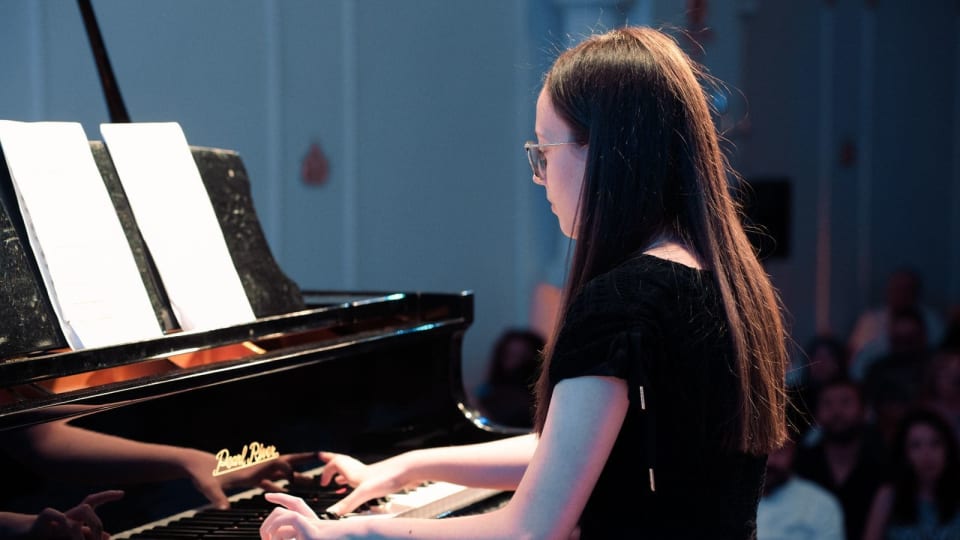
Photo: Bozo Gunjajevic via Pexels
The instrument and tuning facts trigger the best comment wars
7. The piano did not always have 88 keys. People talk about the modern keyboard as if it descended from heaven fully formed. Yamaha's history summary is straightforward here: Cristofori's early pianos had 54 keys, the range grew over time, and the modern 88-key layout was established by the 1890s. That fact spreads well because you can demonstrate it visually in one shot of a keyboard. It also sneaks in a bigger truth: instruments are designed histories, not timeless objects.
8. A=440 is a modern standard, not a sacred natural frequency. For the short version, NIST describes A440 as the internationally recognized standard pitch, not an eternal constant of the universe. That distinction matters because online arguments about tuning often collapse history, science, and mysticism into one pile. A440 won because standardization is useful, not because Western music finally discovered cosmic truth in a lab.
Best visual proof
88-key keyboard
One image is enough to start the question: why exactly 88, and why not more?
Best argument bait
A440 vs A432
Few topics can summon equal parts music history, conspiracy language, and tuner screenshots so quickly.
Best myth correction
Moonlight title
The correction is short, memorable, and attached to one of the most famous pieces on earth.
The weird image facts survive because nobody forgets them
9. Mozart owned a pet starling that could sing back one of his themes. This sounds fake enough to thrive online, which is precisely why it survives. The story rests on Mozart's own expense-book entry from 1784 and later scholarship around the bird's resemblance to the theme from the finale of Piano Concerto No. 17. NPR's interview around Mozart's Starling and the older American Scientist article both keep the anecdote alive because it is too perfect: genius composer, mimic bird, tune recognition, tiny emotional world in one image.
10. The "1812 Overture has cannons" fact is true, but the score history is messier than the meme. Most people know only the fireworks version. Tchaikovsky Research points out that the overture's famous cannon marking is tangled up with the theater instrument called Bombardone, and that Tchaikovsky's correspondence suggests a large drum-like effect rather than a simple blockbuster instruction to wheel in artillery. That is exactly the kind of fact TikTok loves because it is both spectacular and corrective. You still get the cannon image, but you also get the nerdy complication that keeps people talking.
Why these 10 keep coming back
They keep coming back because they do more than inform. They let people perform taste, intelligence, identity, or surprise very quickly. A creator can say "Beethoven never called it Moonlight," "Chopin barely gave concerts," or "A440 is a standard, not a law of nature," and immediately offer the viewer a role: believer, corrector, skeptic, or fascinated newcomer.
That is not automatically bad. Some of the best listeners now entering classical music are entering through exactly this kind of fragment. If the fragment leads to full pieces, real history, and better listening, the fact did its job. The problem starts only when the one-line reveal becomes the whole relationship to the music.
If you want a deeper version of the same phenomenon, the best next stops are our 2026 pianist watchlist and the earlier post on what short-form virality gets right and wrong about classical piano. The internet likes classical music best when it can turn it into a clean, portable idea. The challenge is getting people from the portable idea to the actual art.
More on culture.

Vienna, Conservatories, and Why European Music Training Is Different
European music training differs less by secret technique than by structure: auditions, one-to-one study, ensembles, performance, and cultural proximity.
Pract.is Editorial
The Best Classical Pianists to Watch in 2027
Six classical pianists are turning 2025 competition breakthroughs into real careers. Hear the official performances that make each worth watching in 2027.
Pract.is Editorial

Why Successful Musicians Sometimes Retire Early
Early retirement in music is rarely just one dramatic moment. Injury, burnout, grief, industry mismatch, and a shrinking sense of meaning can push successful artists offstage sooner than audiences expect.
Pract.is Editorial