
Why Gen Z Keeps Finding Classical Music Online
Gen Z is not stumbling into classical music by accident. Clips, study playlists, gaming scores, and internet-native creators have built a much easier path into the genre than classical institutions used to offer.
Pract.is Editorial
Research-based practice guidance for musicians from the Pract.is editorial team.

A lot of Gen Z first hears classical music halfway through something else. A football edit cuts to an orchestral swell. A study playlist slides from lo-fi into soft piano. A game soundtrack sends someone looking for the composer. A pianist appears in the feed not as a distant institution figure but as a person who already understands the internet.
That is why the idea that young people are simply “returning” to classical misses the point. Many of them were never entering through the old front door in the first place. They are arriving through clips, mood listening, fandom, creator culture, soundtrack culture, and algorithms that are better at serving fragments than full symphonies. The surprising part is not that it is happening. The surprising part is how natural the route now feels.
The age brackets in the available data do not always map perfectly onto Gen Z. Some surveys use under 25, others under 35. But the direction is consistent enough to be hard to dismiss.
83%
RPO said 83% of under-25s had an active relationship with orchestral music in its 2020 research.
46%
The same RPO research found streaming and YouTube were the most common entry point for under-25 listeners.
+60%
Southbank Centre and TikTok said #ClassicalMusic grew by more than 60% in 2025, nearing one million posts.
15%
RPO’s 2025 gaming research said one in six under-25 gamers discovered orchestral music through games.
The stereotype is outdated: younger listeners are already there
Classical still carries the old reputation problem. For a lot of people it reads as formal, expensive, slow, and socially coded for somebody else. But the data keeps pointing in the opposite direction once you look at listening rather than just concert etiquette. In the Royal Philharmonic Orchestra’s 2020 research, 83% of under-25s had what it called an active relationship with orchestral music, and 46% of that group were listening via streaming platforms or YouTube. That was already enough to break the caricature that orchestral music belonged mainly to retirees and specialist concertgoers.
The picture sharpened further in the Deezer, BPI, and RPO collaboration on classical listening in 2020. Deezer said 18-25 year olds accounted for 34% of classical streamers worldwide over the preceding year, with global streams from under-35 listeners rising 17%. Just as important, the company linked part of that rise to mood listening: “Feel Good Classical,” “Calm Piano,” and “Classical for Sleep” were not side curiosities. They were real on-ramps.
That lines up with what we have already been seeing across this blog. Our earlier piece on classical piano going viral on TikTok was not really about a novelty. It was about a discovery channel that already matched how younger listeners move through music. The same thing sits behind the reach of creators like the pianist in our Hayato Sumino piece, who treats the internet as a native artistic medium rather than a billboard.
The old question used to be: how do we persuade younger people to enter classical music? The more accurate question now is: what exactly are they already entering through, and what makes some of those routes convert into deeper listening?
The internet fixed one of classical music’s oldest problems: entry friction
Classical music used to ask too much too early. You were expected to know composer names, forms, eras, and canonical works before you had any real attachment to the sound. Even when streaming opened the door, classical still suffered from metadata problems: too many recordings of the same work, confusing movement titles, and interfaces built for pop songs rather than repertoire with dozens of versions.
That is part of why Apple Music Classical matters more than it may seem. When Apple launched the service in March 2023, it positioned it explicitly as something “great for classical experts as well as anyone who is new to classical,” with over 5 million tracks, classical-specific search, guided browse categories, and editor curation for beginners. That sounds like product design language, but it is really cultural access language. A listener who hears a fragment online now has a much better chance of finding the right piece, the right recording, and some context around it without already speaking fluent conservatory.
This is also where short-form clips have genuine value. A clip can do something the old institutional model struggled to do: create immediate emotional legibility before the listener knows any terminology. That is why the clip economy keeps feeding people toward full recordings like the one we wrote about in our Yunchan Lim Goldberg post. The clip is not the final destination. It is the first proof that this music might already be for you.
If you want a concrete example of the kind of classical excerpt that now works online, this official Aria release by Yunchan Lim is useful. It is quiet, visually simple, emotionally direct, and easy to enter without already understanding Bach scholarship.
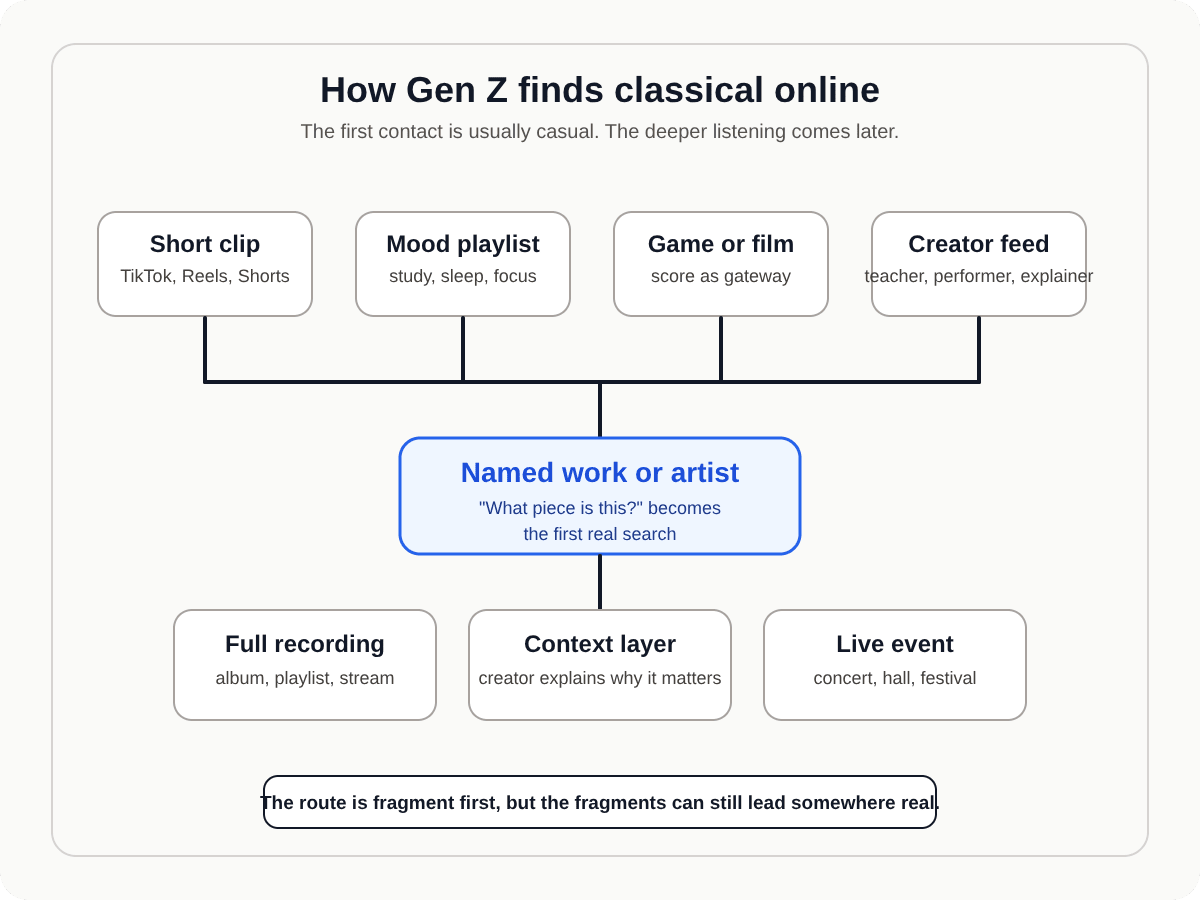
The key shift is simple: younger listeners no longer need to start with “What is the right beginner piece?” They can start with “What is this sound?” and move outward from there.
The gateways are not pure: study music, gaming, memes, and creators all count
A lot of classical people still want the entry route to look noble. They want it to begin with an intentional sit-down listen, or a well-curated beginner guide, or a first live concert in a hushed hall. That does happen. It is just not the dominant pattern online. The online routes are messier, more accidental, and more native to the rest of internet culture.
Study culture
Use comes first
Soft piano and orchestral playlists enter through concentration, sleep, and mood regulation before they become taste.
Gaming and film
Narrative comes first
Big emotional scores make orchestral writing feel familiar long before the listener calls it classical.
Meme culture
Irony comes first
A track can arrive as a joke, trend sound, or over-the-top emotional cue before becoming a real favorite.
Creator feeds
Person comes first
A listener often trusts a musician, explainer, or performer before trusting the genre label itself.
Each route solves a different kind of resistance. Study playlists remove intimidation by making the music useful before it becomes culturally charged. We touched a related problem in our post on relaxing piano playlists: utility listening can flatten music, but it also functions as an entry point. Gaming and film scores solve the relevance problem. They show that large-scale orchestral writing is not a museum piece but part of the emotional language younger audiences already live inside.
The Royal Philharmonic Orchestra’s gaming research from 2025 is especially telling here. It found that 15% of under-25 gamers said they discovered orchestral music through gaming, 21% said games had introduced new audiences to orchestral music, and 19% said hearing similarities between game soundtracks and classical compositions encouraged them to explore more. That is a real cultural bridge, not a side anecdote.
Then there is the irony layer. TikTok’s own classical initiatives make this impossible to ignore. In 2022 the company launched TikTok Classics with Warner Classics, turning major viral sounds into orchestral versions, and said the #ClassicalMusic tag already had 2 billion views. That does not mean every meme becomes a Bach devotee. It means classical sound is no longer sealed off from the culture of remix, exaggeration, humor, and repurposing that younger listeners already inhabit.
Institutions are now copying playlist logic because that is how younger people already listen
One of the clearest signs that the shift is real is that classical institutions have stopped pretending they can simply wait for younger audiences to adapt. They are adapting instead. Southbank Centre’s February 2026 Classical Mixtape takeover is a good example. It was explicitly curated for under-30 audiences, with 20-minute programmes on repeat and a roaming format that let people build their own sequence of Beethoven, Reich, Howard Shore, and other repertoire across the building. That is not a traditional concert model dressed in younger language. It is playlist logic turned into a live event.
| Older entry route | Online Gen Z route | Why the newer route works |
|---|---|---|
| Start with the canon | Start with one clip, one cue, one sound | Lower risk and faster emotional payoff |
| Institution explains why it matters | Creator, algorithm, or fandom explains why it matters | The guide already speaks the listener’s medium |
| Attend a formal concert first | Hear fragments online first, then decide whether to go deeper | Curiosity builds before commitment is required |
| Genre label comes first | Use case, person, or mood comes first | The music enters ordinary life instead of waiting for special permission |
This shift does not automatically solve everything. A lot of younger listeners still meet classical mainly as background ambiance, as the recent Times piece on Gen Z and concerts argued. But that is still a meaningful difference from not meeting it at all. Once discovery moves online, the challenge changes from initial exposure to conversion: how do you turn “I like this sound” into “I want to know the piece, the performer, or the live experience behind it”?
Finding is not the same as staying, but it is still a real change
The most serious limitation here is obvious. Online discovery can create shallow familiarity. A listener may know a hook, a mood, or a twenty-second excerpt without having any interest in the form, the composer, or the concert tradition behind it. That is not nothing, but it is not the same as fandom, much less deep listening. Classical organizations are right to worry about the gap between streaming and attendance.
Still, it would be a mistake to confuse an incomplete conversion with a fake one. The online route is real precisely because it does not ask the listener to become a specialist immediately. It lets them approach from the side. That is why the best online classical musicians matter so much. They make the next step possible. They translate context without draining the mystery out of the music. They give a name to the piece, a face to the performance, and a reason to keep following.
What is actually happening
Gen Z is not discovering classical by suddenly adopting old concert-hall habits. They are discovering it through internet-native habits that make the sound arrive first and the institution arrive later.
That is the real reason Gen Z keeps finding classical music online. The genre now fits the way younger people already encounter culture: in fragments, through creators, across fandoms, alongside games, and inside moods. Sometimes the route begins in irony. Sometimes it begins in background listening. Sometimes it begins with a single clip that sounds too good to ignore. But the path is there, and it is much easier to walk than classical gatekeepers used to imagine.
More on science.
AI × Music in 2026: The Living Guide to Suno, Udio, Copyright, and Licensing
AI music in 2026 is moving from open generation toward licensed systems. Here is the current Suno, Udio, copyright, and release-rights picture.
Pract.is Editorial

Why A=440 Hz Is the Standard (and the A=432 Hz Myth)
A=440 became the global standard for practical reasons: coordination, manufacturing, and broadcasting. A=432 is a valid preference, but the bigger healing claims do not hold up cleanly.
Pract.is Editorial

Why Real Instruments Still Matter in an AI Music Era
Real instruments still matter because music is not just output. It is touch, timing, visible effort, feedback from the instrument, and the shared response of people in the room.
Pract.is Editorial